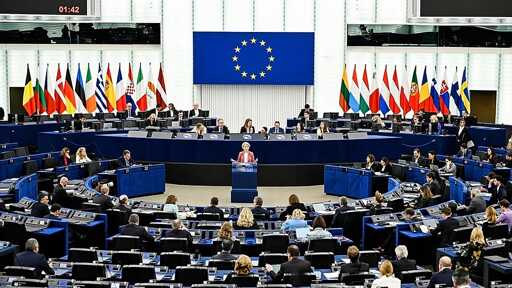
Twelve countries have already backed the initiative, with repeated obstruction by Viktor Orbán's Hungary increasingly fuelling calls for reform. #EuropeNews
It’s not “increased cooperation” if the larger states impose their will onto the smaller states, that is coercion.
And I think you misunderstand what makes the EU attractive for member states. It is exactly that the EU isn’t an imperial power where the core rules over the perifery that makes it attractive.
You might think that the EU can only survive among the big sharks by becoming one itself, but this is neither desireable on principle, nor is it so clear cut. Historically, alliances of nations often defeated imperial powers, both economically and militarily.
Historically, many alliances have been broken up and subjugated through deliberate outside influence as well…
Let’s hope you’re right and I’m wrong.
When I look around the continent today, however, I’m worried that self-serving politicians in a representative system will destroy the alliance of states out of personal greed… even if you’re fundamentally right.
/edit:
It’s not “increased cooperation” if the larger states impose their will onto the smaller states
So what’s your problem with a two-speed EU? Or did I misunderstand you?
Under this model, the small countries retain their veto power, but those that wish to do so can deepen their cooperation independently of that, without it being binding on the rest.
A rump EU where one or two larger states rule over some economically dependent client states in their perifery is not attractive to join, hence the “two-speed” EU might as well be called a dead EU.
If individual EU member states want to cooperate more closely (for example, by harmonizing national standards, deposit-return systems, or who knows what else), this must be possible without a small EU member state blocking it with a veto.
There are now three ways to achieve this: Either the participating countries create another confederation alongside the EU to facilitate this voluntary cooperation, or the countries do so in the form of a “two-speed EU.”, or we get or we’ll end up with a hodgepodge of bilateral and multilateral agreements (which is exactly what the Union was formed to prevent). I fail to see why a small EU member state should have the right to veto a decision made among several other EU partners that does not affect it.
As far as I understand, that’s the “two-speed EU” approach.
Individual member states can already do that without any problems. See the Schengen treaty or the Euro.
The only reason why some larger members want to remove the veto clause is to coerce some smaller members into following regulations that are only to the benefit of the larger countries. If it wasn’t so they could just make another treaty and invite other members to participate. But they know that they would not succeed with that, so they try to force it though in a coercive manner.


It’s not “increased cooperation” if the larger states impose their will onto the smaller states, that is coercion.
And I think you misunderstand what makes the EU attractive for member states. It is exactly that the EU isn’t an imperial power where the core rules over the perifery that makes it attractive.
You might think that the EU can only survive among the big sharks by becoming one itself, but this is neither desireable on principle, nor is it so clear cut. Historically, alliances of nations often defeated imperial powers, both economically and militarily.
Historically, many alliances have been broken up and subjugated through deliberate outside influence as well…
Let’s hope you’re right and I’m wrong.
When I look around the continent today, however, I’m worried that self-serving politicians in a representative system will destroy the alliance of states out of personal greed… even if you’re fundamentally right.
/edit:
It is if it happens on a voluntary basis.
If it is voluntary then there is obviously no need to remove veto powers.
So what’s your problem with a two-speed EU? Or did I misunderstand you?
Under this model, the small countries retain their veto power, but those that wish to do so can deepen their cooperation independently of that, without it being binding on the rest.
A rump EU where one or two larger states rule over some economically dependent client states in their perifery is not attractive to join, hence the “two-speed” EU might as well be called a dead EU.
I don’t quite get it.
If individual EU member states want to cooperate more closely (for example, by harmonizing national standards, deposit-return systems, or who knows what else), this must be possible without a small EU member state blocking it with a veto.
There are now three ways to achieve this: Either the participating countries create another confederation alongside the EU to facilitate this voluntary cooperation, or the countries do so in the form of a “two-speed EU.”, or we get or we’ll end up with a hodgepodge of bilateral and multilateral agreements (which is exactly what the Union was formed to prevent). I fail to see why a small EU member state should have the right to veto a decision made among several other EU partners that does not affect it.
As far as I understand, that’s the “two-speed EU” approach.
Individual member states can already do that without any problems. See the Schengen treaty or the Euro.
The only reason why some larger members want to remove the veto clause is to coerce some smaller members into following regulations that are only to the benefit of the larger countries. If it wasn’t so they could just make another treaty and invite other members to participate. But they know that they would not succeed with that, so they try to force it though in a coercive manner.
Okay, so I was misinformed, or rather, I didn’t think it through enough. Thanks for the clarification!