

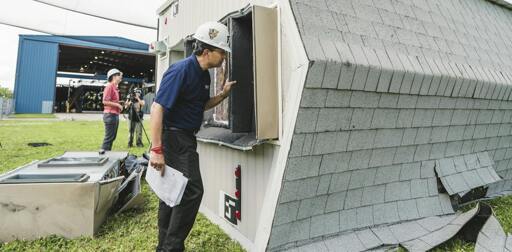
It’s 9:15 in the morning. The wind is roaring at 110 miles per hour (177 kph); the sound is deafening. Dust swirls through the air. We are watching a single-wide manufactured home rock back and forth, as it is pounded by turbulent wind.
Then, in an instant, the screws shear off and the entire unit tumbles backward, rolling two full revolutions before it stops.
In any other situation, this would be terrifying. But here, we are conducting a first-of-its-kind experiment at Florida International University’s Wall of Wind, a test facility that can reproduce wind speeds the equivalent of a Category 5 hurricane.
The US did build houses out of stone, where it made sense. Many places don’t have easy access to stone for building, however 1/3 of the country is forested. Wood is available, economical and suitable for building single family homes in much of the country.
And the US has Fairbanks House which is older than the country itself.
While material availability is an aspect, the big factor for most of the country is that stone houses fall down in earthquakes and are very sensitive to soil erosion, floods, etc. We build stone/concrete/brick houses all over the country, but generally not where they’ll be a hazard to live in.
I think you’re overstating it a bit. Those are considerations for a very small portion of the country, and in fact changes in building code to be less strict on materials made brick/stone no longer a requirement.
It’s primarily material availability. Milwaukee is a great example of the early availability of brick and its prevalence in construction until availability and cost, among other factors, drove the change to wood frame construction.
The east cost cities are good examples too. Boston, Philadelphia, New York all have a lot of brick due to the brickworks and availability but the farther west you go the less you see. This is, in a large part, because it’s expensive to transport brick/stone, especially when there’s an abundance of building material to harvest and use in the form of wood.
I would agree in modern times though it’s largely cost and climate that drive building material in the US and wood is not only suitable and cheaper, it’s also more flexible to build with.
Wood frames are also easier to insulate. Even brick houses made last 100 years are brick veneer, the brick offers no strength.
Solid stone houses are damp and cold, fine for European climates, but when you go into Scandinavia, wood makes more sense.