

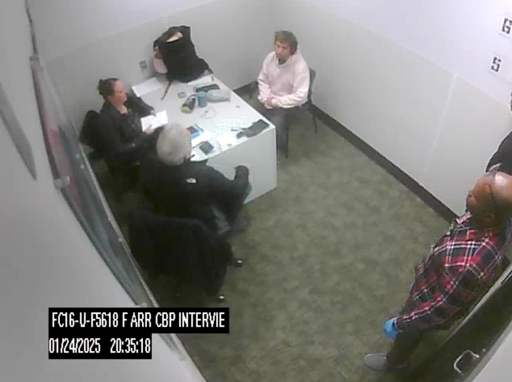
When a Department of Homeland Security official sent out an alert to stop Samuel Tunick, a Stop Cop City activist, at an airport in January 2025, they said the reason was because he was suspected of “terrorist activities,” according to new filed court records which include a screenshot of the alert and photos of Tunick’s interrogation.
Tunick ultimately provided Customs and Border Protection (CBP) officials with a code that, when entered, wiped his security- and privacy-focused GrapheneOS phone. Tunick is now being criminally charged for that alleged act, in one of the most high profile technology civil rights cases in recent memory.
The court records also showed that CBP officials lied to Tunick during his interrogation. Instead of saying he was being targeted for suspected terrorism — although this search happened just at the start of the second Trump administration, it has dramatically broadened what organizations or people may be considered such — they said they needed his phone to look for “kiddie porn.”
“Good afternoon,” an email sent from a Homeland Security Investigations (HSI) official, part of Immigration and Customs Enforcement (ICE), to CBP and other officials reads. “The following subject is scheduled to arrive in ATL [Hartsfield-Jackson Atlanta International Airport] today via DL 1778 @ 1930 Hours. TUNICK is under investigation by HSI/JTTF for suspected terrorist activities.” The email includes a photo of Tunick, and asks the officials to direct him to secondary inspection, retain all of his electronics, and collect their passcodes.
As 404 Media first revealed in December, Tunick was charged because he allegedly “did knowingly destroy, damage, waste, dispose of, and otherwise take any action to delete the digital contents of a Google Pixel cellular phone, for the purpose of preventing and impairing the Government’s lawful authority to take said property into its custody and control.” Matthew Dodge, one of Tunick’s lawyers, previously told 404 Media he only found one other case using the same obscure law, a drug trafficking case. “This is extraordinarily rare,” Dodge said.
Tunick was part of the Stop Cop City movement in Atlanta, which broadly protested the building of a large police training center, and which authorities investigated for arson, vandalism, and doxing. Tunick is not suspected of any crime beyond the alleged wiping of the phone, and has previously put his current prosecution in the context of the wide spanning cases against other Stop Cop City protesters.
The newly filed court record, in which Tunick’s lawyers argue that evidence should be thrown out, include new photos and descriptions of the airport encounter. The CBP officials asked Tunick if they were going to find “kiddie porn” on his phone, which Tunick immediately denied. “As the evidentiary hearing made clear, these unfounded accusations were nothing more than pretext for a fishing expedition into the depths of Mr. Tunick’s devices,” the lawyers wrote. They added, “Officer Findley acknowledged that officers had no reason whatsoever to believe Mr. Tunick possessed child pornography,” referring to one of the officials.
Tunick faces a maximum of five years in federal prison for allegedly wiping the phone.
“I hope people understand that the charges against me are meant to intimidate people against protecting their data and their privacy, and the government hopes to set a precedent that no one has the right to privacy,” Tunick previously told 404 Media.
So, GrapheneOS should have a function that replaces the content of the phone with a vanilla set of apps and a clean account, instead of wiping it, on receiving the distress code.
You are proposing a technological workaround to fascism instead of a political actual solution. You see how that’s hardly fucking helpful, right?
No, we need to keep a crumpled post-it note with the wipe password written on it in our pockets.
It’s the police’s fault for just typing in the unlabeled code they found. We use our actual passwords all the time - why would we have to keep those written down?
GOS developer already said this would be trivial to crack and notice the fake account. It would be a pointless solution that fools nobody.
Wiping it in the background behind the fake account, on the other hand, would be nontrivial to notice in time. And once it’s wiped, what evidence is there that it wasn’t already blank?
Okay but then you are back to square one. Just wipe the entire device. Unless you have tons of data this can be accomplished extremely quickly. And as for your question, that entirely depends on the judge, jury, and lawyer you have. I can’t answer that.
The goal isn’t to keep your data, it’s to make it look like you gave the police your real code and just didn’t have anything interesting on your phone.
And to not wipe the phone unless and until it actually gets seized. Preemptively wiping is a pain, because then you have to restore it even if nothing happened.
Trivial no. It can be async and perform clean exit whereupon no amount of cracking will be admissible for anything
It’s more complicated than that. Forensics software can get related data easy enough. Logs and other data will still be there until a reboot. If the device is rebooted, there is the hash that makes it clear it’s GrapheneOS + a huge hard to miss triangle grabbing attention. Developer options is only available in the owner profile, so using another profile for that would be obvious too.
Obvious yes but forensics are not allowed to access that data. Or do you mean that graphene can not operate that way right now?
That is very hard to make. Also would taken a while for the new profile to be setup and at the same time destroy what was their. Now it just wipes the encryption key. So the data is actually still their but no one can access it. That action takes Mere secconds instead of potentially minutes or longer.
Why not have an option where the encryption key is stored somewhere else or moved somewhere else when the distress code is entered. The data isn’t destroyed and now they have to get a court order to access it.
Thing like that exist and are not new. TrueCrypt had such a function 15 years (or longer) ago already.
The trick is basically to have two partitions in the encrypted volume and depending which key you enter it opens one or the other. The filesystem needs to be given fake data about available free space to hide the “other” one.
It would require a reboot, though.
Doesn’t seem that difficult. Say the phone boots automatically with the public profile. Then you go to the calculator app and punch in the code to go to the private profile. The os loads the hidden encrypted partition with that code and now loads the private profile.
From a regular inspection, it looks just like someone using a new phone. And you can still have a duress code that loads again the public profile. Maybe just show an “updating apps” message while doing so. The phone opens the clean profile while in the background it starts a wipe of that hidden partition in the background.
You are describing Encrochat OS and authorities already cracked that.
Cracked the code or what, it’s not like a system set up like that is permanently exploitable?
Oh they cracked the code, took over as hosts for a long time, took all keys and routed all traffic through their own servers for months before rolling up the entire operation and arrestings dozens of people who used it for criminal acts like drug trafficking.
Haha of course, it is probably a pretty safe bet for fishermen to look for crime in users of such things. It’s a good segway into privacy concerns these days which reminds me; have you heard of our lord and savior <inser favorite dist here>
I think the point was when you use the distress code, it loads a fresh profile and wipes the old one, not to have the two layers both present. If they have possession of the phone and the data is there to be found, they probably will find it. The key is to wipe it all, while making it look like nothing got removed.
You could approximate this by simple having the main profile be left as a dummy profile and users use secondary profiles for their data. Then when you put the special code in it discretely deletes all but the main profile, leaving your dummy profile intact however you have set it up, and they’d have no idea your other profiles were where the data really was. They’d just unlock the phone, see the dummy profile, and think that was the phone.
Kind of. They could pretty easily find out it is not your real profile, and that can lead to other conclusions or investigations. But if sensitive data is gone without any trace att all, then that is the best outcome I guess. It’s pretty hard to achieve without a reboot though. I guess this is why they don’t bother with the theatrics
It would be nearly impossible to prove in a court of law that was not your real profile. All you’d have to do is say that is your travel phone and you don’t use it for much.