You must log in or register to comment.
any economic slowdown lowers emissions, yes.
A bubble popping doesnt mean the tech goes away, it just means corporate restructuring and people losing their savings.
So, no, I doubt it would have a meaningful impact.
In classical economics, it also means capitalists stop investing in extra production. I see this as something that would contribute to reducing CO2 emissions.
The tech has no value. It costs more than its worth
yes if all the ai datacenters becomes defunct due to the collapse.
Remember the bitcoin bubble? Remember the IT bubble?
Remember the bitcoin bubble?
Which one? Depending how you look at it there’s been at least 3 and each peaked higher than the previous one. The current value if far above the first bubble.
When the word blockchain was first used in mainstream media.
The current value of the surviving IT companies is higher than during the IT bubble.
The similarities is that everyone talks about it and how it will be disrupting everything everywhere at once. In the end a lot of companies built up around the technology failed, a few survived and are still hanging around.
It would initiate the expansion of supercooled matter and antimatter, which in turn would cause said matter to turn into hot and dense plasma, but my math could be off.
Can confirm, am slide rule
No, the methane in the bubble is a greenhouse gas
No, under Capitalism emissions too often act like inflation. You might hit a lower number than originally thought, but that’s not the same as the total number decreasing over time.
Capitalism is about infinitely growing the economy. Inflation measures that increase. So when the inflation rate drops, they mean, the rate OF INCREASE dropped (meaning didn’t increase as fast but still increased).
The same thing generally happens with emissions most of the time. AI data centers that exist will still exist, but rather than being used for AI some other function would be found, either as server space, or online gaming, subscription services, research departments, mapping/processing centers. There’ll be other uses.
During the bubble, other industries will have grown their emissions, covering over any fall.
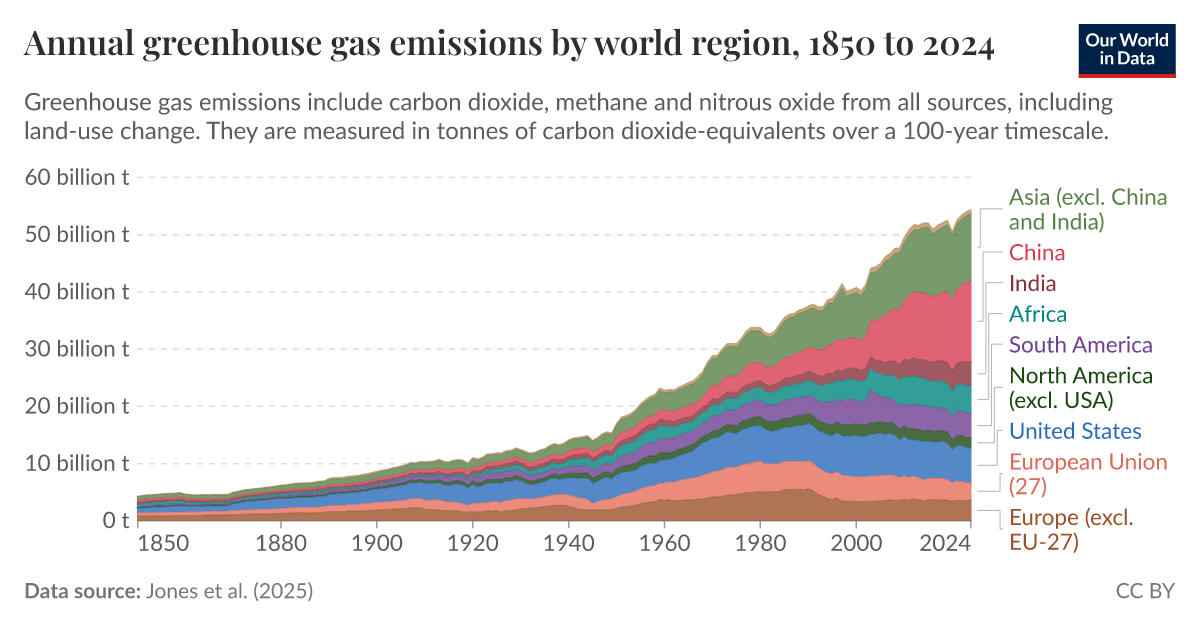
Without mass switching to green energy in multiple countries/industries at once, we won’t see a genuine drop. Here’s the world’s emissions graphed:
https://ourworldindata.org/grapher/thumbnail/ghg-emissions-by-world-region.png?imType=og
The “drops” last in the range of months before the yearly trend of an increasing continues up. There appears to be a plateau but the global south’s developing nations are still able to erase that progress as their manufacturing bases grow.
Even if we switch to green energy, emissions will just dip, then continue back up at a slower rate, because Capitalism will find new growth industries - that’s the problem and why defrowth is so important.
Capitalism is about infinitely growing the economy. Inflation measures that increase.
Disagree to both.
Capitalism is the idea that keeping capital in only a few hands could strengthen a society as a whole.
But there’s no infinity in it. Only a quite disfigured idea of capitalism can try to extend it to infinity. In reality, the further it has extended the closer it is at it’s collapse.
Inflation is no means of measurement (I know that it is often used like one, but that’s not what it fundamentally is - like you can measure temperature to describe the weather, but that’s not what weather is). Inflation is a way of the strong actors in a market to ensure their own further wealth.
Let’s set some things straight, opinions aside.
Capitalism is simply the concept of production being run privately, with supply and demand regulating the market.
Productivity is a measure of how much is created with a specific amount of input. As long as the technology moves forward, productivity usually increases as well. If a new technology allows 9 people to do what was previously the work of 10, you’ve increased productivity in that sector.
Inflation is the increase of prices. Ideally, it’s supposed to broadly reflect the increase of productivity. A small amount of inflation (usually around 2%/year) acts as an investment incentive, since hoarding money makes you effectively slowly lose it, because it loses its value over time, so instead you’re coaxed into investing it into companies/whatever whose value at least keep up with inflation. If you invest well, the value of whatever you invest it in grows larger than inflation, in which case you’ve increased the value of what you’ve invested. If you invest poorly, the value increases less than the rate of inflation, or even decreases, in both cases you’ve lost value.
A company that doesn’t grow or shrink from a production perspective generally will keep up with inflation. An economy is generally measured with the GDP (Gross Domestic Product, a measure of how much is produced, valued in a currency), and similarly, since it’s also measured in currency, if the economy grows at the rate of inflation and there’s no productivity gain, the amount produced will stay the same.
Emissions don’t have to be coupled with growth. A growing economy that progressively switches to renewables at a fast enough pace can still grow while reducing emissions. In fact, the primary reason why emissions keep rising despite capitalism generally dealing with issue of limited resources is that emissions generally aren’t counted as resources, since there are no or not enough costs associated with them (read: externalization of costs). This is the reason why economists repeatedly tout carbon pricing as one of the most effective methods of carbon emission reductions. If companies are forced to factor in emissions costs the way they do every other resource (like working hours, materials, etc.), they will be much more incentivized to do so, since it directly affects their bottom line. Progressively increasing carbon costs could very well lead to the near elimination of carbon emissions. Carbon pricing, however, has not been anywhere rigorous enough to lead to this outcome.
Now that we’ve gotten some facts straight, let the discussion continue.
In reality, the further it has extended the closer it is at it’s collapse.
Been hearing this proclamation my whole life, so I don’t believe it anymore. Marx made that claim 160 years ago, at some point you have to reevaluate and go… You know, I don’t think this is how the system works.
The truth is there’s a whole oligarchy and a corrupt political system propping up the economic system. So it’s not going to collapse the way that’s claimed (industries becoming so efficient that they drum themselves out of business).
…do we even have an example of a business that did that? Let alone all businesses across the whole economic system?
It’s just silly, and probably one of those claims that needs reevaluating.
Well, either you really know more than Karl Marx, or you only believe what you like to believe. Either way, EOD for me.
In Marxism, Marx is considered a necessity of the systems flaws… Not some super special genius. I believe the idea is that if Marx hadn’t come along, someone else would have expressed the same ideas as they’re a product of history… Rather than of exceptional knowledge or “great man” theory.
I imagine most people alive today “know more” than Marx did in the 1800s.
I imagine most people alive today “know more” than Marx did in the 1800s.
Wow. Imagination is your super power.
Okay, I’ll say it outright. Your average person today knows more than anyone in the 1800s. Marx included.
Cars, planes, TV, electricity, Computers, the Internet… All facilitated a massive increase in knowledge transmission.
What’s more I think you’re kind of an idiot for believing otherwise.
Not likely. AI data center hype is just the latest chapter in a long series of data center expansions.
If every AI company closed up shop tomorrow (not likely), the existing data centers would just be repurposed for some other use, otherwise it’s just leaving money on the table.
Porn?
lower it over very recent heightened levels. likely not. someone will buy the data centers at the least. stop the faster increasing. maybe.
The question is, how much? There’s the stopping of the actual power use. But since AI is now ingrained in everything, what kind of backlash will that cause, and how will it affect emissions? Lots of variables. Maybe overall they go back up if everyone gets pulled back into working like before. Or maybe something else happens and productivity drops, income drops, shipping and production drops, etc.
yes