I actually kinda wonder if my issues with Linux as a daily driver and not just for my server stuff was because I was always chasing the bleeding edge. I don’t want my PC just to work, I like doing rad shit with it.
Then again, I first used Linux in 1993 (Slackware). Everything about it was bleeding edge.
I actually kinda wonder if my issues with Linux as a daily driver and not just for my server stuff was because I was always chasing the bleeding edge.
It’s actually more simple than the way people usually explain it.
Each distro is made of thousands of components. Their interoperability needs to be thoroughly tested and the versions of the software need to be stabilised.
Debian’s slow and steady release cycles not only do this, but make a guarantee that if the OS works on your system on release day, the OS will continue working there until the LTS window closes.
With faster release cycles, the interoperability and stability of the software is replaced with more up to date software without that kind of guarantee, and due to deprecations happening and being accepted, this further decays stability.
Recent examples that personally WOULD have affected me include KDEs X11 deprecation, and NVidia removing compatibility for my graphics card from their driver.
EDIT : Even with fedora’s 6 month cycles, while inter-related software might work well together, they are still taking X.X versions , and the in between deprecations will still affect your system. Hooray, KDE got an incremental upgrade from 6.3 to 6.8 you have 3 new features. BTW I hope you were ready to stop using X11, because if not, have fun unbreaking your system and fixing every customisation you made that adjusted the settings of your system and programs to play with X11 the way you wanted it to.
Rolling releases are great for testing new versions of your software, since everything else is immediately preparing you for the future. For stable, “daily driver” systems, older or middling hardware, debian’s long term stability is great.
If you have a bleeding edge system that has hardware that came out yesterday, you are developing something that depends on the newest version of a library, and you have all your essentials in a different machine, and you have a backup, and you want to participate in linux ecosystem actively, raising bugs as you see them, sure, definitely go for a rolling release system.
Also to reconfigure fucking everything constantly.
Yup. Linux really ceased having issues for me when I started using Ubuntu LTS around 2014-15. In fact my main machine hasn’t been reinstalled since then.
That’s why, after my experiences with Debian, i went for Nobara as a Fedora spinoff. Close enough to whatever is currently the bleeding edge, while curated for gamers.


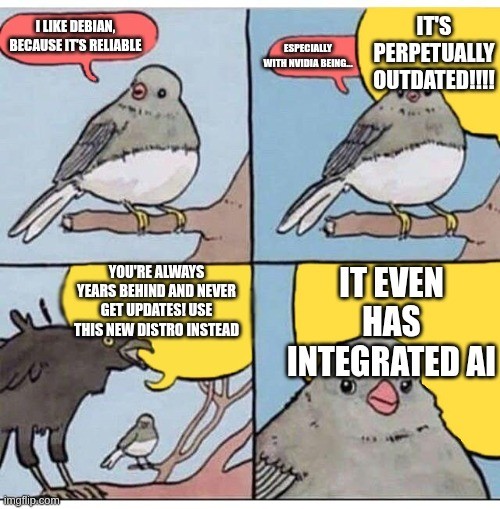
I actually kinda wonder if my issues with Linux as a daily driver and not just for my server stuff was because I was always chasing the bleeding edge. I don’t want my PC just to work, I like doing rad shit with it.
Then again, I first used Linux in 1993 (Slackware). Everything about it was bleeding edge.
It’s actually more simple than the way people usually explain it.
Each distro is made of thousands of components. Their interoperability needs to be thoroughly tested and the versions of the software need to be stabilised.
Debian’s slow and steady release cycles not only do this, but make a guarantee that if the OS works on your system on release day, the OS will continue working there until the LTS window closes.
With faster release cycles, the interoperability and stability of the software is replaced with more up to date software without that kind of guarantee, and due to deprecations happening and being accepted, this further decays stability.
Recent examples that personally WOULD have affected me include KDEs X11 deprecation, and NVidia removing compatibility for my graphics card from their driver.
EDIT : Even with fedora’s 6 month cycles, while inter-related software might work well together, they are still taking X.X versions , and the in between deprecations will still affect your system. Hooray, KDE got an incremental upgrade from 6.3 to 6.8 you have 3 new features. BTW I hope you were ready to stop using X11, because if not, have fun unbreaking your system and fixing every customisation you made that adjusted the settings of your system and programs to play with X11 the way you wanted it to.
Rolling releases are great for testing new versions of your software, since everything else is immediately preparing you for the future. For stable, “daily driver” systems, older or middling hardware, debian’s long term stability is great.
If you have a bleeding edge system that has hardware that came out yesterday, you are developing something that depends on the newest version of a library, and you have all your essentials in a different machine, and you have a backup, and you want to participate in linux ecosystem actively, raising bugs as you see them, sure, definitely go for a rolling release system.
Also to reconfigure fucking everything constantly.
Yup. Linux really ceased having issues for me when I started using Ubuntu LTS around 2014-15. In fact my main machine hasn’t been reinstalled since then.
Crazy when you start using LTS versions of software and that software… works.
That’s why, after my experiences with Debian, i went for Nobara as a Fedora spinoff. Close enough to whatever is currently the bleeding edge, while curated for gamers.
Nobara is super underrated. I never see people talking about it. Been on Nobara for almost 3 years now for gaming and audio production. No complaints.
We are dozens. Dozens!
Same for me. Plus the Nvidia support.
Yep, was a factor for me too - installation and getting it running was completely painless, and the integrated driver manager does it’s job very well.
I loved that there was a game to play while waiting for the installation