

- cross-posted to:
- unitedkingdom@feddit.uk
- cross-posted to:
- unitedkingdom@feddit.uk
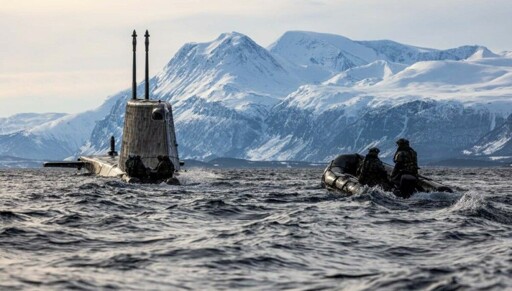
The partnership is designed to protect undersea oil and gas pipelines, as well as cables for data traffic.
Both navies will operate as one – sharing maintenance facilities, technology and equipment to create truly interchangeable forces able to deploy rapidly wherever needed, the British Ministry of Defence said in a press release.
This is the most comprehensive defence agreement in modern times, the Norwegian Ministry of Defence added as the deal was sign by Defence Secretary John Healey and his Norwegian counterpart Tore O. Sandvik at 10 Downing Street on December 4.
“The British presence in the High North plays a crucial role in safeguarding Norwegian and European security,” Prime Minister Jonas Gahr Støre said after he met his British colleague Keir Starmer in London.
The two prime ministers then flew north to the Royal Airforce base Lossiemouth in Moray, Scotland. It is from here British P-8 maritime patrol aircraft are operating when flying missions over the North Sea or further north over the Norwegian and Barents Seas.
…
It’s a little weird but not that weird.
You have to understand a) what Putin cares about and b) what the Russian people care about. Putin and Russia essentially believe that Ukraine, or at least the Donbas and Crimea, are and always were part of Russia. They think that the break-up of the Soviet Union was a national shame and in particular that the assignment of the Donbas and Crimea to Ukraine (because they were part of the Ukrainian SSR) in that break-up was wrong. Putin believes this fervently and has made several speeches about it. The Russian people likely feel similarly but less strongly about it.
So placing Western troops in Ukraine or fighting Russia with them is seen in that light - imagine if the US had a civil war again, Texas seceded, and then Russia put troops in Texas.
But this is not the same when a Russian submarine gets depth-charged off the coast of some European country. Putin, and Russia in general, don’t have historical, deeply-held revanchist claims about Sweden or the UK or Belgium or wherever.
From the public opinion point of view, this means that Putin can’t ignore it as easily if the West supports Ukraine directly by putting troops there. And for Putin himself, that direct intervention is a much more serious challenge to his designs on Ukraine than taking pot-shots at military assets that “accidentally” find themselves violating the borders in sea or air (or on land…) of other sovereign states.
I’ld still be amazed if European countries decided to pile up 150.000 soldiers, thousands of tanks and artillery somewhere in Finland near Russian border pointing towards st. Petersburg. They just can’t not react. This would pull so much Russian force away from the actual frontlines…