

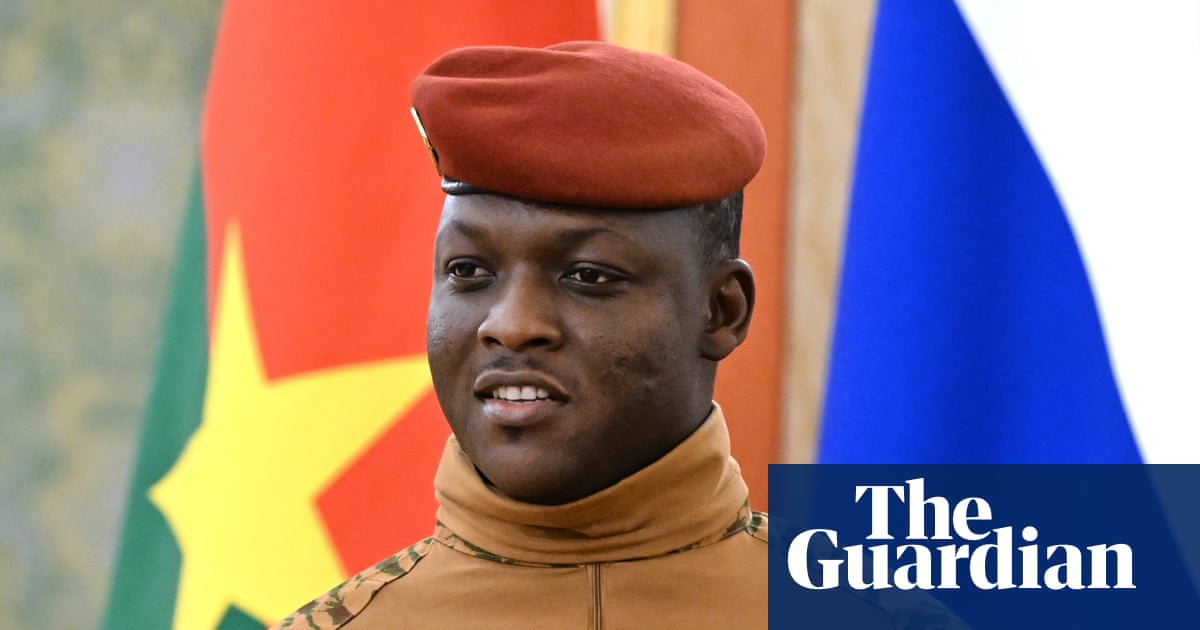
Ibrahim Traoré, who took power in 2022 coup, tells state broadcaster ‘we must tell the truth, democracy isn’t for us’
People in Burkina Faso should forget about democracy as it is “not for us”, the military president, Ibrahim Traoré, told the country’s state broadcaster.
Traoré took power in a coup in September 2022, toppling another junta that had taken power just nine months earlier. He has since stifled opposition and in January banned political parties outright.
A transition to democracy had originally been planned for 2024, but that year the junta extended Traoré’s rule until 2029.
“We’re not even talking about elections, first of all … People need to forget about the question of democracy … We must tell the truth, democracy isn’t for us,” Traoré said in an interview on Thursday with the state broadcaster Radiodiffusion Télévision du Burkina (RTB).
This is a classic appeal to authority rather than addressing their question.
No, it’s not unless you’re claiming Fanon in unreliable and not credible. A counter argument of ‘I don’t personally think so’ is not a valid counter argument against the highly respected works of an academic who both lived and studied his lifes work
The Wretched of the Earth
A Dying Colonialism
Black Skin, White Masks
If you can’t attack the substance, you attack the source. The only other time I’ve seen a weak bs claim of ‘appeal to authority’ is from people who try to discredit human rights reporting on genocide.
You’re asserting that because a person is a highly respected academic that we should accept their conclusions are relevant here - you are not synthesizing their work with applicability for your claim that the current regression on LGBTQ rights is the result of colonialism.
For an example of what I mean:
We are making the claim that Burkina Faso has been an independent country for 65 years. For most of that time, while LGBTQ people were not broadly loved, there was no outright oppression - arguably (from one [edit: one very important] perspective) they were better about homosexual relationships than many western countries in the same timeframes. This recent shift is a regression primarily from internal pressures - it’s been too long to reasonably claim that this shift in attitude is singly the result of a reaction to having been a colony.
You have not done anything to refute that claim, or present evidence or reasoning that your claim (that this is the result of colonial and imperialistic pressures) is at all applicable, beyond citing a well known and well respected academic who has not talked about this specific situation. You are instead insisting that we cannot argue against your argument because your argument cites the work of a respected academic, and are shifting our criticism of your claims to criticism of Fanon’s claims, which is unfair. I have not addressed Fanon’s thesis here because I am questioning the applicability of that thesis to these events; that is a claim you have made, and which you have not supported.
This is absolutely an appeal to authority - you claim that your argument is based on respected works and therefore has standing on that merit above the claims of others.
First, thank you for well written response
It’s true that Fanon himself did not write too much on neocolonialism, as it was a bit past his time. However, if you understand how reactionary sentiments foment in the process of an anti-colonialist revolution, it’s not difficult to understand how that persists in the face of neocolonialism, as western empires continue to subjugate these nations with modern methods.
In the case of Burkina Faso, we can’t ignore France’s neocolonialist actions since their independence. They have not been sovereign in the same sense that western nations have. While western nations were able to develop civil rights free of the constant battle against neocolonial dominance, this is still not the case for countries like Burkina Faso. France has still been a constant threat against their sovereignty, and as such, the anti-western hardliners continue to stay in power.
Spoiler