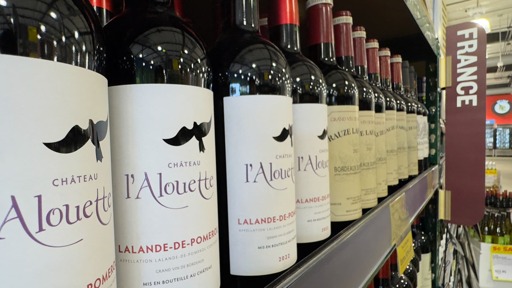
France and Italy maintained their positions as the largest suppliers to the United States by value. France exported €2,130.4 million of wine (-7.9%), while Italy reached €1,807.7 million (-13.21%)
That being said, I suppose that he could probably find other French products to impose tariffs on.
Early 19th century: “France widely converted to the short scale, and was followed by the U.S., which began teaching it in schools. Many French encyclopedias of the 19th century either omitted the long scale system or called it “désormais obsolète”, a now obsolete system.”
1926: “It should be remembered that ‘billion’ does not mean in American use (which follows the French) what it means in British.”
1948: “The 9th General Conference on Weights and Measures received requests to establish an International System of Units. One such request was accompanied by a draft French Government discussion paper, which included a suggestion of universal use of the long scale, inviting the short-scale countries to return or convert.[35] This paper was widely distributed as the basis for further discussion. The matter of the International System of Units was eventually resolved at the 11th General Conference in 1960. The question of long scale versus short scale was not resolved and does not appear in the list of any conference resolutions.”
1960:
The 11th General Conference on Weights and Measures adopted the International System of Units (SI), with its own set of numeric prefixes.[6] SI is therefore independent of the number scale being used. SI also notes the language-dependence of some larger-number names and advises against using ambiguous terms such as billion, trillion, etc.[37] The National Institute of Standards and Technology within the US also considers that it is best that they be avoided entirely.[38]
1961: “The French Government confirmed their official usage of the long scale in the Journal officiel (the official French Government gazette).[39]”
1974:
Mr. Maxwell-Hyslop asked the Prime Minister whether he would make it the practice of his administration that when Ministers employ the word ‘billion’ in any official speeches, documents, or answers to Parliamentary Questions, they will, to avoid confusion, only do so in its British meaning of 1 million million and not in the sense in which it is used in the United States of America, which uses the term ‘billion’ to mean 1,000 million.
The Prime Minister: No. The word ‘billion’ is now used internationally to mean 1,000 million and it would be confusing if British Ministers were to use it in any other sense. I accept that it could still be interpreted in this country as 1 million million and I shall ask my colleagues to ensure that, if they do use it, there should be no ambiguity as to its meaning.
The BBC and other UK mass media quickly followed the government’s lead within the UK.
During the last quarter of the 20th century, most other English-speaking countries (Ireland, Australia, New Zealand, South Africa, Zimbabwe, etc.) either also followed this lead or independently switched to the short scale use.
1994: “The Italian Government confirmed their official usage of the long scale.”


https://wine-intelligence.com/blogs/wine-analytics-pricing-report-data/us-wine-imports-decline-in-2025-impacting-major-suppliers-and-prices
For 2025:
That being said, I suppose that he could probably find other French products to impose tariffs on.
https://www.census.gov/foreign-trade/balance/c4279.html
In 2025, the US imported $68 billion from France.
Wtf are those numbers? Was this written by elementary school kids? There is a name for 1000 million, its called a billion…
grins
Controversial take, given the forum.
https://en.wikipedia.org/wiki/Long_and_short_scales
1475: France is using long scale.
Early 19th century: “France widely converted to the short scale, and was followed by the U.S., which began teaching it in schools. Many French encyclopedias of the 19th century either omitted the long scale system or called it “désormais obsolète”, a now obsolete system.”
1926: “It should be remembered that ‘billion’ does not mean in American use (which follows the French) what it means in British.”
1948: “The 9th General Conference on Weights and Measures received requests to establish an International System of Units. One such request was accompanied by a draft French Government discussion paper, which included a suggestion of universal use of the long scale, inviting the short-scale countries to return or convert.[35] This paper was widely distributed as the basis for further discussion. The matter of the International System of Units was eventually resolved at the 11th General Conference in 1960. The question of long scale versus short scale was not resolved and does not appear in the list of any conference resolutions.”
1960:
1961: “The French Government confirmed their official usage of the long scale in the Journal officiel (the official French Government gazette).[39]”
1974:
1994: “The Italian Government confirmed their official usage of the long scale.”