The so-called “split brain” studies on people who have had the bridge between the two hemispheres - the corpus callosum - cut to treat grand mal seizures are fascinating. They use this method to communicate with each hemisphere separately without the other knowing.
You can, for example, give one an instruction to do something. After it has done it, you ask the other (verbal) hemisphere why they just did that, and they immediately make up a plausible-sounding explanation despite the scientists knowing it’s not the actual reason.
You also get different answers for questions about dream jobs and such.
This all sparks the question: Are there two “people” in our brain the whole time or is the other created the moment the connection is cut? And which one is what I call “I”?
what i want to know is whether making up an explanation is universal, or if other people would just go “no clue”.
Because if EVERYONE with a severed corpus callosum just makes up explanations that is very fucking uncomfortable to think about, and i’ll treasure having mine intact
I’m no neuroscientist but I don’t think this has anything to do with the two hemispheres being separated - it’s just how the human mind works. When something happens we come up with an explanation for it that’s sometimes factual and sometimes completely made up. These people don’t know that they’re making it up - they genuinely believe the reason they’re giving. We’re not comfortable with uncertainty, especially when it comes to our own behavior.
I’m personally one of the people who doesn’t believe in free will so these findings make perfect sense to me and are in no way in conflict with my worldview, but I get how hearing about this might make someone else uncomfortable.
What’s your source (and i don’t mean a citation, more like reasoning) for us making things up even without brain damage? That, uh; feels made up, ironically.
Like i’m not saying i sit around contemplating every single assumption i make, but i can’t recall ever realizing my explanation for something was just completely not based in reality. If i’m not sure then i just say i’m not sure, it’s something i’ve specifically made an effort to be precise about (for example i’ve rewritten a bunch of this text several times as i decide what parts i know and what parts i recon).
The idea of uncontrollably coming up with incorrect explanations is uncomfortable to me not because of uncertainty, but because it would make me fundamentally unable to approach closer and closer to “”“objective”“” reality.
I like uncertainty because it means i’m not mistakenly stating something as fact, and thus deluding myself (and potentially others). I kind of prefer to say “i’m not sure” because it means i’m not risking accidentally hiding the truth, it can always be improved upon later.
You can, for example, give one an instruction to do something. After it has done it, you ask the other (verbal) hemisphere why they just did that, and they immediately make up a plausible-sounding explanation despite the scientists knowing it’s not the actual reason.
There’s an uncomfortable amount of similarities between how the human brain and LLMs work.
Next word correlating with the words said before, confidently spreading false information, telling people what they want to hear… These are by no means unique to LLMs.
you know what’s funny? I think spongebob’s brain is actually pretty damn close to how it actually works.
You’ve got tons of little “voices” doing quite niche tasks like recognizing faces or identifying flavours and forwarding that to another “voice” that links the flavour to memories etc etc, and a “main voice” that collates all that into coherent thought.
I’ve seen this topic covered briefly in one of CGP Grey’s videos. The video also gives a POV of a person with this syndrome. The POV was surprisingly interesting to watch and I was wondering if there are other similar recorded experiments.
You can, for example, give one an instruction to do something.
How would you do that? Since both eyes are connected to both hemispheres isn’t it kind of hard to do that? Or are both ears separated and you can give commands through that without the other hemisphere knowing? I’ve heard about these studies too but I’m not sure about how the setup works because I’ve heard they used text on a screen for that but OP said the eyes do snitch to the other half after all. I find it a little confusing.
By building a setup that allows the researchers to flash text on the right/left visual field. On a normal brain this information does indeed travel between the hemispheres but on a split brain it doesn’t.


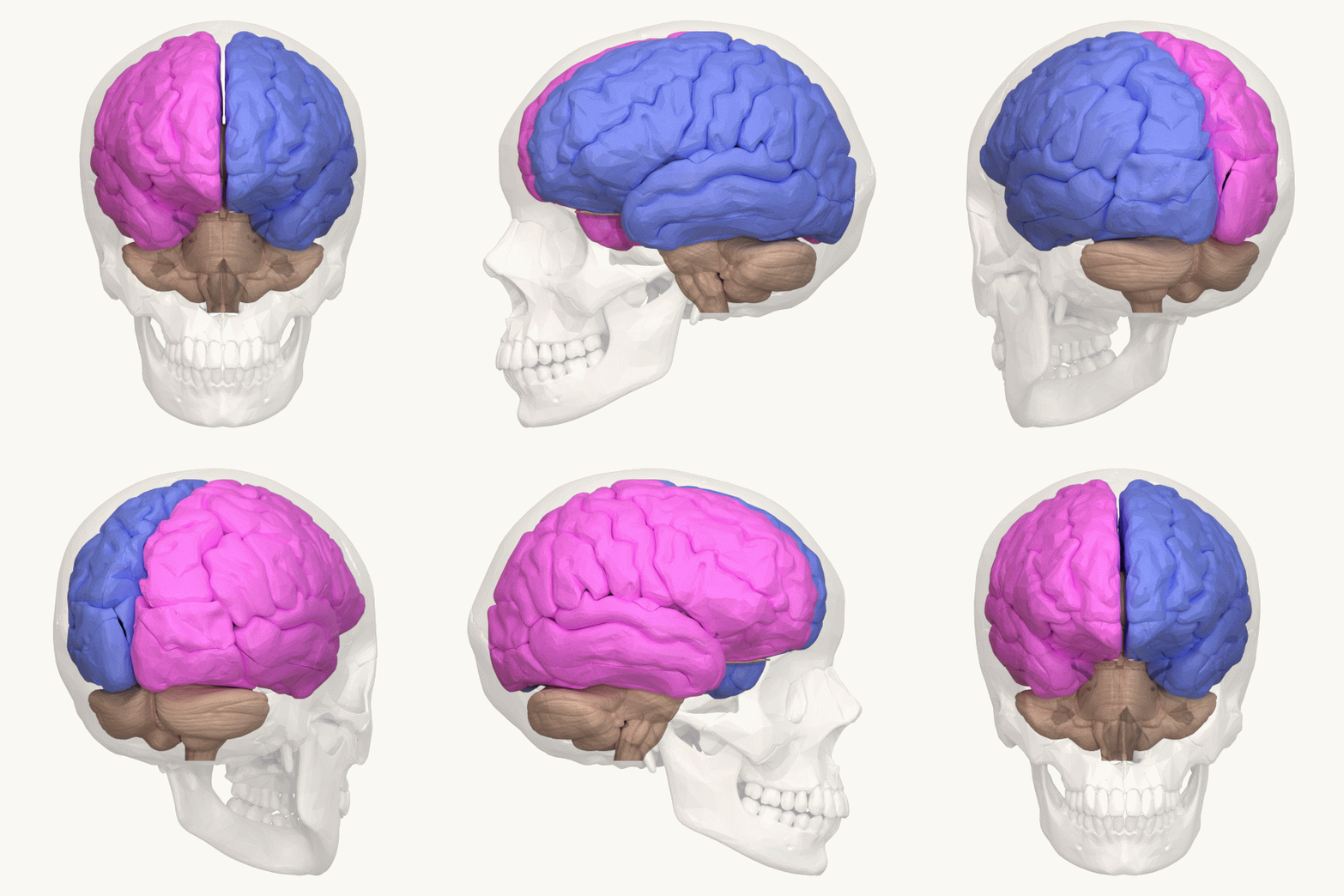
The so-called “split brain” studies on people who have had the bridge between the two hemispheres - the corpus callosum - cut to treat grand mal seizures are fascinating. They use this method to communicate with each hemisphere separately without the other knowing.
You can, for example, give one an instruction to do something. After it has done it, you ask the other (verbal) hemisphere why they just did that, and they immediately make up a plausible-sounding explanation despite the scientists knowing it’s not the actual reason.
You also get different answers for questions about dream jobs and such.
This all sparks the question: Are there two “people” in our brain the whole time or is the other created the moment the connection is cut? And which one is what I call “I”?
what i want to know is whether making up an explanation is universal, or if other people would just go “no clue”.
Because if EVERYONE with a severed corpus callosum just makes up explanations that is very fucking uncomfortable to think about, and i’ll treasure having mine intact
I’m no neuroscientist but I don’t think this has anything to do with the two hemispheres being separated - it’s just how the human mind works. When something happens we come up with an explanation for it that’s sometimes factual and sometimes completely made up. These people don’t know that they’re making it up - they genuinely believe the reason they’re giving. We’re not comfortable with uncertainty, especially when it comes to our own behavior.
I’m personally one of the people who doesn’t believe in free will so these findings make perfect sense to me and are in no way in conflict with my worldview, but I get how hearing about this might make someone else uncomfortable.
What’s your source (and i don’t mean a citation, more like reasoning) for us making things up even without brain damage? That, uh; feels made up, ironically.
Like i’m not saying i sit around contemplating every single assumption i make, but i can’t recall ever realizing my explanation for something was just completely not based in reality. If i’m not sure then i just say i’m not sure, it’s something i’ve specifically made an effort to be precise about (for example i’ve rewritten a bunch of this text several times as i decide what parts i know and what parts i recon).
The idea of uncontrollably coming up with incorrect explanations is uncomfortable to me not because of uncertainty, but because it would make me fundamentally unable to approach closer and closer to “”“objective”“” reality.
I like uncertainty because it means i’m not mistakenly stating something as fact, and thus deluding myself (and potentially others). I kind of prefer to say “i’m not sure” because it means i’m not risking accidentally hiding the truth, it can always be improved upon later.
Inside of you are two brains: a dom and a sub.
Sounds like AI got something right then.
There’s an uncomfortable amount of similarities between how the human brain and LLMs work.
Next word correlating with the words said before, confidently spreading false information, telling people what they want to hear… These are by no means unique to LLMs.
that’s so interesting, really makes you purple apple rubber ducky table tennis on tuesday?
2 people, that’s it? What if you are a voice machine, just voices all the way down… but you only recognize the loudest as yourself?
you know what’s funny? I think spongebob’s brain is actually pretty damn close to how it actually works.

You’ve got tons of little “voices” doing quite niche tasks like recognizing faces or identifying flavours and forwarding that to another “voice” that links the flavour to memories etc etc, and a “main voice” that collates all that into coherent thought.
Fuck you very much for pointing to my brain like that ;)
I’ve seen this topic covered briefly in one of CGP Grey’s videos. The video also gives a POV of a person with this syndrome. The POV was surprisingly interesting to watch and I was wondering if there are other similar recorded experiments.
How would you do that? Since both eyes are connected to both hemispheres isn’t it kind of hard to do that? Or are both ears separated and you can give commands through that without the other hemisphere knowing? I’ve heard about these studies too but I’m not sure about how the setup works because I’ve heard they used text on a screen for that but OP said the eyes do snitch to the other half after all. I find it a little confusing.
By building a setup that allows the researchers to flash text on the right/left visual field. On a normal brain this information does indeed travel between the hemispheres but on a split brain it doesn’t.