That’s only an option if you live in a house. About 50% of all Europeans live in an apartment.
Even if you live in a house, it’s still quite a costly investment to do right, the building needs to be properly insulated and heat pumps are preferably used with underfloor heating. The cheaper heat pumps make quite some noise, which often exceeds the noise limits when living in terraced houses.
I know it’s worth it in the end, but I can totally imagine many people chosing an air conditioner as they are prevalent, low cost and mature, even if the solution is not perfect.
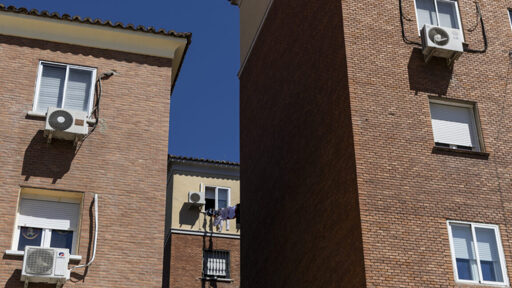
Air-to-Air heatpumps (i.e. AC) are trivial to install in apartments (drill one inch hole in wall, mount compressor on one side and head unit on other, done,) and make for very efficient heating in winter just as much as they can be used for cooling in summer.
I live in an apartment, and I installed airconditioning
An apartment is just a house where you also happen to have neighbours above and below you as well. There is no reason why an AC shouldn’t work in an apartment.
The biggest struggle is updating the rules of your home-owners association to allow for the installation of an external unit, but once that exists all tenants can freely install ACs as they please.
(In my case the rules specify that the external unit needs to be placed on the balcony on the east side of the building)
I agree, and when split units are not possible people will still buy the technically inferior single unit systems.
My post was related to OP who mentioned people will choose heat pumps (replacing conventional heating) over air conditioners.
That’s not what I said though. I said people would opt for a heatpump that is also capable of cooling, in other words and air conditioner.
Airconditioners are (air-to-air) heatpumps
The specific solution for heating/cooling a home might be different for different types of housing. But air-to-air heatpumps are a very interesting way to replace the water boiler as the main method of heating your home.
And as a bonus you can use it to cool your home in summer.
building needs to be properly insulated and heat pumps are preferably used with underfloor heating.
Which is less than ideal for cooling; best place for cooling is in the ceiling.
Cooling in hot humid weather also requires getting rid of excess humidity.
Another aspect is one needs first the insulation before building heating or cooling. Otherwise it would be an inefficient system, and it would also be far larger than needed.
A heat pump capable of replacing conventional heating is possible in an full apartment block, not in a single apartment.
If you rent an apartment, you aren’t going to dismantle steel radiators attached to the central heating system of the building. Many people just have to deal with what the apartment block owner provides.
Installing an air conditioner just for cooling is an easier alternative.
That depends on the type of heating you’re replacing and has nothing to do with it being in an apartment or a house. I have a heatpump in an apartment.
You’re thinking about specific type of central heating that’s probably popular in your part of Europe. Europe is big, Different countries build apartments in different ways.
Fair enough. I’m thinking about radiators in central apartment block heating systems which are common in Germany, Austria, Czechia, Slovakia, Poland, Hungary, Slovenia, Croatia, Romania, Bulgaria, Estonia, Latvia, Lithuania, Finland, Sweden, Denmark, Norway, The Netherlands, Belgium, France, Switzerland and Luxembourg.
Don’t include Romania in this - we already have AC. The weather currently getting everyone in north-west Europe highly exercised is a mild summer day in Romania. I assume this is also true of Bulgaria.
Fair enough. That’s roughly 350 million people. You said 50% of people in EU live in apartments so what you said applies to about 170 million people. That’s ~1/3 of EU. I would say ~2/3 of people getting AC and/or heatpumps still counts as a revolution. But that’s nitpicking and really besides the point. Some people will not be able to upgrade, sure. Some people will install AC in their apartment and use it for heating during winter as pretty much all units they sell now do both. New buildings may also adapt to the new reality and stop installing building wide heating systems, even in the countries you listed. I think it’s obvious things will change and even if half of Europe will not be affected for now it doesn’t mean some sort of revolution is not happening.
Absolutely. My point is not that nothing is going to happen. It’s that many will choose the more common and flexible air conditioners over heat pumps sold to fully replace conventional heating as well.
The naming is confusing here. In Spain the difference between AC and ‘aerotermia’ is that the second one heats water. This is the “heat pump” revolution here. Many people already use AC for heating but they have gas or electric boilers to heat water. Heatpumps are way more efficient here. When you say ‘heatpump’ you mean something that replaces a furnace? Something you plug into central heating system that heats the water and distributes it to the radiators?
Thats what consumers call a heatpump here. It has enough capacity to fully replace gas heating. A normal gas furnace does around 28 kW so you can imagine the heatpump to be quite beefy.
It has several times the price as a simple air conditioner (I know that is technically also a heatpump) you use to cool down or heat up a room and also does hot water.


That’s only an option if you live in a house. About 50% of all Europeans live in an apartment.
Even if you live in a house, it’s still quite a costly investment to do right, the building needs to be properly insulated and heat pumps are preferably used with underfloor heating. The cheaper heat pumps make quite some noise, which often exceeds the noise limits when living in terraced houses.
I know it’s worth it in the end, but I can totally imagine many people chosing an air conditioner as they are prevalent, low cost and mature, even if the solution is not perfect.
Air conditioners are heat pumps.
Air-to-Air heatpumps (i.e. AC) are trivial to install in apartments (drill one inch hole in wall, mount compressor on one side and head unit on other, done,) and make for very efficient heating in winter just as much as they can be used for cooling in summer.
I live in an apartment, and I installed airconditioning
An apartment is just a house where you also happen to have neighbours above and below you as well. There is no reason why an AC shouldn’t work in an apartment.
The biggest struggle is updating the rules of your home-owners association to allow for the installation of an external unit, but once that exists all tenants can freely install ACs as they please.
(In my case the rules specify that the external unit needs to be placed on the balcony on the east side of the building)
I agree, and when split units are not possible people will still buy the technically inferior single unit systems. My post was related to OP who mentioned people will choose heat pumps (replacing conventional heating) over air conditioners.
That’s not what I said though. I said people would opt for a heatpump that is also capable of cooling, in other words and air conditioner.
Airconditioners are (air-to-air) heatpumps
The specific solution for heating/cooling a home might be different for different types of housing. But air-to-air heatpumps are a very interesting way to replace the water boiler as the main method of heating your home.
And as a bonus you can use it to cool your home in summer.
Which is less than ideal for cooling; best place for cooling is in the ceiling.
Cooling in hot humid weather also requires getting rid of excess humidity.
Another aspect is one needs first the insulation before building heating or cooling. Otherwise it would be an inefficient system, and it would also be far larger than needed.
Why would it not be possible in an apartment?
A heat pump capable of replacing conventional heating is possible in an full apartment block, not in a single apartment. If you rent an apartment, you aren’t going to dismantle steel radiators attached to the central heating system of the building. Many people just have to deal with what the apartment block owner provides. Installing an air conditioner just for cooling is an easier alternative.
That depends on the type of heating you’re replacing and has nothing to do with it being in an apartment or a house. I have a heatpump in an apartment.
You’re thinking about specific type of central heating that’s probably popular in your part of Europe. Europe is big, Different countries build apartments in different ways.
Fair enough. I’m thinking about radiators in central apartment block heating systems which are common in Germany, Austria, Czechia, Slovakia, Poland, Hungary, Slovenia, Croatia, Romania, Bulgaria, Estonia, Latvia, Lithuania, Finland, Sweden, Denmark, Norway, The Netherlands, Belgium, France, Switzerland and Luxembourg.
Don’t include Romania in this - we already have AC. The weather currently getting everyone in north-west Europe highly exercised is a mild summer day in Romania. I assume this is also true of Bulgaria.
Fair enough. That’s roughly 350 million people. You said 50% of people in EU live in apartments so what you said applies to about 170 million people. That’s ~1/3 of EU. I would say ~2/3 of people getting AC and/or heatpumps still counts as a revolution. But that’s nitpicking and really besides the point. Some people will not be able to upgrade, sure. Some people will install AC in their apartment and use it for heating during winter as pretty much all units they sell now do both. New buildings may also adapt to the new reality and stop installing building wide heating systems, even in the countries you listed. I think it’s obvious things will change and even if half of Europe will not be affected for now it doesn’t mean some sort of revolution is not happening.
Absolutely. My point is not that nothing is going to happen. It’s that many will choose the more common and flexible air conditioners over heat pumps sold to fully replace conventional heating as well.
The naming is confusing here. In Spain the difference between AC and ‘aerotermia’ is that the second one heats water. This is the “heat pump” revolution here. Many people already use AC for heating but they have gas or electric boilers to heat water. Heatpumps are way more efficient here. When you say ‘heatpump’ you mean something that replaces a furnace? Something you plug into central heating system that heats the water and distributes it to the radiators?