I loved Peppermint OS 10. They did a complete redesign of the DE and it just isn’t the same. It’s also based on Debian or Devuan now instead of Ubuntu which i’m mostly indifferent to.
First: Slackware (there were 2 or 3 distributions at the time… also so many floppies)
Next: Mandrake.
Next: Debian
Next: Ubuntu (and variants, didn’t like it, was brittle and messy)
Next: Gentoo (didn’t like it much when I did an update after three or four months idle, might be on me)
Next: Manjaro (self immolated at some point just because)
Next: OpenSuSE (soon switched to TumbleWeed, was rock solid, but didn’t like one of my new machines for some reason)
Next: Fedora (current, no issues, I’d still prefer a European system, but meh.)I probably forgot a few, but that’s more or less the last thirty years. Unless there’s an issue, I see no reason to change. They all pretty much install the same thing anyway, and I want to use the machine, not configure it. The system ought to be as un-noticeable as possible IMO.
Favorite: Debian Stable (For my uses, it was the least trouble)
First: Slackware (1995, installed from floppy disks, also a short stretch in 2009)
Current: Linux Mint Debian Edition (LMDE) (Using because I need to support users on stock Mint)
Distro you liked the least: Novell SuSE (Used in a corporate setting)
Distro you want to use in the future: Unknown
Distro you used for the longest time: Debian Stable (15 years)
Distro everyone likes but I don’t: Ubuntu
Honorable mention: DietPi (RaspberryPi and SBC focused OS)
Over time, I’ve used quite a lot of different distros: Red Hat, Red Hat Enterprise, Scientific, CENTOS, Fedora, Mandrake, Damn Small, Puppy, CrashBang, Raspbian, Bazzite, to name just the ones I can remember off the top of my head now.
I’m always curious about what you all do with your OS 😅 I mean sure why not but for me it was (after 6 months before going for it) like a weekend check out and then my pc became an 'ol Linux box (boxes, laptops etc followed) and it just chugs on?
Over 20 years I’ve been trying many distros and even rolled my own and now I’m a happy mint user.
Did I do it backwards?Every time I tried to install SUSE, it ended up with a white screen with cursor. Truly worthy of honorable mention
Favorite: still searching
First: Manjaro (actually went quite smooth…until it didn’t. Still grateful to have it, might not switch if it didn’t exist)
Current: Bazzite (immutable distros finally matured enough for me, works perfectly fine for non-gaming tasks as well as gaming)
Distro you liked the least: Ubuntu (was the reason I didn’t get to Linux earlier and got only worse from there)
Distro you want to use in the future: Debian (needs to stop being so easily broken, it’s a stability distro ffs)
Distro you used for the longest time: Fedora (generally a good experience, but doesn’t play fantastically well with nvidia)
Distro everyone likes but I don’t: Linux Mint. (Cinnamon is severely limited and looks dated to me, and it broke like a week into me using it. Not my choice, but apparently others have better experience)
Honorable mention: OpenSUSE Tumbleweed (awesome stability and native rollbacks, but didn’t fix a much highlighted update breaking nvidia drivers in two months, prompting me to reinstall; didn’t ever face breaking issues with other hardware)
Template please 🐧
Don’t have one. I just took someone else’s post and put white squares over the ones I disagreed with
It’s literally a white screen with black rectangles 💀

OpenSUSE got me onto Linux and was such a great option for a first distro. I still think about changing back sometimes. I’m surprised it doesn’t get recommended more often.
openSUSE Tumbleweed is my daily driver. I recommend it to most people. It’s a nice balance of leading edge and stability. Plus, snapper makes it easy to rollback if an update borks something.
I’ve never seen an infographic for “I use arch, btw.” until now.
oh come on. I don’t ever say it outside of meme contexts. I just personally enjoy rolling releases and don’t really like the corporate feeling of Fedora, so i’m left with only really Arch as a good option.
Just lighthearted poking, I don’t have anything bad to say about anyone’s choices. I didn’t mean any offense. Sorry if that was its tone.
No, no don’t worry, no offense taken 😅 I should have expected it lol
Fedora is corporate? I nearly spat my coffee ;-)
I’m flashing back to working with suse on unitedlinux and the challenges we had. If you want a very Corporate distro, it’s right there.
Never again.
Fedora is the most corporate not-actually-corporate distro
I mean… fedora is RHEL, which is very corporate
Debian is where greybeards go to retire things just work once you configured them and you don’t need the helping hand of the AUR as you can just build your own packages with aptbuild.
I’m not a greybeard (yet) but
xbps-srcwould like to have a word.Also, Debian is bad for cognitive abilities since if you use it long enough you forget how to configure things. /j
Every time I have to upgrade to a new release I have to go read the instructions on how to do it…
I would appreciate a big button like in fedora “push here to upgrade to Debian sailwind”
As a youngblood I have heard of the iron stability of Debian, but simply find it difficult to adopt for gaming-related reasons (both hosting and as a game client).
I do wish to one day study the greybeards’ work for a future project box, however. That knowledge needs to be part of my generation as well, for at least a few of us.
Nethack runs fine on my Debian computer.
The thing about Debian is that it’s really not meant for the bleeding edge, not unless you shim a completely different runtime platform onto it, like Docker or Flatpak (or Proxmox). It shines as a very stable very basic host OS that’s limited to just the base functions of the machine and lets the other platform deal with the latest and shiniest releases.
Hey! My beard isn’t that… oh, fuck, I guess it is. Where does the time go?
I hear you brother 1998 was just yesterday right?
Shit. I’ve been on Debian for decades now. Maybe I’m just an old soul… Or I’m just lazy. I don’t even configure my DE anymore. The OS install of today will be wiped in no time, so it’s not worth being too attached.
Same, on the XFCE/LXQt/MATE desktops
Same started on OG Suse from a boxed copy I bought in a store that came with a thick manual but then a year later found Debian and have there ever since.

I think I may have a favorite.
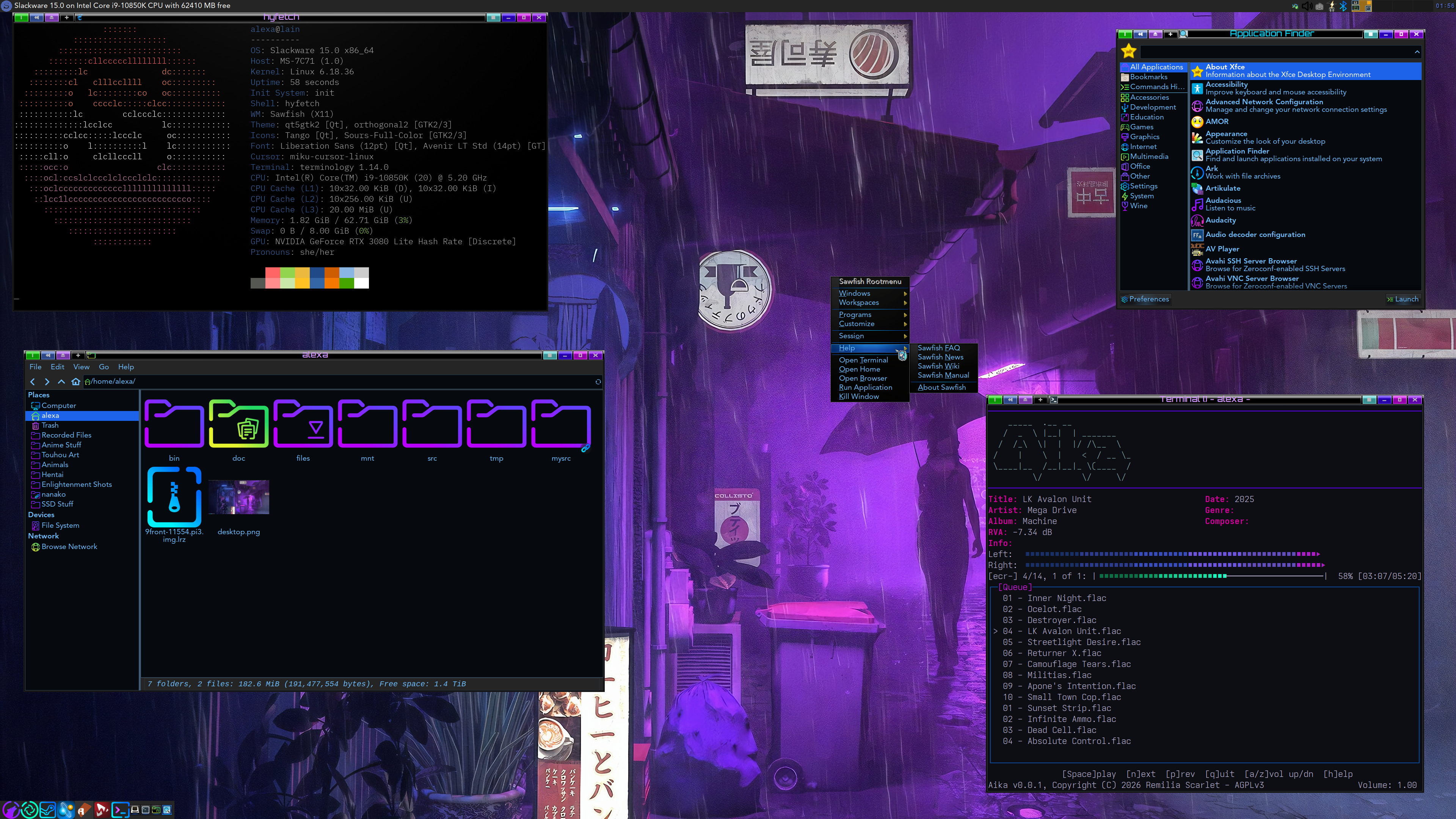
Holy shit i did not expect slack
wow… and what DE do you use with Slackware? I assume you just use pure CLI though
twm was good enough for us, we didn’t need no stinkin’ DE!
That CLI music player looks nice, I can’t find it though. Looks like you made it, did you share it somewhere?
Ahh yeah, that’s the music player I’ve been working on since the beginning of the year called Aika. It’s still pretty early on, but it’s mostly usable so far, depending on your needs. I mostly use it as my daily player right now, except for a few odd cases (like Opus files).
Aika is a spiritual successor to my other music player, Benben, which looks very similar, but not exact. Aika has some different features and goals, is much easier to build, and is lighter on system resources. But Benben is much more mature and featured complete. My goal is to release Benben v1.0 by years end, put it in maintenance mode, then focus on Aika.
Close! Just the wrong repo link. Check my other comment.
It’s just mayhap, fyi.
It’s this https://fossil.cyberia9.org/aika/index
Slackware was my first distro
antiX mentioned
I ditched slackwate in 98 after the validation issue became starkly problematic.
SLSA.dev .
I use linux by the way.
Ubuntu seems universally hated. Why?
Because apt is fundamentally broken and it shows most readily on a desktop-oriented distro like Ubuntu.
In order to benefit from packages not included by the distro you need to use 3rd party apt repos, but there’s no rule against those repos using package names used by another repo, including the distro’s repos. It could’ve also been fixed by identifying packages by [repo name + package name] instead of just [package name]… but it hasn’t.
The result is that when Ubuntu packages get replaced by 3rd party packages by the same name it can mess up the dependency graph if the 3rd party repo isn’t super careful about it.
It’s not a huge issue immediately after installing something but as time passes and more updates pile on top of each other (from both Ubuntu and the 3rd parties) it can get completely ruined and eventually the update solver can’t find an upgrade path anymore and you can’t use Ubuntu’s newer releases.
At that point you have two options. One is to use an advanced solver like the one in
aptitude, for example, but in order to fix the mess it will recommend to uninstall and reinstall a huge number of packages, including very core, essential packages, which is very risky and you lose the 3rd party stuff anyway. At which point you might as well use option two, which is to reinstall a newer Ubuntu release from scratch.Eventually after you go through this a few times it starts to get really annoying and you either get stuck on an old release out of dread, or you start looking for a distro that can be updated in-place indefinitely.
Too much corporate control and enshittification. For example, when you use apt-get (to get native packages) it can instead download a snap package (which works differently, is controlled by them and might not be preferred for many other reasons), even though you clearly meant not to.
The only reason for that is Canonical (Ubuntu’s developer) trying to push people deeper into the ecosystem they build and control.
Then, they roll out a paid Ubuntu version, Ubuntu Pro, separating paying and non-paying customers and turning Ubuntu into a subscription-based SaaS.
It was broken in many subtle ways even before snaps. Version updates were always a bit of a gamble and the whole thing was never as solid as properly managed distributions like the industrial ones such as SuSE or RH (or the properly managed ones that followed).
Widely and loudly hated, but not universal. The fans just aren’t that loud ;)
I believe it’s still one of the most used distributions. One of those people still associate with Linux. For some strange reason it’s also widely used in server hosting.
Hate is perhaps too strong of a word, but personally, I just don’t care for their default desktop environment. If I had to, I could still use it but as I have lots of choices I’m going with something else.
On the other hand, I find Ubuntu to be a fine server OS, especially if you want something in the Debian family but want something a bit more up to date than what’s currently in Debian stable but still widely supported.
Desktop design decisions. A lot of folks hated Unity. I know I did - they turned something familiar into something Apple like and I couldn’t stand it. I’m genuinely not a fan of the unified menus and such. It didn’t help that users were basically forced out of Gnome 2 into it when Unity became the default.
Within Unity they Integrated Amazon results into the Desktop Search. That was likened to spyware since your queries were being shared with Amazon, much like MS integrating web results into their own search. Ubuntu fucked up harder because, absent any filtering, their search occasionally produced adult products in the results - ie sex toys and such. Imagine telling your kid Fluffy needs a new knotted rope chew toy. They start searching “dog knot toy” just to have the results filled with BadDragon knockoffs.
They’ve leaned heavier into enterprise over the years and that has alienated a lot of the Desktop audience which helped bring attention to OS in the first place. They went from “Linux for Human Beings,” making desktop computing more accessible throughout the world, to becoming essentially the Microsoft of the Linux world.
Their snap backend is proprietary. You can’t just host your own snap repository. Even if you host your own local snap cache, it ultimately must point to and retrieve from their repository to populate that cache.
I’m sure there’s other stuff worth pointing out that I’ve forgotten.
The only reason I have ubuntu on my home server is because apparently Pterodactyl Panel is reliant on some aspects of it vs. Mint. It’s frustrating that way.
Their documentation says Debian is supported.
GNOME (by default), Snaps forced on you OOB rather than being an optional thing during setup or in any of the GUI settings, locking newer security updates behind a subscription, and Cannonical just being a bad captain of the ship.
There’s a reason why Mint is hailed as the new “casual (non-gaming) user favorite”, since it’s literally just Ubuntu sans GNOME and the hostile update design decisions.
I don’t hate it, it’s just so far the worst one i’ve used. It’s not necessarily bad, I have friends who use it.
What were the worst aspects for you?
For me, the main thing i don’t like is how the app store defaults to snaps, when the system package you want is hidden behind a drop down.
But i like a lot about it, namely the look and feel of the settings applications, hardware drivers, community support, trouble free updates, so for me it is my favorite.
I think that most Arch users that want to move to something stable are considering NixOS or GNU Guix rather than Debian.
Im a long standing debian user and i just recently installed arch in a separated disk mainly for gaming. I like arch, but debian is just beautiful.
Gentoo is how you upgrade from here
Well, maybe i’m not your average Arch user then… Don’t see the appeal in Nix, honestly, and i’m too lazy to learn. What is GNU Guix? Never heard of it.
I’m kinda tinkering with Debian Sid atm.
It’s strange to see someone move from Ubuntu to Arch, like it, and have aspirations of Debian. Ubuntu to Debian is fairly straightforward, didn’t you have to do a bunch of shit to get on and learn arch?
I mean I see the appeal of both. I used arch for a bit then went back to Ubuntu-based actually. Arch is cool and all, but I had some major functionality break a few times. I got tired of tinkering with it. Ubuntu “just works” most of the time. Interested to see what op writes about it too…
Have you thought about trying Mint, specifically LMDE?
Nah, not really. Pop_OS has been my favorite so far. Been on it about 5 years now.
Do you wanna hear the whole backstory?
I’m in Ur thread, reading Ur posts.
Yes I want free entertainment.
Well, you asked for it.
I started my Journey on Mint. The Install broke, but I wasn’t gonna give up that easily. So I used AI to troubleshoot it (not my best times, but I was desperate). I customized mint, I cherished it and loved my escape from the grasps of Microsoft.
Eventually, I noticed you couldn’t do rounded corners on Cinnamon (I didn’t understand DEs at the time, thinking you could only use the DE that came with the Distro).
It pissed me off so much that I went and tried something with Plasma. I went with OpenSUSE, in part cuz I liked the Chameleon, in part because I did like the concept. Bluetooth and wifi didn’t work ootb and for me as a beginner that sealed the deal, I wasn’t able to fix it.
Next, I went to Kubuntu, thinking it’ll be stable and have Plasma. And it was. It was all i’d ever hoped for. Stable, many features, super customizable. I even messed around with config files etc (mind you, this was like 3 weeks into my journey). I loved it. Even disabled snaps eventually.
But eventually I got bored. I started trying out other Distros, not hopping but just trying out their live installs. I no longer liked the corporate backend of Canonical. I wanted something new.
I also watched a lot of Linux content at the time, and I was confused and annoyed that I wasn’t getting the newest updates to stuff. That’s when I really started learning about DEs, Rolling releases etc.
I didn’t even really think of Debian as an option at the time, I kept hearing it was old and outdated, which I didn’t want.
That’s when I fell down the Arch rabbit hole. Cool logo, cool concept, hacker mode.
I wanted that, So, I tried Cachy and Endeavor. No. It wasn’t enough. I wanted that Arch logo natively in fastfetch. I wanted to say “I use arch btw”. First, I messed around in VMs. from 3pm to 3am, all I did was try and install arch in VMs. Manually, of course. I decided it was the only way to get the experience needed.
I was able to do it eventually. The Step to bare metal was… not as smooth as expected. what the hell is NVMEp02?? And stuff like that. It look a long time until I was done. And it was buggy, I had messed up. Shit didn’t work. I decided, well, it works except for weird stuff, strange issues I didn’t care to troubleshoot. So I used Archinstall, and no I don’t feel guilty, I can still do it manually if I wanted to I was just lazy.
Aaaand here we are. Arch is amazing and fantastic. But Debian Testing is almost as fast in terms of releases and I like the extra stability. Using Cosmic on Arch, actually. I love the tiling functionality. We shall see what the future brings
Thanks for coming to my TED talk.
Guix (pronounced “geeks”) is like Nix (declarative, functional, atomic) but more Emacs (niche, lispy, Free)
I’ve been a Debian guy for many years and it’s unlikely I’ll move away in the foreseeable future.
Nix is a package manager and nix-os is an OS built around that package management system.
You can install nix the package manager in debian. I don’t use it for installing desktop apps like a browser or office suite, I prefer AppImages for those. However, it’s absolutely fantastic for CLI stuff, especially the things you might want as a once off. You can just
nix-shell -p <obscure cli tool>and it’s just magically there in a new temporary shell, and then cleaned up once you quit that shell. No more adding weird repos to apt, or downloading from github and building, or piping scripts to bash.There’s also home-manager which allows you to define packages and their configurations, and just roll out that state on any machine.
These fancy package management tools (flatpak, AppImage, and nix) have dramatically changed the Debian experience. I used to be forever struggling with the trade off between stability and old versions of things. That’s really not the case any more because you don’t have to interfere with Debian’s conservative methodical ideology around stability in order to install and use all the shiny new things.
You can just
nix-shell -p <obscure cli tool>and it’s just magically there in a new temporary shell, and then cleaned up once you quit that shell.🤯❤️
Yeah so “cleaned up” wasn’t completely true.
Nix basically works by installing packages in a store or cache, and then soft linking to the binaries in the cache.
When you exit the temporary shell, the link will no longer exist but the cached package and its dependencies are still there.
You can easily clear that cache but it’s not gone instantly when you exit the shell.
That’s actually what I figured/hoped. As long as they’re making an effort to keep that secure, sounds like a good approach to me!
That sounds like a good compromise. I am really enjoying NixOs, but I miss the simplicity of Debian. I’ll think about your method.
You just installed Nix from APT, I assume, but are you still rebuilding a config.nix every time you make a “permanent” change?
Agreed on nix-shell -p, that’s extremely handy.
Been considering giving Guix a spin as an alternative to Debian, I’m use to freebsd but would like something non systemd linuxish
Either that or Void