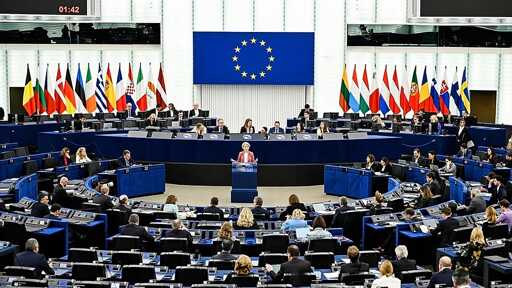
Twelve countries have already backed the initiative, with repeated obstruction by Viktor Orbán's Hungary increasingly fuelling calls for reform. #EuropeNews
Does your point not support abandoning anonymity? Perhaps Germany does not want to impose its Israel-related policy on other states by veto, while maintaining its own point of view?
You mean a rabid Zionist nation state, complicit in genocide once again, violently suppressing pro-Palestinian voices is voluntarily surrendering their veto power, as to not impose their Staatsräson on other nation states within its sphere of influence? I don‘t think so!
Germany has positive leverage through it‘s size and influence in the EU, especially in scenarios with QMV (Qualified Majority Voting). So if there wasn‘t an unanimity rule, it would still have a lot if power to create consent.
On the other hand it would have negative leverage without the unanimity rule, which would make them virtually impossible to outvote, while still being able to build a blocking minority. It would also have the power to discipline smaller countries, forcing them to tow the line, aka marginalizing them.
So contrary to your take, Germany is trying to maximize its power in the EU, which is in line with the aspirations of Merz wanting Germany to become a regional power again. The Hungary example has its basis, but I find it to be rather convenient for Germany‘s strategy.
I guess @sem@lemmy.ml’s is a typical ml comment. They just keep parroting the same propaganda over and again without even trying to understand the topic.


Does your point not support abandoning anonymity? Perhaps Germany does not want to impose its Israel-related policy on other states by veto, while maintaining its own point of view?
You mean a rabid Zionist nation state, complicit in genocide once again, violently suppressing pro-Palestinian voices is voluntarily surrendering their veto power, as to not impose their Staatsräson on other nation states within its sphere of influence? I don‘t think so!
Germany has positive leverage through it‘s size and influence in the EU, especially in scenarios with QMV (Qualified Majority Voting). So if there wasn‘t an unanimity rule, it would still have a lot if power to create consent.
On the other hand it would have negative leverage without the unanimity rule, which would make them virtually impossible to outvote, while still being able to build a blocking minority. It would also have the power to discipline smaller countries, forcing them to tow the line, aka marginalizing them.
So contrary to your take, Germany is trying to maximize its power in the EU, which is in line with the aspirations of Merz wanting Germany to become a regional power again. The Hungary example has its basis, but I find it to be rather convenient for Germany‘s strategy.
I guess @sem@lemmy.ml’s is a typical ml comment. They just keep parroting the same propaganda over and again without even trying to understand the topic.