Hi all!
UPD: thank you all for insightful answers. I am even more confused, but I find fascinating how fluctuating and alive the concept of Europe seems to be, reflecting the relationships between countries, geography, cultural context and even languages. Seems to be a valid PhD topic! Cheers!
I have an ultimately silly question for the thread, but I think it might be the best place to ask about it. I come from Russia and lived in Europe for around 6-7 years. And last weekend I realized I don’t know what do Europeans normally mean when mentioning Europe. Is it EEA? EU?
I’ve mentioned in a random convo that sometime in 2000s Moscow was one of the most expensive cities in Europe, and I was told off that I should not ever say it like that.
I was taught at school back in Russia that Europe is a continent, and the division lies between tectonic plates or something. That means, that there’s a European and Asian parts of Russia, like there are 2 sides of Istanbul sitting on two continents.
I understand, in Europe the most common understanding in Europe is not geographical, but, perhaps, political?
Is Belarus Europe? (I would say yes?) Then what about transcontinental countries? Like, Georgia is Europe and Azerbaijan is not? What about Armenia? (I’ve heard both interpretations).
Right now, my gut feeling is that all transcontinental countries kinda chose their sides? (Like, Georgia chooses European integration and Azerbaijan doesn’t). Could it be most common religion? (Doesn’t quite work tho?)
I’m only asking to clear my confusion, not to bait. I’m not suggesting anything. There’s a difference in education, and knowing how biased post-soviet education, I think I need to understand the conversation better.
Upd: typo on the subject linem
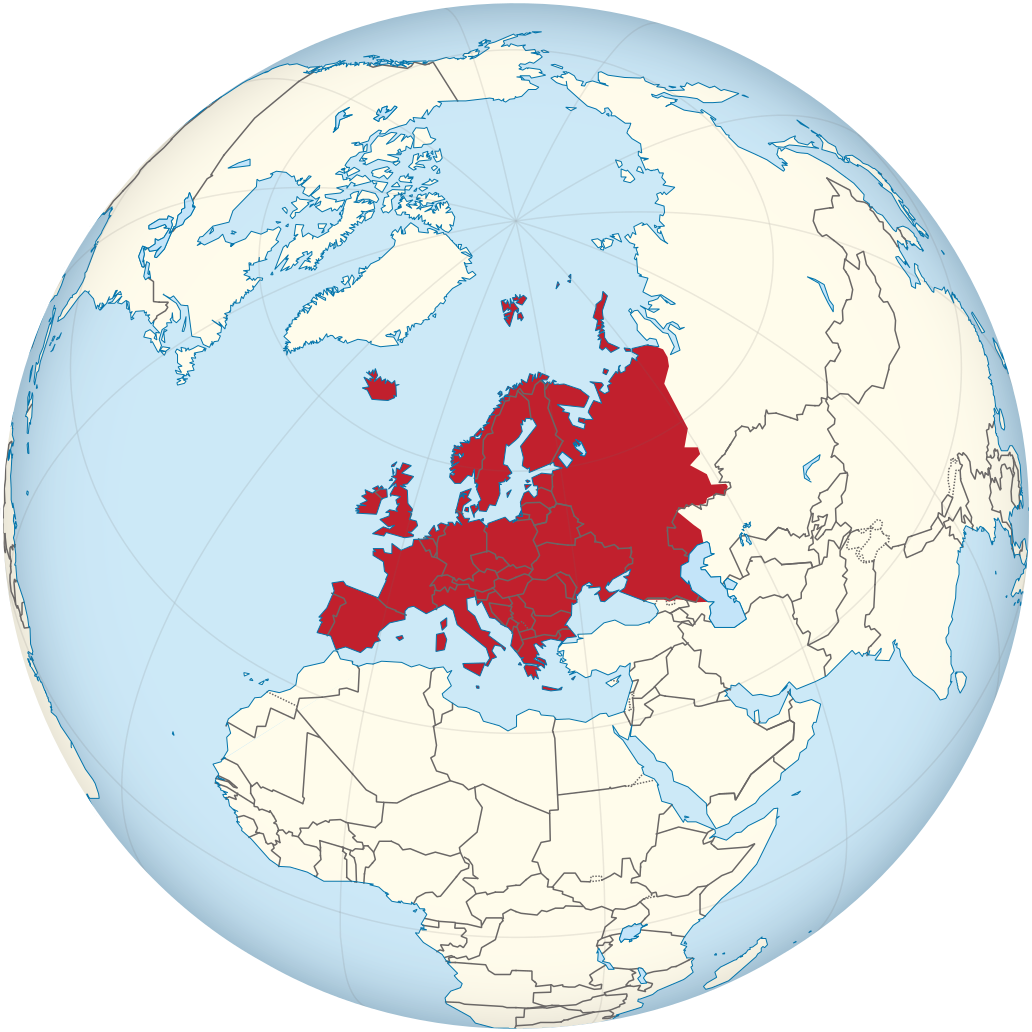
Geographicaly this Wikipedia map shows it correct for me. Politically is a bit more difficult and depends on the context. But in general take the map above, remove Russia and Kazakhstan, add Greenland and maybe the Asian part of Turkey.
Yeah, I was consulting Wiki too, only now realizing I don’t really understand the contextual nuances.
When people talk about Europe they often mean EU + UK + Switzerland + Norway.
When politicians says: “Europe must invest more on defence” or “Europe is stagnating” they are referring to the Western part of Europe, that is (was) aligned with NATO and the United States.
When someone says their are visiting Europe, they mean London, Paris, Rome, Prague, or other major cities in the countries above. Never Minsk or Moscow.
Russia, Belarus, Ukraine are not usually included in the colloquial use of “Europe”.
If someone ask me: “Is Russia in Europe?” I would say yes, no doubt about it. But if someone says “Europe needs to take seriously illegal immigration” then I am not including Russia for sure.
Ukraine sit in the middle, given the greater political alignment of recent years. More or less we see the same shift that happened with Latvia, Estonia and Lithuania.
But Russia and Belarus are rarely considered European in normal conversation because the are perceived as politically isolated enemies of Europe.
At the same time, Turkey, while being partially in Europe, is not counted as European most of the time.
Thank you for the detailed answer! Seems it’s mainly about political alliances. Unrelated, when I lived in America, people did consider Russia to be Eastern European, and e.g. St Petersburg a European city, but I think in the USA people often generalize locations.
It’s a bit sad to hear about Belarus and Ukraine tho… From my more Eastern standpoint, they are relatively more European, and Belarus seems to me culturally closer to Poland than Russia.
But I understand how some countries on the same continent exist outside of EU/EEA/Balkan discourse. I hope Ukraine will be able to gain their place in the EU.
It depends. Some people say Europe when they really mean the EU. I was told by a Belgian woman that “Switzerland is not in Europe”. I was very confused for a second. Some people include Turkey in Europe, others do not. Some include Russia, others do not.
И самие “патриотические” русские не любят когда я скажу что россия часть европи, потому что для них это политическая вещь и не географическая. И конечно, они думают, европа - супер гей, хаха. Идиоты. Слава Украине.
For me, Europe is a geographic-cultural region. It goes roughly from Greenland to the Urals and from Svalbard to Rhodes.
Than you for the answer! Its really funny about Switzerland:)
Not sure I strictly agree about the take on Russians in general but since you mentioned its about so-called patriots and Putin loyalists, it’s correct. But also for not so “patriotic” Russians Europe was a symbol of freedom and quality, I guess? At least in my bubble years ago.
At the same time as a Russian, would not call myself European as it might be offensive and incorrect. (I mean, I’m still a EU citizen, so it’s a bit tricky as I still vote here).
I mean if you’re a citizen in an EU country then you are absolutely european. By law. And no one can tell you otherwise.
I guess there is some anti-russian sentiment because of the war, especially in places that used to be occupied, and that is why some would want to distance themselves from everything russian. I think that’s stupid. There is a very wide spectrum between the regime, its supporters, the passive masses, the opposition, and the heroes who actually fight to free their country from its dictatorship. To treat everyone the same is not right.
I don’t think it’s a firm enough concept that you’ll get one answer everyone agrees on. For me, personally, it’s a fuzzy-edged geographical concept that has a cultural basis. So it’s “that bit of Eurasia west of the Urals and Bosporus”, and we think of that as a meaningful category because a lot of the people here have a lot of shared identity and history
Russia is, in my mind, a part of that. Most of Russia’s landmass is east of the Urals, yes, but the origin of the country is within Europe and it was a major part of that shared history. Britain didn’t become less European when most of Britain’s landmass was in Africa, India, Australia etc. Belarus is just unambiguously European to me. It’s hardly the first time in history that European countries have been hostile with each other
The other ambiguously-European countries - Turkiye, the Caucasian countries, Greenland, I suppose arguably Kazakhstan as well since it does reach into the western side of the Urals a bit - are where the “fuzzy edges” come into play for me. These countries can be thought of as European in some contexts, not in others. Often it is going to be a matter of identity for those countries - as you say, they pick their sides. I can imagine futures in which Russia, Turkiye, Armenia, and so on pull away from Europe altogether and are thought of as entirely Asian. I can equally imagine futures in which they move the other way and become more solidly European. There’s little sense to me in trying to draw a strict and exact geographic line of where “Europe” starts and ends because the concept is too entrenched and useful to just abandon, but the lines that it became entrenched upon were never neat ones in the first place
Thank you very much! Only now I realize how contextualised and nuanced those concepts are.
Interesting notion of the fuzzy edges. Europe seems to be a changing, living idea based on how the world changes and the context.
It is indeed fuzzy. It depends on context and in the speaker. When speaking geographically, unless that context is very clear, many people will say “continental Europe“. Moscow and Belarus are definitely in continental Europe.
“Mainland Europe” usually means continental Europe without the UK.
“Europe has strict privacy rules.” Here, it means the European Union, but the speaker may have intended to include Switzerland and the UK. Technically it also includes overseas areas, though people usually don’t think about those.
“European houses are made from concrete.” This speaker is equating Europe to their narrow experience. Building practices, codes, and materials vary widely across Europe - whichever interpretation you use.
“European banks are highly regulated.” This is about the EEU, even if the speaker didn’t consciously think about it that way.
Is Belarus Europe? It depends on the conversation you’re having. Is Georgia? In most contexts, most people would say yes, although it’s not currently in the EU. Azerbaijan I’m not sure, I think most people would say no in most contexts. And of course the UK is a special case, with people even jokingly removing it from continental Europe.
Haha, it’s surely complicated! Tga k.yoi for your reply.
I thought I kinda understood it intuitively, but it seems I’ve been wrong, since the point of view and the context really change the fuzzy European borders:)
“Mainland Europe” usually means continental Europe without the UK.
Why would it include the UK? Most of that hasn’t been connected to the mainland for ten thousand years. Unless you’re thinking about Gibraltar, which I would indeed consider to be part of the mainland.
It doesn’t include the UK. It just sometimes also doesn’t include other areas, notably Sweden, Norway, and Finland. They’re not an island, but they are almost functionally an island in a European context because the land route to them (prior to the Denmark-Sweden bridge) is very long and has often included at least one hostile border
It’s culturally. Russia choose only Russia. That’s why there’s Europe, Asia and Russia. There was a time when it seemed as if Russia wanted to escape its cultural isolation; people were ready. But then putin happened
Well, there’s a point of view that Russia is uniquely evil and wrong in the human history. Maybe it’s true!
Nah. Maybe too lazy about politics. If the Russian people was ‘evil’, putin wouldn’t need to suppress everything oppositional and free media.
Well, regardless of the average evilness of Russians in general, we can agree that that one Russian is surely a piece of evil shit.
Western Russia is historically a European culture though, definitely if you scale out and look further than just a single century. I see how it is now as far-east European, (because Putin wants to distinguish himself from Eastern-Europeans), but still Europe. Not all of it though, large parts of Eastern Russia were basically colonized and the original inhabitants of those regions have very different cultures. Geographically you can argue Russia is half European, half Asian; but you could also argue both are the same continent making Russia a central Eurasian country. But then we come back to the original topic, what part of west-Eurasia is actually west-Eurasia?
Russia, at least the European core, is culturally European. Politically it is not European. And I guess that distinction is very relevant.
The Cold War removed Russia from Europe.
Yea you can dig out whatever point in history or whatever geographical definition to justify whatever you like to imagine.
Russia doesn’t want to be seen as Asian and not as European. And therefore Asian and European people see it the same way. Russia is just Russia.
On the other side of the coin, first time I went to Russia I was talking to someone and said “it’s just that this is my first time in Europe” and he got offended and said “You’re not in Europe, this is Russia”.
Haha, I can see it’s happening! But I’d say chances are equal that that person was a propaganda believer (that Russia follows a unique path bla bla), or they would know that even western Russia is not generally considered to be Europe because it’s offensive to real Europeans beyond it’s borders. Many others would divide Europe and Asia by Ural mountains like we were taught at school:) (I personally would not r claim Russia is in Europe, but I’d say St Petersburg is… And from my perspective, Belarus and Ukraine are most certainly Eastern European.
I learned that Europe’s furthest border to the east was the Ural. Europe is part of Eurasia. It is a geographical naming convention. Simple as that. Has nothing to do with any of the economic or political unions.
That’s how I was taught, but it doesn’t seem to capture the many connotations of this concept!
Most people just want to feel important and think complicated. Europe is a very simple concept. All other connotations are colloquial in my opinion. Moscow is certainly in Europe, regardless of current politics.
I like your position!, there’s beauty in simplicity:)
Russia is in Europe.
With regard to transnational countries, it’s a blend of geography, geopolitical and cultural ties.
Russia’s capital is in Europe, it has a Indo-European language for its government, like most other sovereign European countries (some of them have Ugric or even Vasconian, though), and has historically been culturally pretty western. The East is Asian, but because of the former factors, I view Russia as a European country.
The Caucasus countries have been historically part of the former Soviet Union, and are also majorly focused on Europe. Only one speaks an IE language, though (Armenia).
Turkey has its capital not anymore in Europe, doesn’t speak an IE or Ugric language, isn’t focused much on the west except for strategical reasons, but it does have a part in Europe, and so it’s a bit iffy.
Greenland is geographically in another continent, but for all intents and purposes, much like Cyprus, it’s very much European - due to its ties being very close to it. Both have a European focus, with an IE language being official, and geographically also are at least in proximity (unlike Australia or New Zealand).
Religion only plays a role insofar there is a historical past shared sense of Christianity - but in my view, more modernly, is that of a secular, maybe laïcised Europe. Bosnians and Albanians are Muslim, but you’d be hard-pressed to view them as anything but just like the Catholics and Orthodoxes around them. Europe is more than which choir you listen to; Europe is a combination of elements.
Thank you very much for the detailed answer and also for bringing in the linguistic perspective into it!
Well as you say, there are multiple ways people see it. I think it’s quite foolish to tell someone off for saying Moscow is in europe, as it clearly is.
I think the most common way europe is used by people within the EU is to mean countries within the EU and maybe countries the EU is friendly with within europe?
I got the same understanding from this thread: its as mix of geography, culture, alliances, language, and also perspective. My friends from both USA and China where I lived considered me (a Russian) European, buffing me. I’m considering Belarus and Ukraine European, but some central/western Europeans do not. It’s very confusing, but also very interesting!
As a EU citizen, if I wanted to refer to that, I’d just say EU & Schengen. That about conveys the same countries anyways.
When I mean Europe, I mean the area delineated by the Caspian and Black Seas, the Ural mountains and its same-named river on one side, the Northern and Atlantic Seas on two others, and the end of the Mediterranean on the south.
I’d do the same. But I often hear politicians and people around me refer to a “stronger europe”. I think they refer to the EU, unless they also want to see Russia stronger.
In that context, russia is Asia.
Our first federal chancellor, Konrad Adenauer, supposedly once (~ 1950s) said: “When I reach the North German Plain near Magdeburg, that’s where Asia begins for me”
Back then, there was the border to the Soviet occupation zone.
Europe as a continent is divided from asia by the Urals then the caspian sea and from there I’m not sure if black sea or mediterranean(I think I’m making it larger than it actually is). The difference you are talking about with transcontinental countries tho is not religious but cultural and is mostly about if a country feels part of “the west” or not. Most europeans now would consider europe politically by the russia+ belarus border, with georgia, armenia, turkey and cyprus being included or not based on who you ask.
Thank you your reply! Looks the notion changes with how the world changes, and political alliances.
Guess on average, I bring up Europe when we’re discussing who sets the standards for cucumbers or internet surveillance. So that’d be the EU or European commission. Once we talk about where we’ve been on vacation, I just say the country name, like Belarus. No need to untackle geography. And it’s very unspecific anyway. Portugal is very different from the Ural mountains. And it’s a subcontinent, so made up. Asia and Europe is the same continent, and to my knowledge, Madrid and Moscow are on the same tectonic plate.
Thank you! The cucumber standards made me smile, but I got your point: the notion changes depends on the context and does not precisely describe a specific geographic region.
The end of Europe is pretty much the border with Russia. I’d consider Královec/Kaliningrad European but not Moscow.
There is this famous bridge connecting Europe to Asia in Turkey, so including countries further east to Europe seems wrong.
In the end nothing is fixed since Asia and Europe are basically one continent and you can split it up how you like.
Also true! Seems yo be subjective. Thank you for the reply.