

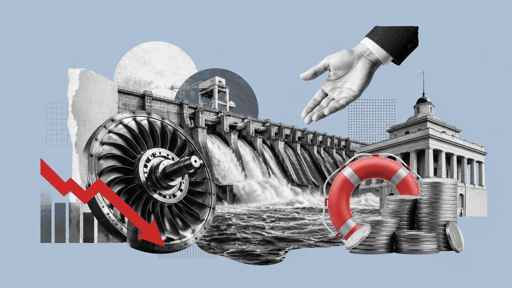
Just in the first quarter of this year, the Russian state power giant RusHydro saw its debt grow 40% to over a trillion rubles. Economic analyst Maxim Blant explains why and how the Kremlin, already buckling under the financial strain of the war and other corporate bailouts and stimulus, will have to bail RusHydro out and what that will mean for the economy.
…
On top of the challenge of financing military spending that is increasingly stretching the federal budget, the Kremlin is now facing another serious problem: rescuing debt-laden “too-big-to-fail” companies. Now, following in the footsteps of the state rail monopoly, Russian Railways (RZhD), Russia’s top electricity producer and one of the world’s largest hydropower companies, state-controlled RusHydro, has found itself unable to cope with its debt burden.
…
RusHydro is neither the first nor the only Titanic of the Russian economy to send out an SOS. Late last year, RZhD turned to the government for emergency assistance. That said, RZhD’s debt relative to earnings (debt/EBITDA) remains substantially lower (that is, better) than RusHydro’s, without exceeding (at least according to the company’s official financial statements) the limit of 3.5 set by the RZhD board.
…
Before RZhD, another state-controlled monopoly had to be rescued: Gazprom. After two years of record losses driven by the loss of most of the European market, the gas giant successfully lobbied for a substantial tax break, while domestic gas prices were approved to be raised at a pace well above officially printed inflation.
…
Overall, the poor state of affairs at RZhD and RusHydro suggests that the Kremlin’s attempt to balance a war that has become a black hole for resources – human, material and financial – and the implementation of massive investment projects in Eastern Siberia and the Far East represents a strategic mistake.
To a large degree, this mirrors the late-Soviet experience, when the country found itself simultaneously fighting a war in Afghanistan, trying to win the arms race against the US and pouring resources into so-called “Komsomol” mega projects, such as the Baikal-Amur Mainline railway.
The consequences of today’s strategic mistake may prove no less fatal.
…
With pleasure. Though I would be happier if you would call me pseudo-rational.
They still have to be close to where the demand is. Norway only now has rising electricity prices because they have started to expand their connection to the rest of Europe. Furthermore the losses from transportation are not insignificant. So it’s not likely that they build in the east to supply Moscow. They must be planning to do something in the east.