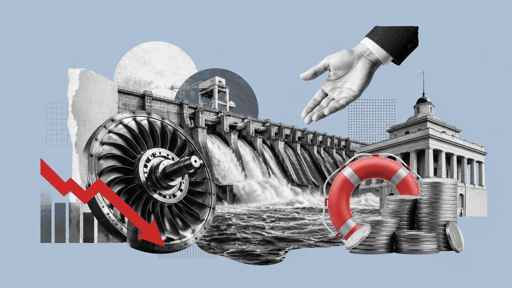
Just in the first quarter of this year, the Russian state power giant RusHydro saw its debt grow 40% to over a trillion rubles. Economic analyst Maxim Blant explains why and how the Kremlin, already buckling under the financial strain of the war and other corporate bailouts and stimulus, will have to bail RusHydro out and what that will mean for the economy.
…
On top of the challenge of financing military spending that is increasingly stretching the federal budget, the Kremlin is now facing another serious problem: rescuing debt-laden “too-big-to-fail” companies. Now, following in the footsteps of the state rail monopoly, Russian Railways (RZhD), Russia’s top electricity producer and one of the world’s largest hydropower companies, state-controlled RusHydro, has found itself unable to cope with its debt burden.
…
RusHydro is neither the first nor the only Titanic of the Russian economy to send out an SOS. Late last year, RZhD turned to the government for emergency assistance. That said, RZhD’s debt relative to earnings (debt/EBITDA) remains substantially lower (that is, better) than RusHydro’s, without exceeding (at least according to the company’s official financial statements) the limit of 3.5 set by the RZhD board.
…
Before RZhD, another state-controlled monopoly had to be rescued: Gazprom. After two years of record losses driven by the loss of most of the European market, the gas giant successfully lobbied for a substantial tax break, while domestic gas prices were approved to be raised at a pace well above officially printed inflation.
…
Overall, the poor state of affairs at RZhD and RusHydro suggests that the Kremlin’s attempt to balance a war that has become a black hole for resources – human, material and financial – and the implementation of massive investment projects in Eastern Siberia and the Far East represents a strategic mistake.
To a large degree, this mirrors the late-Soviet experience, when the country found itself simultaneously fighting a war in Afghanistan, trying to win the arms race against the US and pouring resources into so-called “Komsomol” mega projects, such as the Baikal-Amur Mainline railway.
The consequences of today’s strategic mistake may prove no less fatal.
…
In a related development, the Kremlin is apparently turning to state-owned banks to help finance its rising wartime budget deficit,
Russia’s Finance Ministry … registered two new issues of floating-rate federal loan bonds (OFZs): one worth 500 billion rubles ($6.45 billion) maturing in 2037 and another worth 1 trillion rubles ($12.90 billion) maturing in 2042 [after struggling to sell government bonds on the open market] … [OFZs main buyers are traditionally Russian state-owned lender}
Hydro electric power plants and being a grid operator should be a boring business that just prints money. Really hard to fuck that one up, but Russia managed to.
Things have got to be fucked up if you go bankrupt while your competition is being actively bombed
Is it one of those situations where the company delivered a lot of electricity to big customers who didn’t pay?
The RusHydro management attributes the company’s shaky finances to a combination of a massive investment program (most of it concentrated in Russia’s Far East), as well as the unprofitability of many of those projects and high interest rates, which have made refinancing prohibitively expensive for the energy giant.
Dumbasses.
massive investment program (most of it concentrated in Russia’s Far East),
Isn’t that just a sign that Russia is leaving Europe and moving east?
Just guessing but this looks to me like the elite has ordered them to make those investments. Russia has to move away from Moscow and Saint Petersburg to avoid the threats from short- and midrange missiles from Europe.
Hydro-electric power plants are not where the ‘elites’ order them to be but where water resources are abundant enough to keep the plants running.
But your frequent pseudo-intellectual comments are not just weird but almost hilarious. Keep on ;-)
The ones in Europe have probably been build already and the geography is better in the Far East: