for blue signs it’s not the shape that matters. a blue sign with an arrow is always a must. circular ones indicate what you need to do in your current lane (eg “keep right”), square ones on a lane you could turn onto (eg “the crossing road is one-way in this → direction”)
It absolutely is the shape that matters. A blue circle with an arrow indicates you MUST follow it, a blue square with an arrow indicates you CAN follow it. A blue circle with an arrow pointing forward can be replaced with a red circle with arrows pointing in every other direction, because it indicates a mandatory, I.e. you must eat the banana.
it varies. france and norway have some square mandatory “keep <direction>” arrows and sweden has the aforementioned “one-way in your direction” square arrow.


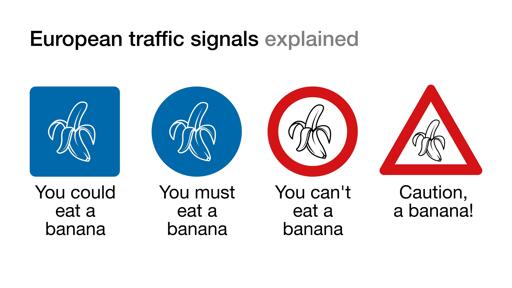
for blue signs it’s not the shape that matters. a blue sign with an arrow is always a must. circular ones indicate what you need to do in your current lane (eg “keep right”), square ones on a lane you could turn onto (eg “the crossing road is one-way in this → direction”)
It absolutely is the shape that matters. A blue circle with an arrow indicates you MUST follow it, a blue square with an arrow indicates you CAN follow it. A blue circle with an arrow pointing forward can be replaced with a red circle with arrows pointing in every other direction, because it indicates a mandatory, I.e. you must eat the banana.
it varies. france and norway have some square mandatory “keep <direction>” arrows and sweden has the aforementioned “one-way in your direction” square arrow.
No, in general the shape 100% matters. Rectangular signs (not to be confused with supplementary plates) are almost always purely informational, with the singular exception that you mention (“one way” which is regulatory). See also: https://www.gov.uk/government/publications/know-your-traffic-signs/regulatory-signs
idk if using the uk in particular as an example there is very useful.