

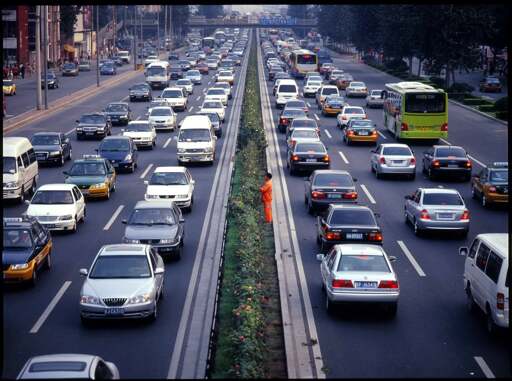
Though progress is often slow, city planners and politicians are gradually waking up to the fact that when cities offer safe and affordable alternatives to cars, we start to travel differently.
More and more young people are choosing bicycles, buses and trains over owning a car out of the sheer cost. In Berlin, it’s public transport, not cars, which is the coolest way of getting around.
In Copenhagen, a city that has a long held reputation for being bike-friendly, a whopping 62% of people choose to cycle their commute.
In the French city of Lyon, the number of cars entering the city has fallen by 20% compared to just a decade ago. As the city’s network of bike hire stations continues to grow, town planners are hoping for a further 20% decline.
In London, where cycle super-highways are becoming popular, the share of journeys made by car has fallen by a quarter since 1990.
Car free days are rising in popularity in many of the world’s largest cities, giving people a taste of what it’s like to live with less noise, traffic and pollution. Bogota was one of the first cities to introduce a car free day, and it’s now become so popular that it’s been extended to a full week.
Bogotá’s Ciclovía is fantastic! I was there in the mid-nineties and they closed a major artery, the Carretera Séptima, on Sundays. Here some pictures.
Jesus Christ, people who are too ill to walk should take a taxi or call an ambulance. I am not saying they should use a bike. But they should certainly not drive a car.
The same for people who are very frail, cannot see well, may have dementia, or severe circulatory problems. They should not drive a car.. Period.
If you are from the US, the idea might be alien to you, but we have public health insurance here, and if you need to go to hospital in an ambulance, this is covered by insurance. If you need a cab, you can get a coupon from your doctor. That might sound alien for you, but it is just a decent, halfways humane system.
And exactly for the people which are ill and frail, we need better public transport with good coverage. There are far too many accidents from the elderly, from people which are objectively unable to drive safely. This has to change.
And as soon we have satisfying public transport for these people, a whole lot more excuses fall apart why one needs to own a car.
I am not saying that nobody should have a car, or that today it isn’t the least worst option for many people. But owning and needing to use a car should be the exception - not the norm. It is not sustainable. We cannot live on like that. Look at the weather - wildfires, drought, floods. Do you think we can continue like that for 20 more years?
Yeah you did. I said some people need a door-to-door solution and explained further who those people are. If you then call the bike a door-to-door solution we’re still talking about those people.
And disabled or sick people can sit in a car and drive it, or sit in the passenger seat. You don’t have to assume their mental status.
Whoever said anything about that? Not being able to walk and dementia don’t have very much to do with one another, except for occurring at an older age.
Yes, I already mentioned the ride-sharing or robo-taxi solutions.
Uhh. No. Where did you get that idea? I already said we mostly agree. I simply disagreed with your point about elderly people not needing to be driven in cars.
It seems you’re doing the exact same thing you accused the other guy of. Trolling, bad faith arguing, moving the goalposts, ascribing ideas to me that I never had (a.k.a. straw man). Knock it off man.