

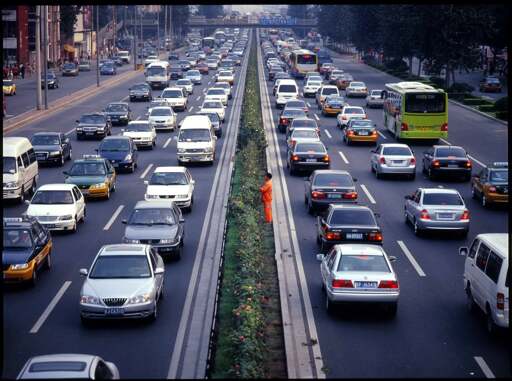
Though progress is often slow, city planners and politicians are gradually waking up to the fact that when cities offer safe and affordable alternatives to cars, we start to travel differently.
More and more young people are choosing bicycles, buses and trains over owning a car out of the sheer cost. In Berlin, it’s public transport, not cars, which is the coolest way of getting around.
In Copenhagen, a city that has a long held reputation for being bike-friendly, a whopping 62% of people choose to cycle their commute.
In the French city of Lyon, the number of cars entering the city has fallen by 20% compared to just a decade ago. As the city’s network of bike hire stations continues to grow, town planners are hoping for a further 20% decline.
In London, where cycle super-highways are becoming popular, the share of journeys made by car has fallen by a quarter since 1990.
Car free days are rising in popularity in many of the world’s largest cities, giving people a taste of what it’s like to live with less noise, traffic and pollution. Bogota was one of the first cities to introduce a car free day, and it’s now become so popular that it’s been extended to a full week.
Bogotá’s Ciclovía is fantastic! I was there in the mid-nineties and they closed a major artery, the Carretera Séptima, on Sundays. Here some pictures.
They can rather easily put a rack of wheelchairs next to the bus stop. I know because that’s what they did in California. I routinely push elderly men and women to their destination when I arrive for my appointments, because they are trying to get there by themselves, and the bike racks that I’m using are like 10-15 feet from the wheelchair racks.
That could help and they should do this wherever they can. But it may not be an option for many city hospitals.
I also know some hospitals that have shuttle buses between the metro station and the hospital.
But the thing is, those kind of solutions don’t scale well. They work when a few people are taking public transport in an otherwise car-centric place. But if cars were to be banned and everyone would have to take the train or bus, it would be chaos. And there wouldn’t be enough volunteers to help even a fraction of the patients.