
- cross-posted to:
- privacy@lemmy.dbzer0.com
- cross-posted to:
- privacy@lemmy.dbzer0.com
I am so excited about this project. Yes, I am a backer. I love that they are actually testing patterns against real-world cameras (Flocks, Rings, etc) and releasing only those that reliably defeat them.
Check the two most recent updates
The GPUs have been at 100% for months. Billions of patterns tested against an “impossible” gauntlet of camera models. Here is the plain truth on where we stand.
Hoodie: our best piece. Across all the person detectors we test, nearly 5,000 patterns hit a perfect record. The hoodie covers the most of you, so the pattern has the most to work with.
T-shirt: strong on individual detectors, still tightening. T-shirt patterns beat person detectors on tens of thousands of tests. What we are still building is the harder win: a single T-shirt pattern that stops a real camera on every person, every time. The hoodie is there. The T-shirt is close, and the ship design will be our strongest.
Buff: oh, the buff. The hard one, and here is why. It has to beat two things the shirt and hoodie do not: face detection and facial recognition, both far tougher than spotting a person. So far it reliably beats one of the four face detectors (2,600+ wins), facial recognition is cracking. Two of the toughest models have not fallen to our main method yet. So earlier this week I implemented a second, smarter method, and it is already working. In testing, it fooled the hardest face detector 71% of the time on people it had never seen before. That is the direction the final buff design is heading.
I do not count a win unless two things are true. One, the pattern beats a plain black version of the same garment, so we know the pattern is doing the work, not just covering you. Two, it works on people the system was never tuned on That is a strict test. I watch the wins and losses come in live, and most patterns die on that screen. The ones that make it are real.
The shirt and hoodie are proven. They defeat real cameras today. The buff is the last wall, and I have found the cracks. Last night, on faces it had never seen, it beat that detector 71% of the time. A week ago that number was zero.
This is what it looks like when a wall comes down. Not a press release months from now. Right here, in real time, with you watching. We will finish this.
We crossed $100k today. I set the goal at $5,000 because that is what I thought it would take to get the first patterns onto real fabric. I never expected to be writing this kind of update.
When I started this research I knew it was important. The feedback from the community has been overwhelming, and your support for this project means you care about your privacy too. Know that every waking minute I am developing the strongest countermeasures possible.
Every dollar of this goes into the research. More cameras to test against, more fabric, more print runs, and the time to keep pushing on the problems that are not solved yet. Six months ago I was begging for GPU hours. Now I can chase the hard cells until they break.
Thank you. I am humbled, grateful, and thankful for you all. Genuinely. If you know someone who would want this, please send it their way.
-Bill
You must log in or register to comment.
I am disappointed in the number of naysayers here. This guy is working on the problem and delivering results. What are any of you doing? Yeah, it turns into a cat and mouse game if one person is doing it and that mouse is bright purple. If there is a diversity of solutions to this issue, now there is a whole rainbow of mice, more than cats.
If you have an idea, contribute. If all you want to do is armchair quarterback, maybe don’t. The world already has plenty, that job is well filled.
It’s a nice idea, but it seems like something that the software could be patched to fix relatively quickly. Even if it works exactly as intended on release, it probably won’t continue working very long. Every instance of a person wearing this clothing in view of one of the cameras will provide training data for the AI model to recognize people wearing the clothing. In cybersecurity terms, the exploit will be “burned” on use.
You also have the classic xkcd problem:

Based on the number of backers (currently 638) there won’t be thousands or millions of people wearing these. Picking that one individual out of any given group of people is going to be pretty easy with parallel information and some process of elimination.
Also, in the context of privacy, ordering a custom one-of-a-kind pattern that only you have is a terrible idea. The fact that this is even an option they’re offering makes the seriousness of the whole project questionable.
Even worse, buying this through Kickstarter most likely means you’ll be using a credit card. You will be extremely easy to identify from purchase records (“oh look, there are only 2 people in Nowhere, Kansas who paid into this campaign, let’s go knock on their doors”).
This feels more like a grift playing on a current hotbutton issue than it does a genuine attempt to create privacy.
If you back this you should do it because you support the concept and the motivation and/or you find the research interesting, but you shouldn’t expect the thing itself to be reliable for the purpose described.
I mean its kinda one or the other. if its so common they do a patch then it won’t be the one guy but if they don’t do a patch then it will. That being said when something has to do more and more things it tends to degrade the quality or at least increase the cost of the tracking.
Not really, because it can be common enough to observe, train and patch against nationally while still being uncommon enough to identify specific individuals locally.
If 1000 people wear the shirt, they won’t all be wearing the shirt in the same location at the same time. Collectively they will create hundreds or thousands of data points, and enough incidents that the need to resolve the technical issue (model recognition failure) becomes apparent. However, each incident will still have a date, time and location in the database along with the captured video of the person, which will make it relatively easy to figure out who among the local population is the most likely candidate.
However, each incident will still have a date, time and location in the database along with the captured video of the person, which will make it relatively easy to figure out who among the local population is the most likely candidate.
It sounds like this adversarial clothing is designed to prevent the systems from identifying an image as a person at all, so it wouldn’t be logged. They’d need to rerun the patched software on the entirety of whatever archived video stream they happened to have retained, which is far less assured than just the logs and retained records from when the system detects a person.
Legally you’ll have plausible deniability.
IANAL, but IIUC from reading about Monero use in court dockets, the fact that you are one of a pool of (day) a few dozen, is enough that this piece of evidence isn’t enough to convict and may well be thrown out entirely.
Legally you’ll have plausible deniability.
Maybe.
Not if you’re the only person in your town who bought one, especially if you paid with a credit card or Paypal or w/e on Kickstarter. That evidence trail ends with you.
Now if you’re in NYC? sure, there’s probably at least 10 other people in town who have that shirt. How many of them match the height & weight of the person in the video?.. ok, now you’re 1 of 3 possibles. Oops, you forgot to shut your cell phone off and it pinged the nearest antenna at the time of the incident… now you’re 1 of 1.
This feels more like a grift playing on a current hotbutton issue
I’ve been looking for a way to describe how I was feeling about DDG selling sunglasses, this does it perfectly.
I mean its kinda one or the other. if its so common they do a patch then it won’t be the one guy but if they don’t do a patch then it will. That being said when something has to do more and more things it tends to degrade the quality or at least increase the cost of the tracking.
Sorry, did you mean to reply to the parent comment? Mine is just referencing the DDG sunglasses.
yeah likely. I thought I responded to the long one with the xkdc. thanks.
software could be patched
Ummm… no.
IIUC, the vendor would need to retrain their model, not simply apply a patch like for an out-of-bounds memory error.
Sure, but do you remember DeepDream? The whole point of that system was pattern recognition (especially faces) in images. That’s over a decade old.
The point being, image pattern models are legacy machine learning technology. They’re very easy to train compared to the cutting edge language models, you can do it at home with a decent GPU or TPU. Flock and the other companies wouldn’t have to completely dump their existing models either, just train a new one to deal with these patterns specifically and then add it to the system. It really won’t take that much time or resources to address.
Depends.
Do the existing cams allow for over-the-wire model updates? I’d be a bit surprised if that were the case.
Hmm, I kind of assumed the actual recognition model was running on the server side since the cameras are all networked for data sharing (which is kind of the problem).
It’s a fair question, I don’t know enough about their software to speculate.
do flock cameras have good ir filters, if not ir LEDs could help overexpose the image
Need something like this for car windows. Like a one-way diffraction grating that doesn’t damage the view from in the car but distorts or muddies the view from the outside.
Need something like this for car windows
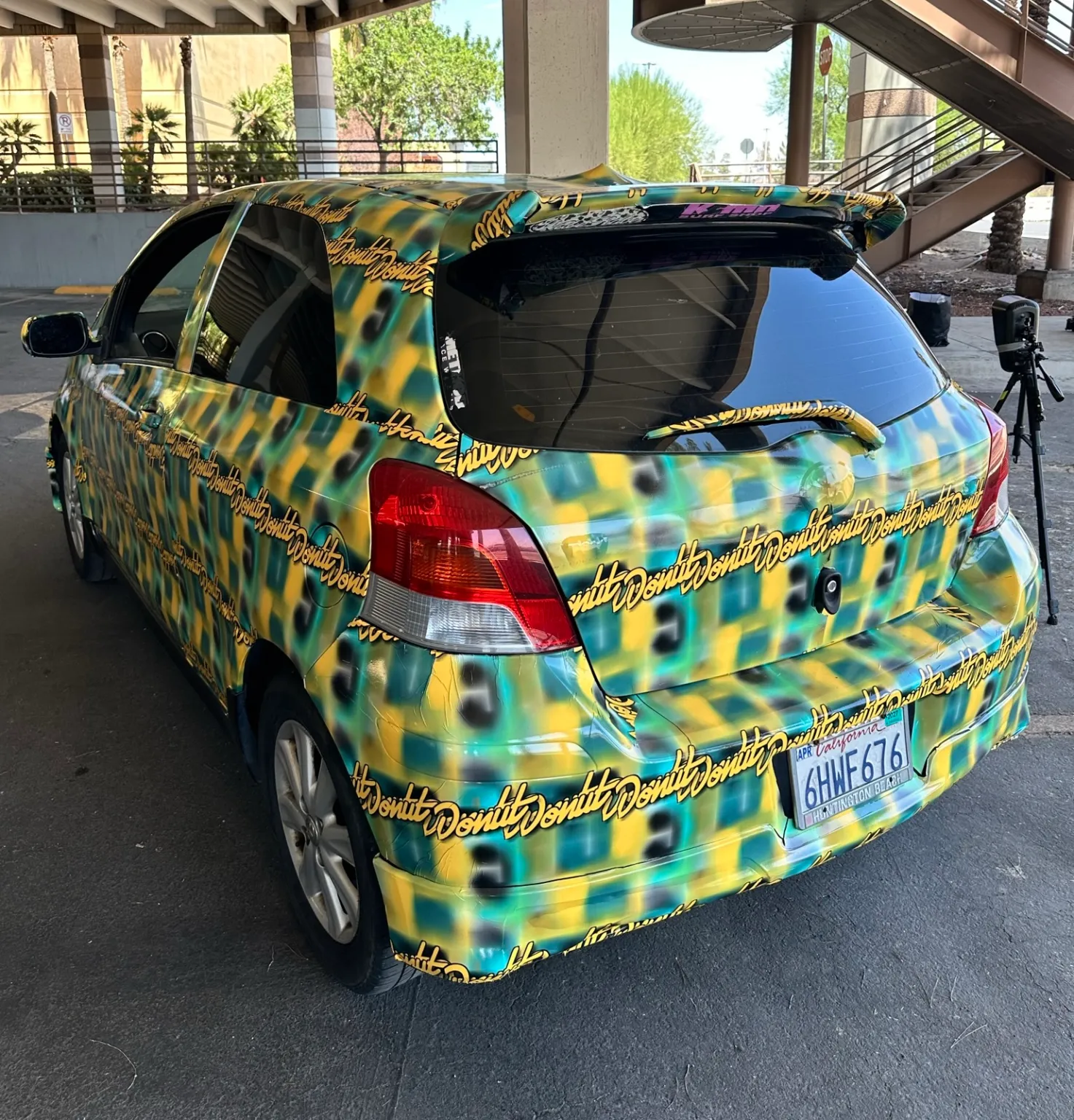
Same guy successfully demoed a car wrap at Black Hat 2026 that ALPRs do not register as a car
While I do agree with other comments saying this will have a really hard time keeping up with patches to the models doing the detection and wearing really unique clothing like this will single you out, I do still kind of like it. It is part of a counter movement and the fabric quite clearly signals what you think about having cameras everywhere. Kind of like a RATM t-shirt or something in the 90s. Idunno. Anyway, I hope noone does something silly in these thinking they are fool proof though.
Problem with Kickstarter, is that you may or may not end up getting a product that works
Problem with Kickstarter, is that you may or may not end up getting a product
that worksI was going to mention that, but apparently, you’re only allowed to advertise now if you have a prototype and fairly late. So, not sure it still generally applies.
The bigger issue, is that it would be probably easier to detect these patterns, and immediately flag them.
only allowed to advertise now if you have a prototype
Wild. Wonder if it’s helped any.
The bigger issue, is that it would be probably easier to detect these patterns, and immediately flag them.
I could definitely see that being a big issue
I see this lasting about as long as the bell bottom pants fad of the 1970s, or the pants worn so low that they reveal literally at least half your underwear (and/or ass) fad of the 1990s.
A decade or two later nobody will admit to having done so, even though some box in storage somewhere will contain proof otherwise,
You do realize both of those made a come back right?
Both even shorter-lived than the first pass. It’s not like the human race doesn’t routinely recycle old concepts.