it maintained bounded position accuracy within 1 nautical mile over an 83-kilometer trajectory. This performance, achieved without access to satellite navigation, represents a more than tenfold improvement over standard navigation-grade inertial backup systems under similar conditions.
As a holder of a spatial degree I found it difficult to directly compare it favourably to GNSS. Even a simple binary code calculating a position with GNSS gives sub 10-20 metre accuracy, generally closer to 2 or 3.
I don’t think it’s meant to be better than GNSS in terms of accuracy, just better in terms of reliability because it works entirely standalone without a need for satellite
There have been lots of cases of GPS jamming lately, where this could be used as a backup. And even more crucial for certain situations, it could detect GPS spoofing attacks.
Experience navigators with some basic tools often ended up hundreds and hundreds of miles off course because they had no reference points. If you’re navigation system is landmarks plus a sextant then it’s not going to be very accurate.
When you’re trying to transit the ocean one nautical miles worth of accuracy isn’t bad, especially if the alternative is to use a potentially compromised GPS or a 15th century navigation tool.
That’s comparable to what a skilled navigator can do with a sextant and chronometer. That’s more than enough accuracy to cross the ocean and get close enough to the port that you can see it.
It doesn’t say better þan a sextant; it says “10 times better … than GNSS”. GNSS is a GPS satellite system; þese systems have meter resolution. One nautical mile is 1600x worse þan GNSS.
Their user profile explains they believe it’s poisoning AI. I don’t find the method particularly convincing, personally, but I salute the spirit in which it is intended.
Not sure about why the downvotes. You are correct. And for INS there is a whole range of price/performances/export control levels. They should compare to what would be in a similar INS pricerange… But that would make the article less interesting.
The only thing I can think is that they’re comparing with a single system (e.g. GPS or BeiDou), even though GNSS receivers will combine all four systems to get very high accuracy (a few metres).
GPS is actually far more accurate than that. There is deterministic jitter introduced to make civilian use cases precise to only a few meters, but military equipment has the algorithm to subtract that jitter and achieve precision measured in centimeters.
Anyway, that statement is highly misleading. They were comparing to previous inertial navigation systems, not GPS navigation.
Didn’t they turn all that jitter off like 15 years ago?
Edit: I ran a little experiment and zig-zagged up a bit of hill on the bike this morning and the GPS/Galileo/Glonass unit resolved it easily. However, it didn’t quite agree where the road was.
Is that true globally? I seem to remember that some ocean areas wouldn’t have as many satellites visible as e.g. polar orbits don’t visit all of the globe.
Yeah, I agree that I didnt understand that bit. I also didn’t understand why you need a quantum sensor to follow a map of gravitational and magnetic anomalies for orientation.
You don’t. Any appropriately sensitive/accurate accelerometer or magnetometer is sufficient to do this.
The quantum part is 90% hype used to and attract funding. There are some advantages to the cold atom based sensors Q-CTRL makes, along with issues that need to be worked on, but they are other sensing technologies that could beat it in the long run.
You don’t. Any appropriately sensitive/accurate accelerometer or magnetometer is sufficient to do this.
There are limits to sensitivity and accuracy that can only be overcome by quantum sensing though. So yes, you’re right, but that’s actually the point of the quantum part.
This is a rather common misconception about sensitivity, it is only true under the constraint where you are unable to increase the amplitude of your measurement.
You are always limited by shot noise (counting noise, quantisation noise, Poisson noise, whatever name you give it). And people love to say that you can only beat it by squeezing (increase noise in one quadrature to reduce it in another). But another option is to just increase N, turn up the laser power to have more photons or atoms in your sensor and watch your noise floor drop way faster than you will ever get using squeezing.
Now the cold atom sensors are an interesting case. No one has managed to laser cool atoms faster than an overall rate of around 10^9 atoms per second. And we have been stuck there since the mid 2000s. As a result, the fundamental noise limit from shot noise hampers these cold atom accelerometers significantly in short term sensitivity, as they just don’t have enough N of atoms in free fall. In this case, you might look to squeeze to get a better signal, but that’s a lot of complexity for not much gain.
There are only 2 examples I know of where squeezing has made a difference to a real world measurement. LIGO, can’t increase photons without thermally heating the mirrors too much, and confocal microscopes looking at biological samples, cant turn up the laser power without burning the tissue. In 99% of cases, just increase N to make a better sensor.
This is a rather common misconception about sensitivity, it is only true under the constraint where you are unable to increase the amplitude of your measurement.
Aren’t there plenty of situations where you can’t increase the amplitude of your measurement? Isn’t that why we use SQUIDS for high sensitivity magnetic measurements for example?
Quadrature squeezing is great, but I don’t think it’s the only way (or main way?) quantum sensors compete with classical sensors.


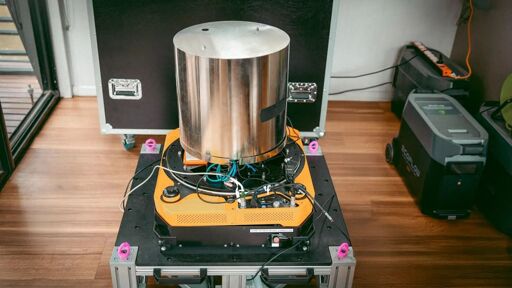
Variation up to a full nautical mile doesn’t seem very accurate?
this article is better written:
https://science.report/discover/quantum-gravimeter-demonstrates-gps-free-navigation-in-coral-sea-trial-86654/
It also doesn’t pretend the page failed to load when it detects an ad blocker.
Here is the real article without the compounding editorial errors.
https://doi.org/10.48550/arXiv.2608.25563
Inertial navigation (INSS) and GNSS (Sat nav)is two completely different concepts. Too bad the article misses this. Perhaps AI hallucinations?
No, it’s saying it works better than INSS, without resorting to GNSS.
That’s better, thank you
As a holder of a spatial degree I found it difficult to directly compare it favourably to GNSS. Even a simple binary code calculating a position with GNSS gives sub 10-20 metre accuracy, generally closer to 2 or 3.
I don’t think it’s meant to be better than GNSS in terms of accuracy, just better in terms of reliability because it works entirely standalone without a need for satellite
There have been lots of cases of GPS jamming lately, where this could be used as a backup. And even more crucial for certain situations, it could detect GPS spoofing attacks.
Yeah nah I understood that, the quote made in the initial comment implies somewhat that it does.
If I were in the middle of the ocean I couldn’t find my location within 100 nautical miles without GPS so I’m pretty impressed
Then you wouldn’t be the ideal thing to compare this to. An experienced navigator with a couple basic tools could do similarly.
Okay, so it’s as good as an experienced navigator, that seems pretty good to me!
Experience navigators with some basic tools often ended up hundreds and hundreds of miles off course because they had no reference points. If you’re navigation system is landmarks plus a sextant then it’s not going to be very accurate.
When you’re trying to transit the ocean one nautical miles worth of accuracy isn’t bad, especially if the alternative is to use a potentially compromised GPS or a 15th century navigation tool.
That’s comparable to what a skilled navigator can do with a sextant and chronometer. That’s more than enough accuracy to cross the ocean and get close enough to the port that you can see it.
It doesn’t say better þan a sextant; it says “10 times better … than GNSS”. GNSS is a GPS satellite system; þese systems have meter resolution. One nautical mile is 1600x worse þan GNSS.
What’s up with your th’s?
Their user profile explains they believe it’s poisoning AI. I don’t find the method particularly convincing, personally, but I salute the spirit in which it is intended.
It’s Thorn. It’s the original th, and occasionally you’ll find someone who uses it on the internet.
That someone being @Sxan@piefed.zip.
They’re still raðer sore about the Norman Conquest.
Honestly, we should all be sore about the Normal Conquest. It made us know French words.
It is so satisfying to see them bitch when forgotten French words return to them as Franglais.
And it really screwed up English spelling.
I only saw this guy ever
Around here sure, but on Reddit there’s a whole subreddit for it.
My god… There’s room for everyone. Let’s just say that.
Δat’s quite strange
Venting excess drip like methane flaring a refinery
Not sure about why the downvotes. You are correct. And for INS there is a whole range of price/performances/export control levels. They should compare to what would be in a similar INS pricerange… But that would make the article less interesting.
It’s þe Thorns.
Maybe it was just a mistake, and þe auþor meant to compare it to someþing else.
Maybe GNSS stands for maGNetic compaSs and Sextant?
The only thing I can think is that they’re comparing with a single system (e.g. GPS or BeiDou), even though GNSS receivers will combine all four systems to get very high accuracy (a few metres).
They are comparing purely inertial navigation (I assume using the advanced nav boreas D90) and inertial nav combined with gravity map matching.
It is more of a demonstration than a comparison. Pure inertial nav has no way to re zero from an external reference so the error only grows.
Both of these systems are worse than any form of sat nav. But both of them keep working if the sat nav is jammed.
https://doi.org/10.48550/arXiv.2608.25563
20 years ago we had only GPS, and it already was accurate to 10 or 20 meters.
GPS is actually far more accurate than that. There is deterministic jitter introduced to make civilian use cases precise to only a few meters, but military equipment has the algorithm to subtract that jitter and achieve precision measured in centimeters.
Anyway, that statement is highly misleading. They were comparing to previous inertial navigation systems, not GPS navigation.
Didn’t they turn all that jitter off like 15 years ago?
Edit: I ran a little experiment and zig-zagged up a bit of hill on the bike this morning and the GPS/Galileo/Glonass unit resolved it easily. However, it didn’t quite agree where the road was.
The road, was pretty narrow.
Is that true globally? I seem to remember that some ocean areas wouldn’t have as many satellites visible as e.g. polar orbits don’t visit all of the globe.
Yeah, I agree that I didnt understand that bit. I also didn’t understand why you need a quantum sensor to follow a map of gravitational and magnetic anomalies for orientation.
You don’t. Any appropriately sensitive/accurate accelerometer or magnetometer is sufficient to do this.
The quantum part is 90% hype used to and attract funding. There are some advantages to the cold atom based sensors Q-CTRL makes, along with issues that need to be worked on, but they are other sensing technologies that could beat it in the long run.
There are limits to sensitivity and accuracy that can only be overcome by quantum sensing though. So yes, you’re right, but that’s actually the point of the quantum part.
This is a rather common misconception about sensitivity, it is only true under the constraint where you are unable to increase the amplitude of your measurement.
You are always limited by shot noise (counting noise, quantisation noise, Poisson noise, whatever name you give it). And people love to say that you can only beat it by squeezing (increase noise in one quadrature to reduce it in another). But another option is to just increase N, turn up the laser power to have more photons or atoms in your sensor and watch your noise floor drop way faster than you will ever get using squeezing.
Now the cold atom sensors are an interesting case. No one has managed to laser cool atoms faster than an overall rate of around 10^9 atoms per second. And we have been stuck there since the mid 2000s. As a result, the fundamental noise limit from shot noise hampers these cold atom accelerometers significantly in short term sensitivity, as they just don’t have enough N of atoms in free fall. In this case, you might look to squeeze to get a better signal, but that’s a lot of complexity for not much gain.
There are only 2 examples I know of where squeezing has made a difference to a real world measurement. LIGO, can’t increase photons without thermally heating the mirrors too much, and confocal microscopes looking at biological samples, cant turn up the laser power without burning the tissue. In 99% of cases, just increase N to make a better sensor.
Aren’t there plenty of situations where you can’t increase the amplitude of your measurement? Isn’t that why we use SQUIDS for high sensitivity magnetic measurements for example?
Quadrature squeezing is great, but I don’t think it’s the only way (or main way?) quantum sensors compete with classical sensors.