Both things are going on at the same time, as Torvalds and Timmy are both paying Sam Altman to pour oil into the river as a byproduct of the service he’s providing. For something as important as the Linux kernel, it wasting fewer CPU cycles as a result of LLM-aided optimisation work might even be net beneficial for the environment once you take into account that it’ll affect billions of computers for years to come. If the end product is shitty, though, there’s no question that it wasn’t worth the environmental damage.
It would have to use trillions of fewer cpu cycles to do that. Currently scientists estimate it at 8 cups of water consumed for every 100 word prompt. What developer do you know that consumes 8 cups of water a day much less every thirty seconds. A developer can sit there and think with their own mind, computer doing nothing, while an LLM consumes thousands of gallons of water and kilowatts of electricity to do the same thing.
It only needs to save a few hundreds of seconds on one computer, or one second on a few hundreds of computers, or a tiny fraction of a second on the number of computers that actually run Linux to save trillions of cycles. A trillion cycles isn’t very many at all. A hundred-word prompt on a frontier model running on GPUs in a datacentre burns much more power than a trillion cycles on a CPU, so for a large Linux kernel patch, trillions is the wrong number by many orders of magnitude. There are also a lot of computers spending a lot of time running Linux, so it kind of balances out. There’s only one Linus Torvalds, and he’s very busy, so it’s likely that if he’d not used an LLM to get this work done, it simply wouldn’t have happened, even if someone had been willing to fund a different human to do it.
Either way, the original point of the post was that LLM-generated code is always shitty (even when it’s not immediately obvious to whoever’s responsible for it that it’s shitty) and so having any amount of it already makes things worse, even ignoring the huge environmental cost. With that context, it is the case that there’s a huge difference between Timmy and Torvalds as Torvalds is famous for having very high standards, so if he’s using it, he might be able to make something that isn’t shitty.
I didn’t realize you were talking about performance in the kernel, which I think will be incredibly hard to measure. That that’s usually the main focus of enterprise investment into Linux, so I very much doubt that an LLM is coming in and making improvements there, but maybe it’s happening. As far as I can tell all the latest things are security scans, which usually will result in worse performance since the goal isn’t speed but safety.


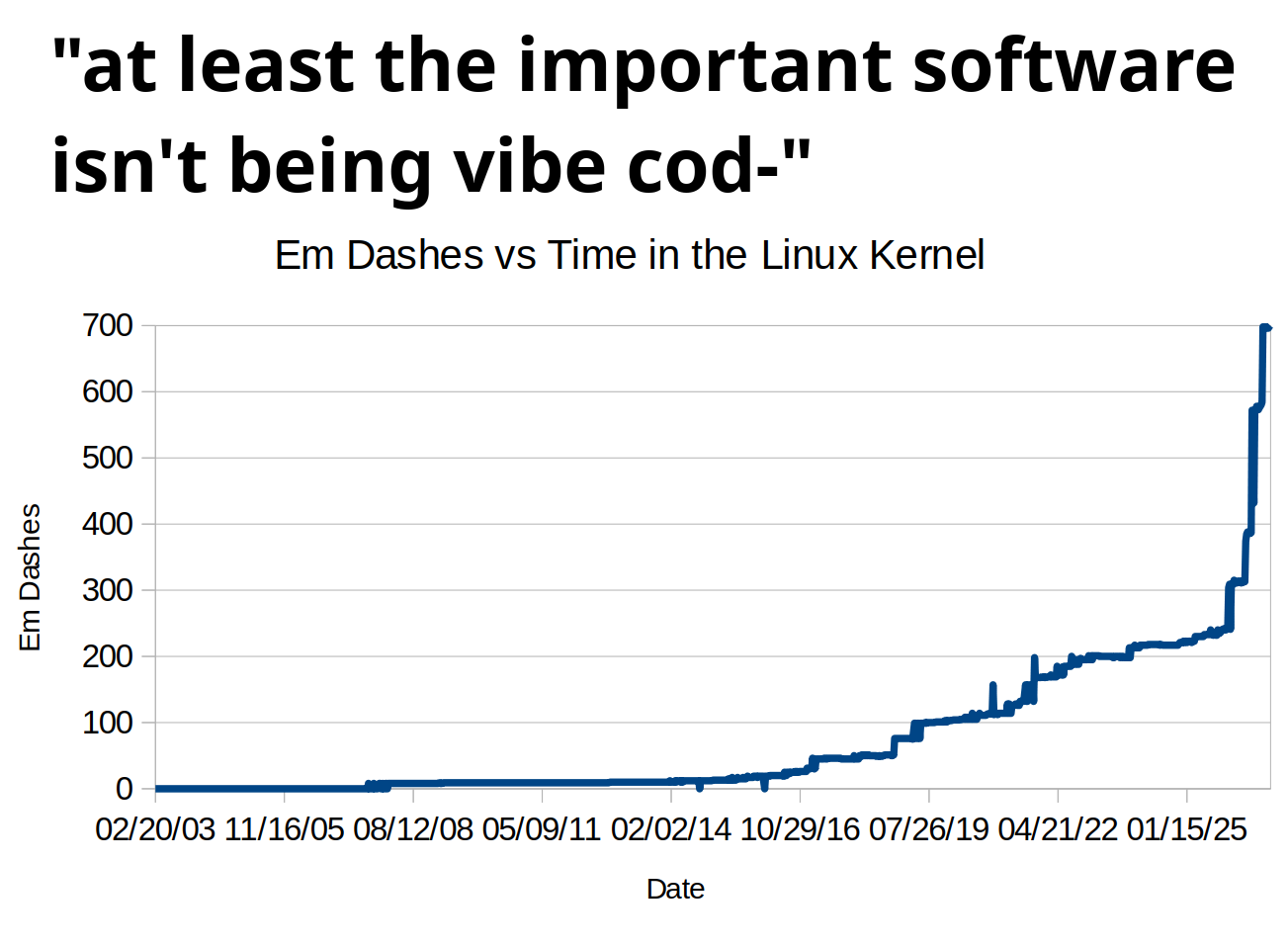
Both things are going on at the same time, as Torvalds and Timmy are both paying Sam Altman to pour oil into the river as a byproduct of the service he’s providing. For something as important as the Linux kernel, it wasting fewer CPU cycles as a result of LLM-aided optimisation work might even be net beneficial for the environment once you take into account that it’ll affect billions of computers for years to come. If the end product is shitty, though, there’s no question that it wasn’t worth the environmental damage.
It would have to use trillions of fewer cpu cycles to do that. Currently scientists estimate it at 8 cups of water consumed for every 100 word prompt. What developer do you know that consumes 8 cups of water a day much less every thirty seconds. A developer can sit there and think with their own mind, computer doing nothing, while an LLM consumes thousands of gallons of water and kilowatts of electricity to do the same thing.
It only needs to save a few hundreds of seconds on one computer, or one second on a few hundreds of computers, or a tiny fraction of a second on the number of computers that actually run Linux to save trillions of cycles. A trillion cycles isn’t very many at all. A hundred-word prompt on a frontier model running on GPUs in a datacentre burns much more power than a trillion cycles on a CPU, so for a large Linux kernel patch, trillions is the wrong number by many orders of magnitude. There are also a lot of computers spending a lot of time running Linux, so it kind of balances out. There’s only one Linus Torvalds, and he’s very busy, so it’s likely that if he’d not used an LLM to get this work done, it simply wouldn’t have happened, even if someone had been willing to fund a different human to do it.
Either way, the original point of the post was that LLM-generated code is always shitty (even when it’s not immediately obvious to whoever’s responsible for it that it’s shitty) and so having any amount of it already makes things worse, even ignoring the huge environmental cost. With that context, it is the case that there’s a huge difference between Timmy and Torvalds as Torvalds is famous for having very high standards, so if he’s using it, he might be able to make something that isn’t shitty.
I didn’t realize you were talking about performance in the kernel, which I think will be incredibly hard to measure. That that’s usually the main focus of enterprise investment into Linux, so I very much doubt that an LLM is coming in and making improvements there, but maybe it’s happening. As far as I can tell all the latest things are security scans, which usually will result in worse performance since the goal isn’t speed but safety.
This comment chain is specifically referencing a single LLM-assisted patch that Linus Torvalds posted to the mailing list for review a few days ago that solves a longstanding performance problem that interacts with enough things parts of the kernel that there are only a handful of people in the world qualified to deal with it, and that none of them have had the time to investigate and fix properly until just now. https://www.tomshardware.com/software/linux/linus-torvalds-posts-his-first-llm-assisted-patch-to-the-linux-kernel-after-issuing-clear-pro-ai-directives-the-bossman-makes-use-of-ai-tooling-himself