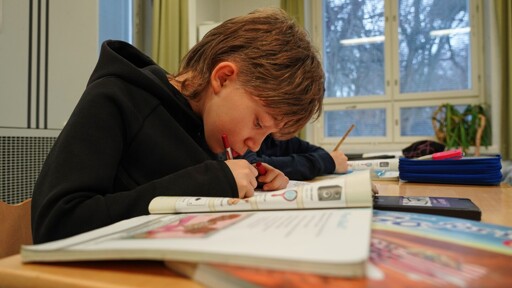
For decades, the Nordic nation has woven media literacy, including the ability to analyze different kinds of media and recognize disinformation, into its national curriculum for students as young as 3 years old. The coursework is part of a robust anti-misinformation program to make Finns more resistant to propaganda and false claims, especially those crossing over the 1,340-kilometer (830-mile) border with neighboring Russia.
Now, teachers are tasked with adding artificial intelligence literacy to their curriculum, especially after Russia stepped up its disinformation campaign across Europe following its full-scale invasion of Ukraine nearly four years ago. Finland’s ascension into NATO in 2023 also provoked Moscow’s ire, though Russia has repeatedly denied it interferes in the internal affairs of other countries.
“We think that having good media literacy skills is a very big civic skill,” Kiia Hakkala, a pedagogical specialist for the City of Helsinki, told The Associated Press. “It’s very important to the nation’s safety and to the safety of our democracy.”
The Finnish educational system really is excellent from my own reading and understanding.
I’ve had the opportunity to work with some Finns, not enough to be sufficiently representative, but still helpful. Calm, considered and extremely thoughtful. Interesting conversations about how their kids and themselves had studied as children compared to UK children. I wish I’d gone to school in Finland.Meh… a bit clickbaity article. First of all, obviously 3 year old kids in here don’t read newspapers and while the curriculum on paper is pretty decent our education severely lacks funding and as there’s less and less children around it’s not going to get any easier. Also there’s been a ton of changes on curriculum, one might say just for the sake of it since someone wanted to show that they’ve achieved something, but effects of those changes aren’t too clear and they’ve been too frequent.
Comparing on how my school was and how it is now with my kids I’d say it’s gone downhill. Specially maths and reading skills have gone down from the 1990s. Answer to why is not simple, and obviously there’s some improvements too, but in general I’d say my kids are less prepared for the world after their school career than I was.
But yeah, media literacy is an important skill regardless of the source of any given media and it’s neat our schools teach that. And obviousy it’s not just because of Russia.
The USA ranked fifth in the world for educational spending in 2019, while Finland spent $12,000.
In 2019, the United States spent $15,500 per full-time-equivalent (FTE) student on elementary and secondary education, which was 38 percent higher than the average of Organization for Economic Cooperation and Development (OECD) member countries of $11,300 (in constant 2021 U.S. dollars).
https://nces.ed.gov/programs/coe/indicator/cmd/education-expenditures-by-country
But this doesn’t tell the whole story. The USA spending varies dramatically between states. There’s an obvious teaching-to-the-measure, and edddctively racial segregation even outside the South. Also, there’s a preoccupation with funding sport extracurriculars, instead of teachers and educational programs. When the institutions devalue the work of the educators, it drives the good teachers away from the profession, so kids aren’t taught with passion.
Is there an English translated curriculum available?
Each municipality has their own, but country wide core curriculum (and a ton more) can be found at Finnish National Agency of Education website: https://www.oph.fi/en/statistics-and-publications/publications/new-national-core-curriculum-basic-education-focus-school
This is why fascists hate education