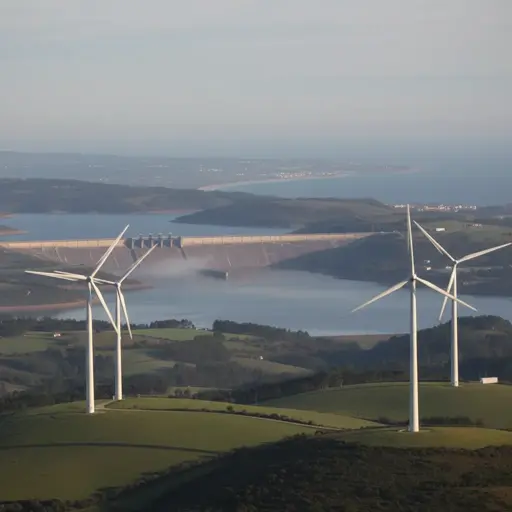
Portugal hit 80% renewable electricity in January, saving €703 million on bills, securing the grid and spurring green projects—benefiting residents nationwide.
I always like to check out the data myself. Out of the 39 countries Eurostat tracks for household electricity prices, Portugal is 17th highest. Prices decreased around 1% last year for consumers. Portugal consumers pay the 5th highest rate of taxes and levies for electricity in the same cohort. Last year, Portugal had the third highest increase in electricity prices for businesses.
This is a mixed bag for me. They’re about middle of the pack for consumer prices, but prices aren’t coming down, and businesses are facing massive increases. This will have downstream effects on jobs and the economy. See Germany.
The fixed part of an electric bill in Portugal is insane, both because of a good chunk of it are taxes charged via it and because the “fixed network connection costs” are very high.
This means that if one invests in saving power the returns of that are pretty bad because there’s still this huge immovable cost chunk from merelly having a grid connection: I’ve been an early adopter of things like LED lights and tend to take power consumption in account for my computing equipment and nowadays outside Winter (when I spend a lot of power in warming as over 70% of houses in Portugal have very bad insulation and mine is one of those >70%) my bill is literally only half actual electricity costs and the other half is that fixed componen - my incentive for saving power is mainly one of principle because the actual financial incentive only goes so far before you start seeing diminishing returns from investing into more efficient electric devices.
Meanwhile policies in Portugal are such that they almost try and stop people from having home solar - for example if you try and sell excess power to the grid you’ll get at best 1/4 the price that it costs when you buy power from the grid, so it’s simply not worth it to have an installation which produces excess power, all this in one of the countries with the highest number of sunshine hours in Europe were it would make a lot of sense for people to have home solar.
And then, of course, there’s the French problem: specifically France keeps refusing the creation a proper connection for the Iberian countries to sell its excess of power due to Renewables to the rest of Europe (because France wants to sell their own from their large number of Nuclear Power Plants at a higher price), so there are actually plans to do it with cables in the middle of the Med going around France and enter the rest of the continent via Italy.
I imagine as we move to renewables, a lot of places are gonna have similar situation. Maybe not as bad, but I don’t know what the situation with the taxes there is.
There’s a fixed cost associated with having the infrastructure that maintains a wire from consumer to producer functional, if you’re not paying for electricity, you’re paying for all the transmission lines and other hardware.
I can’t imagine any grid making it profitable for people to sell power to it, sounds like a nightmare to try and balance load with random home setups bumping it up and down, but a fully self-sufficient solar home could probably eliminate all costs but maintenance for the grid connection, if you want backup to solar.
However I suspect that what’s charged in Portugal for that cost is way beyond a fair value, with rent-seeking “administrative costs” of the power provider which far exceed actual real costs in the era of smart-meters and computing (plus which are already included in the price for power itself, which is why retail power prices are much higher than bulk market prices, thus there’s double-dipping going on there) as well as “taxes” to pay for subsidies for renewables which were often de facto politicians needlessly shoving money to their mates so that they had higher profits - the big power company in Portugal is very well connected politically and is involved in at least on major Corruption case - rather than actually needed to incentivise provision of things which would otherwise not be provided.


I always like to check out the data myself. Out of the 39 countries Eurostat tracks for household electricity prices, Portugal is 17th highest. Prices decreased around 1% last year for consumers. Portugal consumers pay the 5th highest rate of taxes and levies for electricity in the same cohort. Last year, Portugal had the third highest increase in electricity prices for businesses.
This is a mixed bag for me. They’re about middle of the pack for consumer prices, but prices aren’t coming down, and businesses are facing massive increases. This will have downstream effects on jobs and the economy. See Germany.
The fixed part of an electric bill in Portugal is insane, both because of a good chunk of it are taxes charged via it and because the “fixed network connection costs” are very high.
This means that if one invests in saving power the returns of that are pretty bad because there’s still this huge immovable cost chunk from merelly having a grid connection: I’ve been an early adopter of things like LED lights and tend to take power consumption in account for my computing equipment and nowadays outside Winter (when I spend a lot of power in warming as over 70% of houses in Portugal have very bad insulation and mine is one of those >70%) my bill is literally only half actual electricity costs and the other half is that fixed componen - my incentive for saving power is mainly one of principle because the actual financial incentive only goes so far before you start seeing diminishing returns from investing into more efficient electric devices.
Meanwhile policies in Portugal are such that they almost try and stop people from having home solar - for example if you try and sell excess power to the grid you’ll get at best 1/4 the price that it costs when you buy power from the grid, so it’s simply not worth it to have an installation which produces excess power, all this in one of the countries with the highest number of sunshine hours in Europe were it would make a lot of sense for people to have home solar.
And then, of course, there’s the French problem: specifically France keeps refusing the creation a proper connection for the Iberian countries to sell its excess of power due to Renewables to the rest of Europe (because France wants to sell their own from their large number of Nuclear Power Plants at a higher price), so there are actually plans to do it with cables in the middle of the Med going around France and enter the rest of the continent via Italy.
I imagine as we move to renewables, a lot of places are gonna have similar situation. Maybe not as bad, but I don’t know what the situation with the taxes there is.
There’s a fixed cost associated with having the infrastructure that maintains a wire from consumer to producer functional, if you’re not paying for electricity, you’re paying for all the transmission lines and other hardware.
I can’t imagine any grid making it profitable for people to sell power to it, sounds like a nightmare to try and balance load with random home setups bumping it up and down, but a fully self-sufficient solar home could probably eliminate all costs but maintenance for the grid connection, if you want backup to solar.
Yeah, that does make sense.
However I suspect that what’s charged in Portugal for that cost is way beyond a fair value, with rent-seeking “administrative costs” of the power provider which far exceed actual real costs in the era of smart-meters and computing (plus which are already included in the price for power itself, which is why retail power prices are much higher than bulk market prices, thus there’s double-dipping going on there) as well as “taxes” to pay for subsidies for renewables which were often de facto politicians needlessly shoving money to their mates so that they had higher profits - the big power company in Portugal is very well connected politically and is involved in at least on major Corruption case - rather than actually needed to incentivise provision of things which would otherwise not be provided.
Yeah, that sounds pretty bad.