

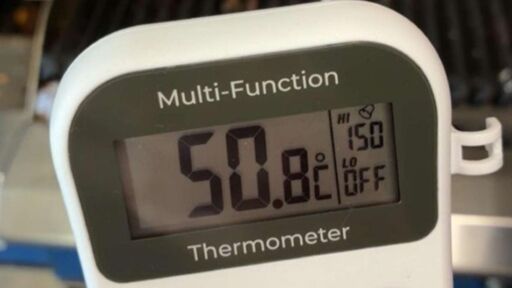
Wales, England and France had the hottest Spring on record
The wording of the title made it sound like authorities forced them to close. In this case the manager/owner decided to shut down because it was too hot for their own staff, so kudos to them.
I would have guessed something more like a manager saying, “Well, all my kitchen employees have gone to the hospital for heat stroke, so I guess we’ll have to close for the day, since they literally can’t work.”
Not sure about worker rights in the UK, but I am pretty sure in Germany the restaurant would have to shut down whether the manager or owner wants to or not.
There are worker protection regulations for temperature in the UK, which account for both excessive cold and heat. However, whereas there is an explicitly stated minimum temperature for indoor workplaces (16°C, or 13°C if the work involves rigorous physical exertion), there is no stated upper bound, only that employers must ensure the safety of their workers with respect to heat stress, by maintaining a “reasonable” temperature at work.
We honestly need an update to the regulations, because part of why there isn’t nearly as much guidance for excessive heat is that when the regulations were written, it was assumed that the only workplaces that would be at risk of excessive temperatures were places like bakeries and foundries. Although a kitchen like the one in the article obviously has plenty of equipment outputting additional heat, places like this getting too warm probably wasn’t conceived of when these regulations were written — and it’s only going to get worse.
Unfortunately, the word “reasonable” is pretty fluffy, and I can imagine some workplaces only shutting once workers start experiencing heat stress. And in some cases that I know of, some asshole employers will continue pushing employees past that point — the employees would no doubt succeed if they tried to take action against their employer at this point, because that’s clearly beyond what’s reasonable, but it’s much easier to prove “the temperature was this high” than it is to argue that the temperatures were unreasonable.
I learned a bunch of this from a friend who was concerned for her employees — she was complaining to me about how much work it took for her to figure out what constituted “reasonable” and how the lack of clearer regulations about excessive heat not only made it easier for asshole employers to exploit their workers, but also harder for employers like her to protect her workers (another friend, who was a manager but didn’t directly employ the people working under him concurred, because it took him a lot of arguing to convince the higher ups that AC was necessary in the office)
heat protection rules in Germany are actually quite weak, above 30 they have to let you wear some lighter clothing and give you water… but yeah I think over 50 would not be allowed
Above 30 degrees, your employer has to take measures to cool down your working place. A room above 35 mustn’t be used for work.
happened here too in large metro area in PNW (USA) when temps hit 108 F in June a few years back
This is without doubt a symptom of man-made global heating. And it will get worse. Eventually certain regions of the planet will be too hot for humans to live in. The data and scientific consensus prove it.
Climate change is here, time for the UK to discover air conditioning
Noone should be forced to work in temperatures over 30 degrees, anything over 25 should require free drinks and ice creams
Basing that comment on Britain which falls apart in hot weather, your mileage elsewhere may vary
Anything bellow 25 should require space heaters and the option to wear a blanket.
Anyway, hello from Brazil. Yes, YMMV.
From the Midwest USA. If it was below 25 we might have a sweatshirt on. Anyone asking for a space heater would be ridiculed for their “thin blood”.
Obviously I’m talking F for my area. Had to look up Brazil. Do ya’ll really get cold below 25C?
“All” is a lot of people.
But we are in one of the coldest weeks of the year here. Everybody has used heavy coats all through the day, and complained about it.
When I wrote my previous comment, my thermometer was marking 23.5°C. It was around noon, and it’s crazy cold for noon. But it’s still marking 23°C now at night (because my home is closed), what is not very cold (outside it probably is).
lol
lmao even
Obviously you’ve never been to the Middle East.
Have you? It’s dry there, so your sweat evaporates, cooling you down.
Yes, i have been there. It’s not always dry. Oman and the UAE can get pretty humid at times.
Here in Canada we have laws regarding both minimum and maximum temperatures we’re allowed to work in, although it varies from industry and province.
There’s a minimum temperature for indoor work in Britain, but no maximum. The minimum for sedentary work used to be 17°C, but they reduced it to 16°C during the last government. Notably, it hasn’t been increased again under the current one. (For active indoor work, it’s 13°C. Outdoor work has no limits otherwise the country would be even less functional in extreme weather than it already is.)
In Alaska we don’t have that hippie regulation bullshit.
https://labor.alaska.gov/lss/pads/heat.htm
Table for the limits is at the bottom of the page.
Sure you do. Your regulations around environmental damage are more strict than Canadian regulations.
Canadians are the America’s punchlines.
For those of us who go by Fahrenheit, 50 C is 122 F! Damn!
So a normal day in Phoenix during summer.
“yeah but it’s a dry heat”
says the skeleton impaled on a dying cactus
Inside an air filled snow-globe at the mega gas station giftshop
Here Oklahoma they would not shut down not even for the customers.
News is from Wales but this is happening in other places too.
https://www.news10.com/news/capital-region-restaurants-close-doors-due-to-extreme-heat/
Buildings in the UK are designed to keep heat in to defeat the winter cold and up until recently A/C has generally been deemed an unnecessary luxury so it’s not terribly common.
At the industrial site I worked at in in MS, A/C was considered crucial in the offices and if it broke they would generally start sending all people normally stationed in them who were not working on something absolutely crucial that had to be done there home as the temperature drifted up past like the low 80s or something (even in the winter all the computers could heat the office up to the 90s without A/C and in summer going outside was like walking into a mouth so you can imagine how unpleasant that was). They had certain actions and relief that they had to provide by procedure to people with long stay times at high temperature to comply with company and federal rules and it was prohibitive to do that for literally everyone so it was better to call it a WFH day for most people while the A/C got fixed.
For some jobs in super toasty areas it was unavoidable though and they’d have countermeasures like ice vests, nearby break rooms with refrigerated water and fans that they were mandated to use with more breaks for hotter and/or longer stays, etc.
Well when the Gulf stream collapses that will have been a wise building choice.