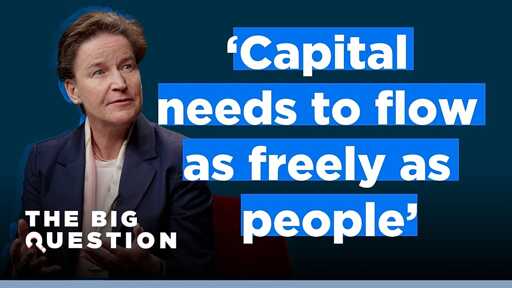
An estimated €37 trillion is sitting largely idle across the European Union. Why aren't Europeans investing more, and what would it take to unlock that capital? #TheBigQuestion
I believe people overestimate the difference between “state pensions” and “capital markets pensions”.
State pensions: People pay taxes and retirees get money from taxes. How much is mostly determined by how well the country’s economy is doing.
Capital markets pensions: People buy shares and retirees get dividends or sell shares. How much is mostly determined by how well the economy is doing.
The differences are more subtle. For example, the capital market is not constrained to the country but one can invest globally. However, the capital market is constrained to the economy of public companies whereas all companies pay taxes. With state pensions, is a little less determined by the economy as a state is more free to redistribute money than fund managers.
There’s other less subtle differreces with the pensions-on-the-capital-markets model in North America. It really is you-manage-your-own-savings model.
That means you decide to contribute something, or nothing. This is a big problem because this money can be extracted by businesses via higher prices and marketing. As prices go up people spend more of their wages to cover expenses with less and less remaining for savings. This is the largest reason for 50% of Canadians and Americans having no pension savings.
The other significant difference is that you decide exactly what to do with those savings, buy a diversified ETF or GameStop, the whole casino is yours. This means everyone has to do the same work of learning, reading, not being wrong, not fall for legal scams of which there are plenty. And if you happen to be unlucky to be of retirement age in 2008, you end up working till you die. I had a colleague while working at one of the big Canadian banks that lost his savings like that so he couldn’t retire. The time and ability to manage retirement investment is not the same between some who works in finance, a grocery store cashier, a brick layer and a dedicated pension fund professional.
This is the reality that most of us live with here. Some lucky bastards have the old school defined benefit pensions that their employer contributes money to and manages (either internally or through a dedicated fund management entity). Those don’t suffer from either of these issues and such pensions are often invested in capital markets and other things. For example the Ontario Teachers Pension Plan. That scheme works fine but most companies that had it got rid of it cause it’s more expensive than dumping all the risk to employees.


I believe people overestimate the difference between “state pensions” and “capital markets pensions”.
The differences are more subtle. For example, the capital market is not constrained to the country but one can invest globally. However, the capital market is constrained to the economy of public companies whereas all companies pay taxes. With state pensions, is a little less determined by the economy as a state is more free to redistribute money than fund managers.
You can’t be saying this shit after the money stolen by the spacex IPO
Indeed. Seems there’s not many who have understood that heist.
If you’re worried about corruption affecting 401ks, you should look at the corruption inside state pension funds.
There’s other less subtle differreces with the pensions-on-the-capital-markets model in North America. It really is you-manage-your-own-savings model.
That means you decide to contribute something, or nothing. This is a big problem because this money can be extracted by businesses via higher prices and marketing. As prices go up people spend more of their wages to cover expenses with less and less remaining for savings. This is the largest reason for 50% of Canadians and Americans having no pension savings.
The other significant difference is that you decide exactly what to do with those savings, buy a diversified ETF or GameStop, the whole casino is yours. This means everyone has to do the same work of learning, reading, not being wrong, not fall for legal scams of which there are plenty. And if you happen to be unlucky to be of retirement age in 2008, you end up working till you die. I had a colleague while working at one of the big Canadian banks that lost his savings like that so he couldn’t retire. The time and ability to manage retirement investment is not the same between some who works in finance, a grocery store cashier, a brick layer and a dedicated pension fund professional.
This is the reality that most of us live with here. Some lucky bastards have the old school defined benefit pensions that their employer contributes money to and manages (either internally or through a dedicated fund management entity). Those don’t suffer from either of these issues and such pensions are often invested in capital markets and other things. For example the Ontario Teachers Pension Plan. That scheme works fine but most companies that had it got rid of it cause it’s more expensive than dumping all the risk to employees.
The billionaires don’t want to pay taxes.