

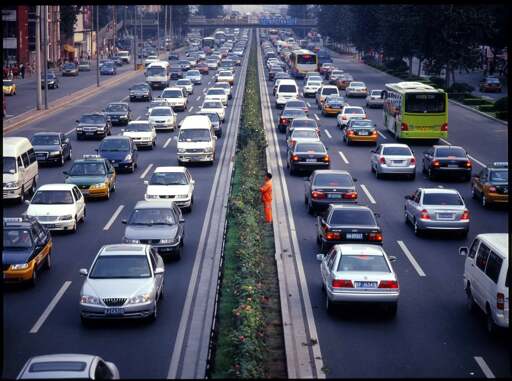
Though progress is often slow, city planners and politicians are gradually waking up to the fact that when cities offer safe and affordable alternatives to cars, we start to travel differently.
More and more young people are choosing bicycles, buses and trains over owning a car out of the sheer cost. In Berlin, it’s public transport, not cars, which is the coolest way of getting around.
In Copenhagen, a city that has a long held reputation for being bike-friendly, a whopping 62% of people choose to cycle their commute.
In the French city of Lyon, the number of cars entering the city has fallen by 20% compared to just a decade ago. As the city’s network of bike hire stations continues to grow, town planners are hoping for a further 20% decline.
In London, where cycle super-highways are becoming popular, the share of journeys made by car has fallen by a quarter since 1990.
Car free days are rising in popularity in many of the world’s largest cities, giving people a taste of what it’s like to live with less noise, traffic and pollution. Bogota was one of the first cities to introduce a car free day, and it’s now become so popular that it’s been extended to a full week.
Bogotá’s Ciclovía is fantastic! I was there in the mid-nineties and they closed a major artery, the Carretera Séptima, on Sundays. Here some pictures.
And plenty of safe and comfortable bike paths - the cheapest, and often fastest option.
And, if you look at the transport capacity of bike paths in persons per hour passing, they are absolutely incredible. Far more than most large multi-lane streets for cars. Cykelslangen in Copenhagen has at rush hour times a vehicle frequency of 2 per second - that’s 7200 vehicles per hour. Cars would need a motorway through the city to reach that capacity.
One of the many more good things about bikes is that they release expensive public transport resource for those which do really need them - people who are too ill, too old, incapacitated, or need to go too far distances to get there by bike. We should think of public transport in cities as an extension and supplement of a bike-centered system, not as the main option.
I would love it if the local light rail had a car to lock your bike up while you ride the train.
Yes. And painting a white line along the side of the road doesn’t cut it.
What the hel… oh. Europe. That makes more sense. I’m not biking a marathon to and from work.
I might not have made many smart decisions in life, but one was to move at biking distance from work, and when changing work places, not to go above that distance.
Depending on the area you live in and income level that can be pretty much impossible. I was driving well over an hour each way to work to get to a $1,400/mo 2br apartment in the Denver metro years ago, and it’s only gotten worse.
Most of the US has dug themselves into a very deep hole.
Most were born in the hole.
It’s not a reason to not fix it, just an acknowledgement of the systematic issue
Yeah. The next 2 years or so are going to likely get very, very bad. Hopefully we can keep it to that.
It’s less about the next two years and more about the multiple dacades old decision to mostly build low density cities. No matter what good transportation can be, it’s not easy when people live so far apart from each other
Get one of those folding bikes, bike to the railway station pop bike on with you, bike from railway station to work at the other end.
I just saw some folding ebikes at Costco, too. If I hadn’t just set up my own bike, and if the trike they offered was not a dorky delta trike…
I think I’m going to go for one of those sick stylish Vespas that can go like 110kph.
If you live a large distance from your work but actually have public transport you can cycle the easily bike the last (and/or first) mile.