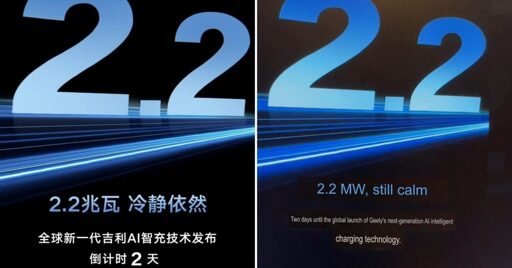
The mention of AI seems superfluous, but seems related to Geely’s charging algorithm. Supposedly this “smart charging” technology will help to manage battery temperatures and longevity. We’ve seen claims that this includes 3,500 charge/discharge cycles “with limited degradation.”
You can do this with rule-based systems. I don’t want a probabilistic engine managing my big expensive battery.
Also, making it seem like AI provides power when it’s literally the opposite… Cringe
The AI here probably is a predetermined set of rules, much like how AI in games is often is just following a predefined set of rules. Maybe some optimization (‘machine learning’) is involved with determining some charging curve or parameters. But I doubt an LLM or other generative model is involved.
I know, I took a mandatory university course on AI basics… Still cringe
JFC…2.2MW in 4 minutes is a massive amount of power to short to ground when things go wrong.
Do they mean MWh?
No, cut out “in 4 minutes” and it makes more sense. 2.2MW shorting to ground.
Depends on what it shorts through. Highly resistant wire then not much, low resistant very thin wire then I think it would just pop like a fuse very quickly. I presume its a fairly normal voltage anyway, or at least not something that can jump a significant distance.
Now if it shorts through you and doesn’t cut out, have fun because it can deliver a massive current and keep going.
A constant 2.2 MW delivers 145 kWh in 4 minutes. Likely less because the battery needs to be charged in constant-voltage mode from some point, limiting its own current, or a temperature regulator kicks in, preventing continuous peak power flow.
Ah.
No, Wh.
No
FYI, it’s the equivalent of 15L of petrol. A lot of energy, but not absurd levels.
Explosions are not slow release of energy
15L of petrol is quite the bomb, but petrol takes time to burn, while a short is nanoseconds.
A short on the charger would be 2.2MW, not the entire battery detonating at once - which is usually more of a rapid ignition than an explosion, or at the very least you don’t get the entire stored energy going off at once. Also even depleted there is a lot of energy from the materials that make up the battery.
2.2MW is a rate, not a quantity of energy. Petrol is about 34MJ/L. 2.2MW is comparable to burning 64mL/second of petrol.
We don’t actually know for sure how much energy, but it’s less than that.
We know that peak power is 2.2 MW and that the overall charging time is 4 minutes, but don’t actually know how much energy that is, because charging power slows down as the battery approaches full charge. We’ll have to wait for the announcement to tell.
Fireworks
I don’t know anything about batteries. Would you need specific compatible batteries to use higher-speed chargers? 2.2MW seems like a lot of juice to shove into a battery if it’s unable to charge that quickly.
It is a lot. The key problem is heat. A properly designed battery can handle those short of values, for a short time. It needs an active cooling system, however. Even then, you wouldn’t want to do it regularly. It will significantly lower the battery lifespan, on EV car batteries.
the big question is why. You can’t fill any car with gas in 4 minutes.
Are you using a straw to fill up your tank? It takes seconds, not minutes, for most cars. Most of the time taken at a petrol station is walking over to pay.
the big question is why.
for most people, zero reasons. I plug mine in when I’m home It’s full when i go to use it and I run a 3kW charger at home.
You can’t fill any car with gas in 4 minutes
its mostly to impress non EV owners, in much of the world that’s an ever shirking %.
4 minutes seems like plenty of time for a gas car, but it seems very fast for a battery.
You can’t fill any car with gas in 4 minutes.
Unless they’re actually presenting a “revolutionary new battery” that can withstand routine five-minute charging, assume they’re cooking batteries for show. China does not have a great reputation for academic honesty.

Once China has fusion down, and starts miniaturizing it. Gosh they’re going to go crazy with it. Who knows, 1 second charge time as a fusion reactor dumps its full output into your mortal car battery.
That’s a limitation of Li-Ion. They’re impissible to charge faster than in minutes without extremely deteriorating. Even then, a massive power distribution and active cooling system is required, greatly increasing the battery’s size and cost for the same capacity. Dumping all the energy into one in 1 second is basically guaranteed to make it explode. The only rechnology that can charge this fast is (super)capacitors, which reach mowhere near the required energy density.
Oops! Double post!
I’m mostly expressing the enthusiasm that comes from the fact that China has a very active research field, and is constantly delivering real world improvements in technology & quality of life improvements.
What kind of range and charge time could a super capacitor car have?
Charging spots along the motorway that you just drive slowly past and boom 5GW charging for 3 seconds from one of the many fusion reactors on the network keeps you going for another 10 miles!
Well, power needs to be delivered to supercapacitors via metal contacts. You’re going to reach physical limits of voltage (safety, isolation distance) or current (conductor cross-section) that can be reached inside the space of a car way before you reach the 100MW mark. Even the 2.2 MW delivery system is not something to drive over, the connector is probably a set of big metal pads that a spring or screw holds together. And not all supercapacitors can charge in a second, it’s usually a trade-off between power capability and energy density. Think 10 Wh/𝑙, about 40x less than Li-Ion, for charging below 10 seconds.
If you’re considering things this far-fetched, just forgo onboard storage for highway trips and build a trolley system.
Well my next idea was going to be a metal grid above the motorway like bumpercars.
deleted by creator
Pairs of wires like for trolleybuses are required. Grids are for free roaming in an area, which almost nobody needs, and only work when the traction surface is conductive, at which point best just build metal-on-metal rails.
deleted by creator