“In ancient Greece, everyone could express their opinion openly and by name – they would raise their hand and share their view. This should inspire us as we shape a new digital democracy,” the minister told Euractiv on the sidelines of the Delphi Economic Forum.
The kind of social media they know about, anyway.
I am not ashamed of anything I say here, but I am never doing it with my full identity accessible to whomever. Basic online hygiene.
I’m sorry, but all of us here on Lemmy have agreed that we need to see your official ID, a 20 second video of you turning your head left and right while blinking, a certificate of your DNA and any other relevant biometric data, a complete list of everyone you’ve ever had sexual relations with, your passwords to all online accounts, and the account number and sort codes of all bank accounts you hold.
If you don’t provide this information within 2 hours we’ll just have to assume you’re a paedophile terrorist and terminate your access to socialising with any other human being online.
Thank you for your attention on this matter.
Disclaimer!
Please do not upload any of this information! If it wasn’t obvious enough this comment is in jest! For the love of
Christburritos do not do what a fellow student at my university did and upload your password onto a publicly visible forum!I’d print this and upload a video of wiping my ass with it, but you could ID me from my asshole print
That was you?!?!
Bumetrics
It’s funny because I watch Kitboga, a famous scambaiter, and he asks scammers to verify some bullshit thing with their webcams, and many agrees.
Even people who clearly shouldn’t divulge their identity are so used to banking identity verification they comply immediately when you ask to see their face…
I think sometimes we forget that citizenship in ancient Greece was reserved for wealthy bloodline males who owned land and slaves, and were able-bodied and politically unproblematic.
Sure, Greek democracy was an important first step, but it was functionally just an expansion of the aristocracy. Let’s not romanticize it overmuch.
I definitely forgot this.
they remember it exactly and found it good, since one saying the thing would be one of the rich people
At least they’re being honest about it and not hiding their intentions like all the other countries, who are doing the same thing but pretending it’s to save the children.
Will be willing to hold the advertisers on social media to the small level of accountability? Any ad should be from an identifiable real world business, and provide enough information that you could directly report them to authorities.
Accountable advertisers? In this economy?
Anonymity can be important though, and for legitimate reasons. Whistleblowing, for example, is much more dangerous if you can’t do so anonymously. Sharing any opinions on politics/international affairs, advocacy, or any other thing that will piss of a certain percentage of the internet exposes your personal details and those of your familial connections and personal associates to risk of IRL backlash. Women who post pictures online will open themselves to employment risks as well as stalkers. Anonymity is a double-edged sword, I know. Advertisers hiding behind fake ad testimonials. Bigots and fascists harassing people and spreading misinformation. Etc. But I still think that over-reaching laws and government control like this will expose people to unnecessary risks which I think is arguably a bigger concern.
I agree with you, I don’t support it at all, I just appreciate they are being honest about it and telling people what their actually voting for
Accountability for thee, not for me.
Precisely. The worst actors on the corporate social media sites are paying for their exposure. They get banned and just pop up new again.
“In ancient Greece, everyone could express their opinion openly and by name – they would raise their hand and share their view. This should inspire us as we shape a new digital democracy,” the minister told Euractiv on the sidelines of the Delphi Economic Forum.
Didn’t they kill Socrates precisely because he expressed himself?
He corrupted the youth! #ThinkOfTheChildren
Socrates and Aristotle have an addendum
“in ancient Greece we would force our philosophers to flee the polis or commit suicide if we disagreed with them”
How will thay do that while keeping privacy intact?
That’s the best part (for them) they won’t
Privacy? What are you, some kind of terrorist?
What are you hiding?! 😡
If you still think this after reading even the title then you’re missing the point. The whole point is that there is no (privacy|anonymity)
Removed by mod
This makes perfect sense since we have a government that does not spy on its people or political opponents, or change laws that can let you verify that they are actually spying on you.
FYI, we have a pretty much mandatory government application that recently applied the google verification api and does not work if it has not been installed from the playstore. The application is of course closed source, has google analytics and can now only be obtained with a google account that basically requires a phone number that cannot be anonymous.
You cannot enter a football match for example without this application. You could use a second phone and take a photo of the QR (screenshots do not work).
In one breath you are saying you trust your government because it doesn’t spy on you but at the same time your government is trusting Google (a corp) and that companies black box technology to not leak any of your information.
No offense but, doubt. There is no way this system can’t be taken advantage of. How is the government protecting that data? Who is responsible as steward of that data? Who do you sue when that data is compromised in a data breach?
Sometimes it’s not about the government using that data against you (although that’s still in the realm of possibilities). Sometimes it’s about bad actors using it against you.
It was sarcastic. It has been proven in court that they spy and they have for a fact, changed the law a few years back. I would not, at any chance trust this corrupt government.
Thank you for giving further information.
I think the first part was sarcastic
There’s a reason we started using a “/s” to denote sarcasm in written speech on the internet.
Dumbass doesn’t know the inherent survivorship bias in history.
Nice logic. Coming for the secret ballot is the obvious next step. I’m sure that is a great way to prevent toxicity at the ballot booth.
Does this really help when ppl are already posting their real photos on social media with nazi supporting posts?
If they’re breaking the law with racist bullshit they can at least get a knock on the door.
Insert identify verification probe.
ΜΗΤΣΟΤΑΚΗ ΑΥΤΟΚΤΟΝΑ!!!
Anonymity is the whole point of knowing that everything said on the internet is bullshit. It’s how you don’t bother giving a flying fuck what anyone says online because you need to figure it out for yourself.
Now people will attach their name and other people will think they have a legitimate platform for their bullshit.
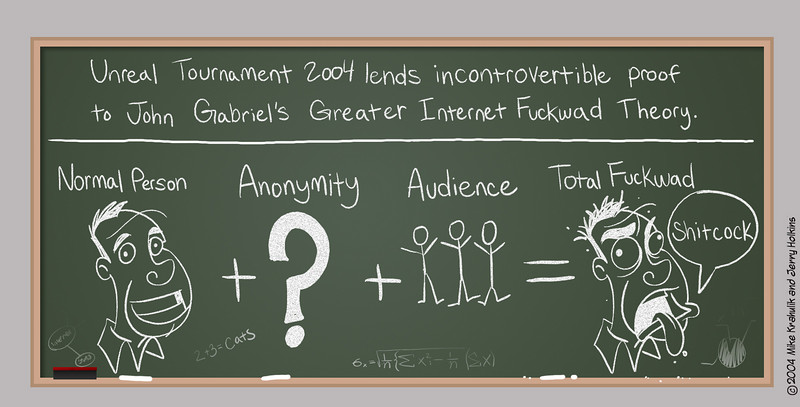
Studies have shown that on the internet pseudonymous interactions are generally more civil than ones using real names.
Something that anyone who’s ever read a Facebook comments section will understand.
deleted by creator
The key phrase in their statement is ‘pseudonymous interactions’, which is what we have right here. We are not anonymous, because we each have a username and we can develop a rapport of sorts based on who we see around in various threads. What you’re thinking of is anonymous interactions, where there’s nothing to associate a post to an individual, which are toxic. The surprising thing seen, is that tying your real name to your post actually leads to less civil interactions than pseudonymous nicknames, with the possibility that people are less civil because they’re effectively playing it up for their social circle. [Source]:
We built a data set of 45 million comments on news articles on the Huffington Post website between January 2013 and February 2015. During this period, the site moved from a regime of easy anonymity to registered pseudonyms and finally to outsourcing their comments to Facebook. This created three distinct phases.
…
We looked initially at the use of swear words and offensive terms – a crude measure of civility. We found that after the first change the use of these words dropped significantly. This was not just because some of the worst offenders left the site. Among those who stayed, language was cleaner after the change than before.
…
Our results suggest that the quality of comments was highest in the middle phase. There was a great improvement after the shift from easy or disposable anonymity to what we call “durable pseudonyms”. But instead of improving further after the shift to the real-name phase, the quality of comments actually got worse – not as bad as in the first phase, but still worse by our measure.
…
What matters, it seems, is not so much whether you are commenting anonymously, but whether you are invested in your persona and accountable for its behaviour in that particular forum. There seems to be value in enabling people to speak on forums without their comments being connected, via their real names, to other contexts. The online comment management company Disqus, in a similar vein, found that comments made under conditions of durable pseudonymity were rated by other users as having the highest quality.
Do you know if moderation was included as a variable? I don’t have the time right now to read, but I’d be curious.
Removed by mod
Removed by mod
deleted by creator
Removed by mod
Removed by mod
Can’t say I’m behind the approach but it might help loosen the stranglehold that social media has on average people’s lives. I’d agree that anonymity enables greater levels of toxicity, but I think a greater problem is credibility. Its almost impossible on the internet today to know who is ‘credible’ and if we solved that problem a lot of the toxic content and misinformation would fall into the ‘not credible’ arena and we could treat like fringe fiction accordingly.
anonymity enables greater levels of toxicity
No. No, it doesn’t. Various fora that have required real names and IDs over the years have proven this—people are quite willing to be extremely toxic even if their real names are attached to every post.
Great; humanity has found a new way to disappoint me today. :(