As someone that uses AI at work because 1. this is a run-out-the-clock situation, and 2. I don’t give a fuck and would like to be at my desk as little as possible, it feels weird and hypocritical to expect no AI in all of the software around me as well.
With that said, if I still had any semblance of passion for writing code, which I do not, anything I worked on for the OSS community would be fully devoid of AI usage. But I’m mentally at a point where I’d rather move to a cabin and use computers less and less with each passing day.
There’s also a huge difference between someone like Linus Torvalds, who understands code better than most people on earth, using AI supervised to increase productivity, and Timmy off the street having chatGPT build something he has no clue how it works or what code even does.
Vibe coding isn’t just using AI. It’s using AI to do things you don’t understand in the first place.
100%. There’s a difference between asking AI to do things that you yourself don’t understand, and using it as a quicker route to something you already know as an engineer. The difference is that the engineer knows when to halt the agent or push back to do something properly. I don’t make AI dabble in languages I don’t already know myself.
There’s also a huge difference between someone like Linus Torvalds, who understands code better than most people on earth, using AI supervised to increase productivity, and Timmy off the street having chatGPT build something he has no clue how it works or what code even does.
disagree. there’s no difference between the car mechanic or the politician pouring oil into the river. They’re both horrendous. sure, one of them might have a reason for doing so, but that reason isn’t a good reason.
Both things are going on at the same time, as Torvalds and Timmy are both paying Sam Altman to pour oil into the river as a byproduct of the service he’s providing. For something as important as the Linux kernel, it wasting fewer CPU cycles as a result of LLM-aided optimisation work might even be net beneficial for the environment once you take into account that it’ll affect billions of computers for years to come. If the end product is shitty, though, there’s no question that it wasn’t worth the environmental damage.
It would have to use trillions of fewer cpu cycles to do that. Currently scientists estimate it at 8 cups of water consumed for every 100 word prompt. What developer do you know that consumes 8 cups of water a day much less every thirty seconds. A developer can sit there and think with their own mind, computer doing nothing, while an LLM consumes thousands of gallons of water and kilowatts of electricity to do the same thing.
It only needs to save a few hundreds of seconds on one computer, or one second on a few hundreds of computers, or a tiny fraction of a second on the number of computers that actually run Linux to save trillions of cycles. A trillion cycles isn’t very many at all. A hundred-word prompt on a frontier model running on GPUs in a datacentre burns much more power than a trillion cycles on a CPU, so for a large Linux kernel patch, trillions is the wrong number by many orders of magnitude. There are also a lot of computers spending a lot of time running Linux, so it kind of balances out. There’s only one Linus Torvalds, and he’s very busy, so it’s likely that if he’d not used an LLM to get this work done, it simply wouldn’t have happened, even if someone had been willing to fund a different human to do it.
Either way, the original point of the post was that LLM-generated code is always shitty (even when it’s not immediately obvious to whoever’s responsible for it that it’s shitty) and so having any amount of it already makes things worse, even ignoring the huge environmental cost. With that context, it is the case that there’s a huge difference between Timmy and Torvalds as Torvalds is famous for having very high standards, so if he’s using it, he might be able to make something that isn’t shitty.
I didn’t realize you were talking about performance in the kernel, which I think will be incredibly hard to measure. That that’s usually the main focus of enterprise investment into Linux, so I very much doubt that an LLM is coming in and making improvements there, but maybe it’s happening. As far as I can tell all the latest things are security scans, which usually will result in worse performance since the goal isn’t speed but safety.
Bookmarking this one for later. Thanks! It’s hard not to feel like my entire field has been cheapened. We spent so long perfecting our craft, only for it to to be completely devalued with speed as the main focus.
The bright side is that AI will never be as good as me when it comes to CSS. I’m still the go-to CSS person at work, despite folks having AI tools at their disposal.
only for it to to be completely devalued with speed as the main focus.
Welcome to the rest of the world. All middle managers and C suite dickheads know is “hurry up and get it done,” they’ve entirely lost the concept of “slow is smooth and smooth is fast.”
The middle manager above my direct supervisor regularly clocks in late every day (and that’s after a 3h time difference no less, and it doesn’t seem he understands timezones either), and then with about 1.5h left in my day suddenly “hey stop what you’re doing and get this 3h of work done by the end of the day, but also no you can’t work OT.” Like “hey dickhead, it’s physically impossible to do that,” but of course instead of telling him, my direct supervisor just pulls that guy’s penis out of his mouth for long enough to say “yes sir” and tell me to break the laws of physics.
I’ve managed to land at a wildly uncommon yet positive company where engineers get to steer a lot of the timelines. We don’t always get what we want, but I feel like we have a better spot at the table than I have at previous jobs where it felt like MBAs and product people set the deadlines in stone before conversations with engineering even started. The only way I’ll leave this job is if they fire me.
It’s valid to feel that way working in software, but try to hold space also for the fact that computing is ‘the means of production’ in the information age, and how it is made and who controls it is inherently political.
I don’t give a fuck and would like to be at my desk as little as possible
I always had this stance and found it weird when people resisted. Your boss’s boss’s boss’s boss is telling you to work half as much? Whether you think that the output is half as good quality or not why the fuck aren’t you JUMPING at the chance to do that.
It’s coming after your job. Why would I want to feed my output into the machine breathing down the back of all our necks? I like what I do. A carpenter isn’t going to be happy working in a factory where chairs are made by robot arms. I’m not gonna be happy working in a slop factory
Your comment was that people should be jumping at the opportunity to use it. I’m telling you why people aren’t. Efficicecy is a different thing. Maybe it might be ore apparent to you if you were to say the same thing about outsourcing to oversees rather than outsourcing to AI.
You literally stated that 8 billion people couldn’t stop the flow of the Mississippi river. Aside from the fact that the Mississippi ebbs and flows from 20 ft wide to a mile wide, 8 billion people take up a lot of mass. 8 billion people could reverse the flow of the river if they wanted.
Whether you think that the output is half as good quality or not why the fuck aren’t you JUMPING at the chance to do that.
Two reasons actually.
Most people want to be productive in some way. Even if you don’t like your job very much, its a much bigger mental burden to sit around and do nothing than it is to actually work.
You employer isn’t going to pay you the same rate for half as much work done. It is that way now cause they have no idea what the actual productivity will end up being, but once the numbers are stable they will save as much money as possible. You will either be lucky and will work just as much as before with more but worse output, or you will be fired.
But the HR lady can use it to make policies that are fucking stupid and my direct boss can use it to create an app to more effectively micromanage us without having to actually do the micromanaging himself so he has free time to blow his boss and cook breakfast for 30min on the clock every day.


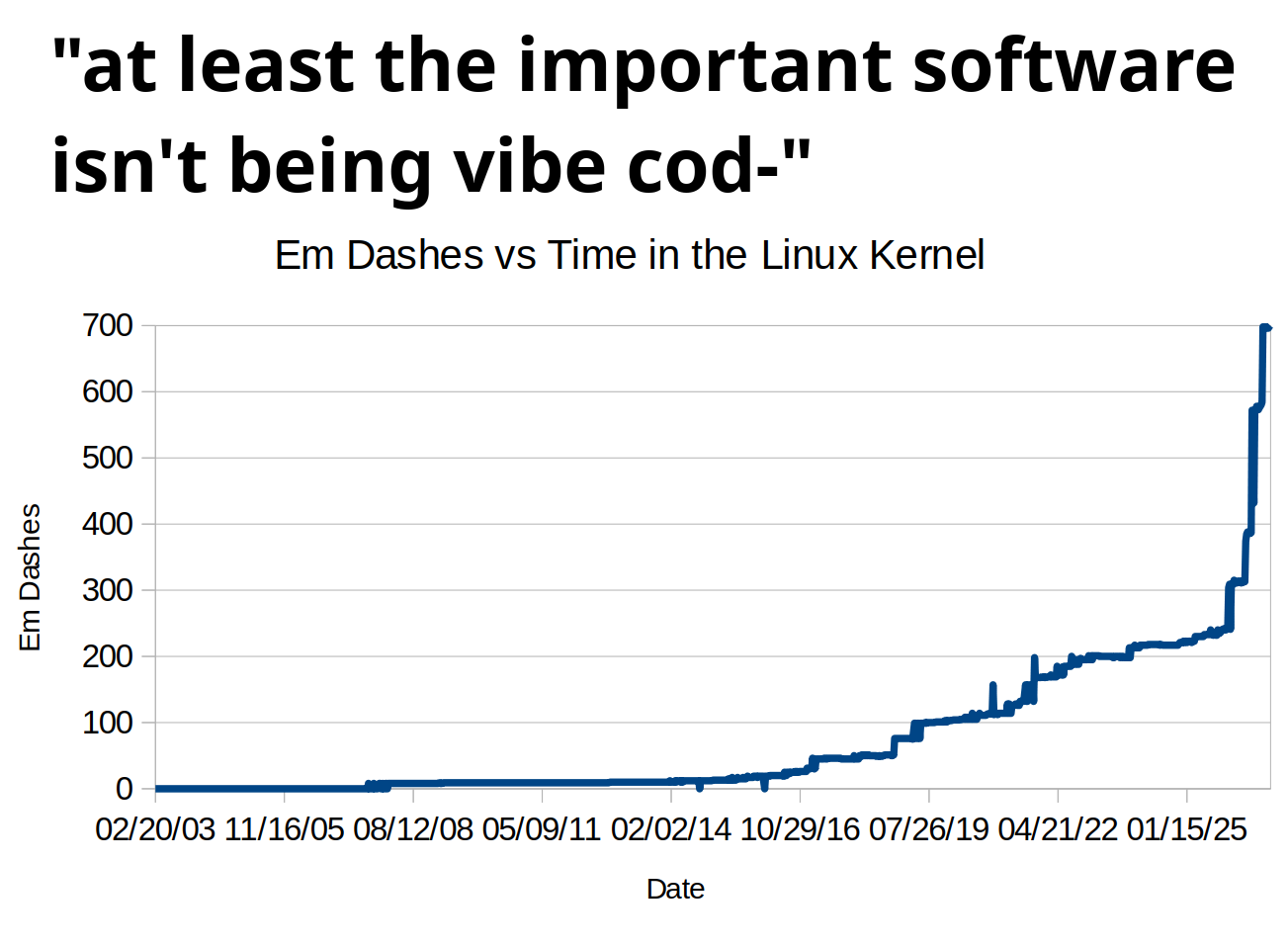
As someone that uses AI at work because 1. this is a run-out-the-clock situation, and 2. I don’t give a fuck and would like to be at my desk as little as possible, it feels weird and hypocritical to expect no AI in all of the software around me as well.
With that said, if I still had any semblance of passion for writing code, which I do not, anything I worked on for the OSS community would be fully devoid of AI usage. But I’m mentally at a point where I’d rather move to a cabin and use computers less and less with each passing day.
There’s also a huge difference between someone like Linus Torvalds, who understands code better than most people on earth, using AI supervised to increase productivity, and Timmy off the street having chatGPT build something he has no clue how it works or what code even does.
Vibe coding isn’t just using AI. It’s using AI to do things you don’t understand in the first place.
there’s a lot of wilful ignorance around that last point
100%. There’s a difference between asking AI to do things that you yourself don’t understand, and using it as a quicker route to something you already know as an engineer. The difference is that the engineer knows when to halt the agent or push back to do something properly. I don’t make AI dabble in languages I don’t already know myself.
disagree. there’s no difference between the car mechanic or the politician pouring oil into the river. They’re both horrendous. sure, one of them might have a reason for doing so, but that reason isn’t a good reason.
Both things are going on at the same time, as Torvalds and Timmy are both paying Sam Altman to pour oil into the river as a byproduct of the service he’s providing. For something as important as the Linux kernel, it wasting fewer CPU cycles as a result of LLM-aided optimisation work might even be net beneficial for the environment once you take into account that it’ll affect billions of computers for years to come. If the end product is shitty, though, there’s no question that it wasn’t worth the environmental damage.
It would have to use trillions of fewer cpu cycles to do that. Currently scientists estimate it at 8 cups of water consumed for every 100 word prompt. What developer do you know that consumes 8 cups of water a day much less every thirty seconds. A developer can sit there and think with their own mind, computer doing nothing, while an LLM consumes thousands of gallons of water and kilowatts of electricity to do the same thing.
It only needs to save a few hundreds of seconds on one computer, or one second on a few hundreds of computers, or a tiny fraction of a second on the number of computers that actually run Linux to save trillions of cycles. A trillion cycles isn’t very many at all. A hundred-word prompt on a frontier model running on GPUs in a datacentre burns much more power than a trillion cycles on a CPU, so for a large Linux kernel patch, trillions is the wrong number by many orders of magnitude. There are also a lot of computers spending a lot of time running Linux, so it kind of balances out. There’s only one Linus Torvalds, and he’s very busy, so it’s likely that if he’d not used an LLM to get this work done, it simply wouldn’t have happened, even if someone had been willing to fund a different human to do it.
Either way, the original point of the post was that LLM-generated code is always shitty (even when it’s not immediately obvious to whoever’s responsible for it that it’s shitty) and so having any amount of it already makes things worse, even ignoring the huge environmental cost. With that context, it is the case that there’s a huge difference between Timmy and Torvalds as Torvalds is famous for having very high standards, so if he’s using it, he might be able to make something that isn’t shitty.
I didn’t realize you were talking about performance in the kernel, which I think will be incredibly hard to measure. That that’s usually the main focus of enterprise investment into Linux, so I very much doubt that an LLM is coming in and making improvements there, but maybe it’s happening. As far as I can tell all the latest things are security scans, which usually will result in worse performance since the goal isn’t speed but safety.
This comment chain is specifically referencing a single LLM-assisted patch that Linus Torvalds posted to the mailing list for review a few days ago that solves a longstanding performance problem that interacts with enough things parts of the kernel that there are only a handful of people in the world qualified to deal with it, and that none of them have had the time to investigate and fix properly until just now. https://www.tomshardware.com/software/linux/linus-torvalds-posts-his-first-llm-assisted-patch-to-the-linux-kernel-after-issuing-clear-pro-ai-directives-the-bossman-makes-use-of-ai-tooling-himself
I felt a lot like that too. I still do, but this helped me a lot:
Don’t take the black pill
Bookmarking this one for later. Thanks! It’s hard not to feel like my entire field has been cheapened. We spent so long perfecting our craft, only for it to to be completely devalued with speed as the main focus.
The bright side is that AI will never be as good as me when it comes to CSS. I’m still the go-to CSS person at work, despite folks having AI tools at their disposal.
Welcome to the rest of the world. All middle managers and C suite dickheads know is “hurry up and get it done,” they’ve entirely lost the concept of “slow is smooth and smooth is fast.”
The middle manager above my direct supervisor regularly clocks in late every day (and that’s after a 3h time difference no less, and it doesn’t seem he understands timezones either), and then with about 1.5h left in my day suddenly “hey stop what you’re doing and get this 3h of work done by the end of the day, but also no you can’t work OT.” Like “hey dickhead, it’s physically impossible to do that,” but of course instead of telling him, my direct supervisor just pulls that guy’s penis out of his mouth for long enough to say “yes sir” and tell me to break the laws of physics.
I’ve managed to land at a wildly uncommon yet positive company where engineers get to steer a lot of the timelines. We don’t always get what we want, but I feel like we have a better spot at the table than I have at previous jobs where it felt like MBAs and product people set the deadlines in stone before conversations with engineering even started. The only way I’ll leave this job is if they fire me.
The process has been backward before LLM.
When we try to get a new customer, they already have a price point for their PCB and a release date that cannot be moved.
Without knowing what the requests they have will entail.
Thank you for linking that talk. I wasn’t expecting something that deep and also funny. I concur with your recommendation wholeheartedly.
No, coding should be done to garner clout, so eventually when I start my shitcoin, I can rugpull more people! /j
It’s valid to feel that way working in software, but try to hold space also for the fact that computing is ‘the means of production’ in the information age, and how it is made and who controls it is inherently political.
I always had this stance and found it weird when people resisted. Your boss’s boss’s boss’s boss is telling you to work half as much? Whether you think that the output is half as good quality or not why the fuck aren’t you JUMPING at the chance to do that.
It’s coming after your job. Why would I want to feed my output into the machine breathing down the back of all our necks? I like what I do. A carpenter isn’t going to be happy working in a factory where chairs are made by robot arms. I’m not gonna be happy working in a slop factory
Standing in the Mississippi won’t dam it
Your comment was that people should be jumping at the opportunity to use it. I’m telling you why people aren’t. Efficicecy is a different thing. Maybe it might be ore apparent to you if you were to say the same thing about outsourcing to oversees rather than outsourcing to AI.
If enough people do it will.
Every person on earth could jump in the mississippi and it would flow anyways.
it most definitely would not. you ever switched the direction of a lazy river? doesn’t take that many people. Your ignorance is showing.
You comparing the mississippi to a lazy river is showing your ignorance lmao
You literally stated that 8 billion people couldn’t stop the flow of the Mississippi river. Aside from the fact that the Mississippi ebbs and flows from 20 ft wide to a mile wide, 8 billion people take up a lot of mass. 8 billion people could reverse the flow of the river if they wanted.
Two reasons actually.
Most people want to be productive in some way. Even if you don’t like your job very much, its a much bigger mental burden to sit around and do nothing than it is to actually work.
You employer isn’t going to pay you the same rate for half as much work done. It is that way now cause they have no idea what the actual productivity will end up being, but once the numbers are stable they will save as much money as possible. You will either be lucky and will work just as much as before with more but worse output, or you will be fired.
I can’t use AI in my job, because I manufacture.
But the HR lady can use it to make policies that are fucking stupid and my direct boss can use it to create an app to more effectively micromanage us without having to actually do the micromanaging himself so he has free time to blow his boss and cook breakfast for 30min on the clock every day.
So yeah I’m not a fan.