

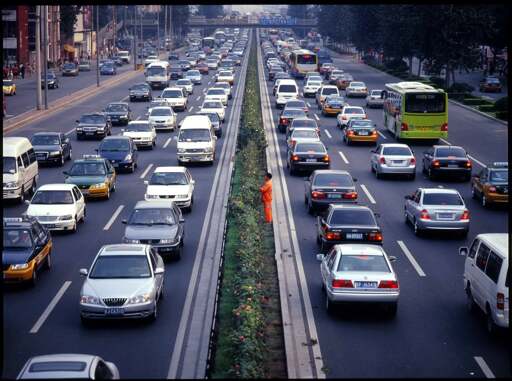
Though progress is often slow, city planners and politicians are gradually waking up to the fact that when cities offer safe and affordable alternatives to cars, we start to travel differently.
More and more young people are choosing bicycles, buses and trains over owning a car out of the sheer cost. In Berlin, it’s public transport, not cars, which is the coolest way of getting around.
In Copenhagen, a city that has a long held reputation for being bike-friendly, a whopping 62% of people choose to cycle their commute.
In the French city of Lyon, the number of cars entering the city has fallen by 20% compared to just a decade ago. As the city’s network of bike hire stations continues to grow, town planners are hoping for a further 20% decline.
In London, where cycle super-highways are becoming popular, the share of journeys made by car has fallen by a quarter since 1990.
Car free days are rising in popularity in many of the world’s largest cities, giving people a taste of what it’s like to live with less noise, traffic and pollution. Bogota was one of the first cities to introduce a car free day, and it’s now become so popular that it’s been extended to a full week.
Bogotá’s Ciclovía is fantastic! I was there in the mid-nineties and they closed a major artery, the Carretera Séptima, on Sundays. Here some pictures.
I hate this sentiment so much, because it implies that everyone can just wait for change: “Just go buy another gas powered car until that rail road line is built”.
If you can afford an electric car (instead of your current gas powered car) today please buy one or you are part of the problem. If you don‘t need it anymore, because of that rail road line, sell it. Electric cars are much better for the climate & the surroundings. They can also be important for electric grid stability.
Additionally since Copenhagen was mentioned: In the last ten years car ownership in Copenhagen actually increased (https://kk.statistikbank.dk/statbank5a/SelectVarVal/saveselections.asp). Just because people take the bike every day doesn‘t mean that they don‘t own a car.
PS: I live in the city center and don‘t own a car. Never have.
I hate this sentiment so much, because it implies that everyone can just wait for change:
Also: “Don’t let perfect be the enemy of good [enough].”
Societal Progress is an exercise in iterative steps. Electric cars today, something even better tomorrow (and by tomorrow I mean in fifty to a hundred years because lord knows people refuse to fund mass transit in some countries).
Did you miss the word “just” in the title?
There is not going to be a one size fits all solution for all countries and regions.
In cities you need public transport and walking/biking facilities. Car infrastructure is too expensive.
In suburbia, getting households to go from dual car to single car, you need public transport and bike facilities.
For rural, public transport is not really cost effective, so you are going to need to incentivise self power generation and home charging. Popularizing from high speed ebikes might be a good option though.
We really have to do something about tires though, their usage is one of if not the biggest sources of micro plastic pollution. Everybody is usually so focused on emissions and social/infrastructure aspects that they miss a lot of the other problems with cars.
I think much like with CFCs, this can be addressed by regulating tires to have longer life and not rely on the materials that generate micro plastics.
I also think cars should come with a 25 year warranty. To force manufacturers to make them to last. Japanese cars from the 90s are doing 30-35 year lifespans when maintained.
For rural, public transport is not really cost effective, so you are going to need to incentivise self power generation and home charging.
So, how do you think does the rest of world’s rural population outside of the US and Europe move?
They don’t move very much. They go as far as they can afford private transport to take them. Hopefully to a town where public transport to other towns are available.
I grew up in a developing country and if people there could afford cars they’d immediately drive away from the rural neighborhood lol. This person you are replying to has never been outside the US/EU so has no idea what they are talking about.
The village I grew up in was essentially walkable because all the dwellings were close to each other where the well was and the electric lines came in. The fields spread out radially from there. There was a van that would drive around to the different villages and take people to the city that circled in and out of the area a few times a week that was paid for by the central government. We also had busses that would take us to school. It would be the perfect spot to build a train station to go in and out of the closest city.
Actually, I am in Africa, so I am very aware of the situation. Outside of cities and Major towns, people are often trapped with little access to transport. They can only afford to travel to local towns, once or twice a month to access services like healthcare and professional services. For goods they usually have to coordinate as a community to get a goods truck to bring them items.
The problem with rural areas is that the tax base is too low to warrant the cost of infrastructure investment. Its cheaper for those people to move to larger towns and cities. In the “old world” they at least have the advantage of dense and walkable towns.
The US as the problem that their small towns are build car centric, and subsidized by taxes from urban tax payers. They will need reabilitate their towns to build over the top of roads and radically rework their power, electricity and sewage infrastructure.
But what about the quarterly profits? We need more each quarter, not less.
We need public transport. Electric cars are like methadon for carbrain, it’s better, but not really.
We need public transport.
And plenty of safe and comfortable bike paths - the cheapest, and often fastest option.
And, if you look at the transport capacity of bike paths in persons per hour passing, they are absolutely incredible. Far more than most large multi-lane streets for cars. Cykelslangen in Copenhagen has at rush hour times a vehicle frequency of 2 per second - that’s 7200 vehicles per hour. Cars would need a motorway through the city to reach that capacity.
One of the many more good things about bikes is that they release expensive public transport resource for those which do really need them - people who are too ill, too old, incapacitated, or need to go too far distances to get there by bike. We should think of public transport in cities as an extension and supplement of a bike-centered system, not as the main option.
Yes. And painting a white line along the side of the road doesn’t cut it.
What the hel… oh. Europe. That makes more sense. I’m not biking a marathon to and from work.
I might not have made many smart decisions in life, but one was to move at biking distance from work, and when changing work places, not to go above that distance.
Depending on the area you live in and income level that can be pretty much impossible. I was driving well over an hour each way to work to get to a $1,400/mo 2br apartment in the Denver metro years ago, and it’s only gotten worse.
Most of the US has dug themselves into a very deep hole.
Yeah. The next 2 years or so are going to likely get very, very bad. Hopefully we can keep it to that.
It’s less about the next two years and more about the multiple dacades old decision to mostly build low density cities. No matter what good transportation can be, it’s not easy when people live so far apart from each other
Get one of those folding bikes, bike to the railway station pop bike on with you, bike from railway station to work at the other end.
I think I’m going to go for one of those sick stylish Vespas that can go like 110kph.
If you live a large distance from your work but actually have public transport you can cycle the easily bike the last (and/or first) mile.
It’s all fine and dandy that they only think about the big cities, but the problem is that the focus on public transport seem to be exclusively focused on big cities while those of us who live in rural areas are starved for public transport options.
I see they pick Copenhsgen among the places to praise public transport. Psh. Cool. I live in Jutland and my household was literally forced to buy a car after they cut the public transport budget in our city - again - and as a result, my boyfriend was forced to get up at 3 in the morning to be at work at 8. So, we bought a car because it was literally killing him and the limited time we had as a couple already, was pretty much eradicated.
Getting a car not only did wonders for his health, it also gave us our relationship a much needed boost because now he had the energy to actually be awake and do things with me, when he got home from work.
There are zero signs that public transport is a priority where we live and we aren’t going back now. We did everything to depend on public transport and save the expense of having a car until we were in our 30s and the only reason we ended up buckling was because public transport was cut from our area. It wasn’t only his bus route that was fucked with, btw. When I wanted to go see friends and family, the busses I used to take had been cut too and I suddenly had to take three trains and two busses to go see people who lived two to three hours away by car took me something around 6 hours to go on a 2 hours ride anywhere. One time they flat out canceled my bus home and I was stuck on a train station in Aarhus at midnight Nad would have to wait until 4 in the morning to get home. My boyfriend came and picked me up in the car and told me that from now on he’d drive me when I went because the last few trips I had taken had been disasters and this one had been the worst one yet. I had left for home, btw, at around 5 in the afternoon and wasn’t home until 2 in the morning. That trio would have taken me 3 hours by car. Public transport forced me to be on the go for 9 hours and that is only because my boyfriend picked me up. If he hadn’t done that, it would have been 13 hours.
That is unacceptable. And from what I have been told recently, public transport has only gotten worse in Denmark since. But I’m so happy for people in Copenhagen that they get to have busses, trains and metro that arrive every two minutes and take them anywhere they need to go. Must be nice.
while those of us who live in rural areas are starved for public transport options.
Those could elect politicans who improve their situation. Otherwise, it just looks like people have chosen a non-sustainable way of life, do nothing to improve that, but moan when they are bitten by consequences. I even know about a community outside of Munich where people oppose to set up bus connection (apparently they fear that poorer people move there).
And of course, poor people should receive help - but come on, not everyone who moved to a large house in the middle of nowhere is poor.
Apart from that, by far most the population lives in cities, suburbia, and metropolitan areas. Here is where improvements help in the quickest way, and often are most efficient.
You really like putting the onus on people who are held captive by systems they have very little control over.
I thought the US is a free and democratic country? What happened?
Haha…
Running buses in rural areas just doesn’t make economic sense. There are just too few people, buses are running empty most of the time, buses are rare and bus stops are far away. Also, in those rural areas many people don’t have supermarkets within walking distance. Did you ever try to bring an entire shopping cart full of groceries home by bus? Because that’s how much a family can consume in a week.
Running buses in rural areas just doesn’t make economic sense. There are just too few people, buses are running empty most of the time, buses are rare and bus stops are far away. Also, in those rural areas many people don’t have supermarkets within walking distance.
You are describing the status quo, not the changed system we need. The superb systems of Amsterdam, Copenhagen, Berlin, Vienna, Paris did not appear overnight out of the blue sky. They are result of political decisions, planning, and sustained, persistent efforts.
By the way, the US had in the 1920ies to 1940ies a traffic system based on dense street car, bus, and train connections. Germany in the 1950ies. People had far less money then. It is certainly not uneconomical.
Did you ever try to bring an entire shopping cart full of groceries home by bus? Because that’s how much a family can consume in a week.
Funny that you ask, last week I went to the beverages market with my bike trailer and because it was hot, I asked my older neighbor whether I should get something for him, too.
I returned with four beer boxes of about 15 kilogram each, which is about 60 kilograms, a full load of the trailer.
If you are in Europe, I can’t recommend the company “hinterher” enough which produces these trailers: Their web site is at https://hinterher.com/ . They are light, extremely sturdy, almost over-engineered, and fully foldable. Not cheap but worth every cent.
I returned with four beer boxes of about 15 kilogram each, which is about 60 kilograms, a full load of the trailer.
Did you try riding uphill with that much load? In hilly places with steep inclines, a bicycle is almost useless, because it is easier to walk uphill than to ride.
Hehe, I lived in Edinburgh which has a couple pretty impressive slopes. My favorite was Princess street down to Dundas street, snd up the Blackford Hill. It is really nice to have a hub gear and hydraulic disk brakes there.
If I did that kind of shopping there, I’d use an eBike.
And no, most larger German cities and their surroundings are pretty flat, because the are situated at large rivers, such as Berlin, Hamburg, Munich, Hannover, Cologne, Frankfurt, Leipzig, Dresden, Bremen, and so on. Stuttgart being an exception.
Amsterdam, Copenhagen, Berlin, Vienna and Paris are large cities. If you try to run as many buses in a rural area, they will be empty most of the time. If you try to have as many supermarkets as in a large city, they will be empty too.
Also, all of those cities have a mild climate. In a harsh climate, even walking to a bus stop is untenable for some people.
If you try to run as many buses in a rural area, they will be empty most of the time.
Only in a dominantly car-based system.
Many poorer countries cannot even afford such a car-based system. The use a system based on public transport which already shows that it is more economical.
That’s also a macro-economic argument against cars: They cost a lot of resources and money which is not well spent. Ultimately, money for gas ends up for drilling holes into the ground. For EVs, it is not much better. While a transport system based on bikes and public transport leaves far more money in the local economy.
Because rural areas have smaller population density, there are fewer passengers. In such places, there are usually fewer routes, bigger interval between buses, no service during nights and/or weekends. If you need to go somewhere where there is no direct bus line, you may need to take a long detour. Running buses where there are few passengers is uneconomical: an empty bus uses more fuel than a full car. Bicycles can help, but not everyone is fit enough to ride long distance. Also people don’t want to ride bicycles during rain, snow or heat. In such places, most people have cars. At least there is no shortage of parking space.
If you live in a country then you are evil and problematic. You should move into the city like a civilized progressive person. That’s how humans have been living for thousands of years, it’s a natural habitat for humanity.
If you live in a country then you are evil and problematic.
What you are confusing a bit is the traditional human life style of living in the countryside on a farm, growing one’s own food, and being self-sufficient, with the “American Way of Life” with living in Suburbia, working in an office in the city, daily commuting huge distances with use of fossil fuels, and burdening the rest of humanity with the fallout from that. The latter is just plain unsustainable. And exactly these people want subsidies to sustain it - at the cost of all others.
In Copenhagen, a city that has a long held reputation for being bike-friendly, a whopping 62% of people choose to cycle their commute.
I did that too when I lived in Copenhagen. And it’s also the fastest way to get around.
But now I live in the countryside, and here we absolutely need cars, but everyone on my road drive electric, and half of us have solar panels. So in that way I don’t think our environmental footprint is worse than living in an apartment in the city. Because we to a large degree are energy self sustained.The problems of car dependency go beyond carbon, though - it’s also about road danger, space demand, micro plastics, the exclusion from society of people who can’t afford cars, the exclusion of disabled people, etc etc. Changing the engine doesn’t address these and we need to work towards reducing reliance on this form of transport
IMO the best way to get rid of cars (in your own life) is to not live on the countryside.
Not everyone can afford a place in a large city.
They could if they weren’t paying for a car note, excise tax, parking, gasoline, repairs, and maintenance…
Likely have a shorter commute to work (since no traffic), too, and thus a better work/life balance.
But…you likely lose out on recreational perks of suburban and rural life, like gardening, since you have very limited space for it. On the flipside, though, there are usually more recreational options and “third places” readily available.
The cost of having a car is much less than the cost of renting an apartment in a large city. And you usually don’t need to pay for parking in rural areas, everyone has a driveway or a garage, and many places have free parking.
The barrier to entry is prohibitive. So many people are living paycheck to paycheck, a down payment on a home within walking/cycling distance of their workplace is a pipedream.
Even if they could, with how large cities are, it’s unlikely it’ll be close to where they work.
The solution is always mass transit: even a simple bus, as long as it’s comfortable, reasonably fast and timely will do wonders. Trains and subway, even better.
Mass transit doesn’t solve the problem of high rent prices, unfortunately.
Not to disagree, but better only have those problems and not have those problems and fossil fuel emissions. Working towards that goal is much more sensible in the places with high density populations.
That too DEI! But seriously, that Ciclovia looks really nice.
That’s an easy thing to say when you’re young and healthy.
You will think differently why you are 70, arthritic and facing chemo.
That’s an easy thing to say when you’re young and healthy.
You will think differently why you are 70, arthritic and facing chemo.
I am 59, have asthma, and cycle one hour to work. And cycling conserves and improves my health.
And: People in their 70 need public transport far more than others. Many of them cannot drive a car safely anymore (examples here). There are many tragic and unnecessary accidents because of that.
Bullshit! Give it another 20 years, you will think differently.
You think you’re hot shit now , but death comes to us all, and the ending is always more ugly than your bloated ego thinks it will be.
No arguments left, now resorting to trolling?
BTW I won’t drive a car in 20 years because I arranged my life pretty nicely to do without in the last 40 years. I never had a car.
He’s being a dick about it… but he does have a point. Some people really do need a door-to-door solution. Cars are simply the most feasible means to that end. Even the bus stops outside of the hospital grounds and the entrance can be a few hundred meters away. And that can be like a marathon for some of the sick, frail and elderly.
That doesn’t mean that everyone should own a car. A ride-share system or self-driving taxi service could provide for people in need. But banning cars and roads entirely is just not going to work, especially not in the USA, without any public transport to speak of. I wish we could and it is a nice dream, but not a feasible one.
Even the bus stops outside of the hospital grounds and the entrance can be a few hundred meters away.
Terrible design.
Perhaps, but that’s the way it is. Hospitals are so big they often have multiple entrances too.
They can rather easily put a rack of wheelchairs next to the bus stop. I know because that’s what they did in California. I routinely push elderly men and women to their destination when I arrive for my appointments, because they are trying to get there by themselves, and the bike racks that I’m using are like 10-15 feet from the wheelchair racks.
Some people really do need a door-to-door solution.
Well, a bike is a door-to-door solution, isn’t it?
I am not saying one size fits all. Some people do need an ambulance, or a van. But it should not be considered the norm.
As you can see, I do not favour banning all cars. But restricting unnecessary ones. And making cycleways so safe and convenient that they are preferred by healthy people,
I wouldn’t mind a lack of a door-to-door solution if there was a safe, reliable, means of traveling the first/last mile. Something sheltered from the elements, that could be safely driven in places that actually experience seasons. Probably something communal (think like the bikes or the scooters that you can pick up and rent anywhere), but more like a small golf cart or a covered ATV/trike.
Not everyone can bike everywhere. And many people that (physically) could, are dissuaded from it, because of road conditions, distance, climate, or having to share said road with blind idiots in cars.
Hell, I have a sweat gland condition…if I stand still in the sun for 10 minutes on an 80 degree day then take of my shirt, it’ll make a “thump” when it hits the ground. Going out for a casual stoll in the summertime, itself, is embarrassing. No way in hell am I going to be walking in the office after biking even a mile to the bus stop (but my nearest bus stop is actually 5 miles).
I went in one day, and the A/C on the train was broken. I spent my first half of the day working from a crashcart in the cold aisle of the datacenter…not because I needed to be there, but because I needed to be isolated from people and frozen to the bone.
Not everyone can bike everywhere. And many people that (physically) could, are dissuaded from it, because of road conditions, distance, climate, or having to share said road with blind idiots in cars.
This, exactly, is the point we have to change. For example by building safe cycleways and reducing speed limits in all shared streets to 30km/h (20 mph).
P.S.
Regarding seasons, elements, Winter and so on: Did you hear of Oulu, Finland? It is close to the polar circle, and people cycle there in Winter.
And… Did you hear of the Netherlands? People cycle there a lot. And it is normally a rainy and windy country.
If you think people who can’t walk a few hundred meters can bike to the hospital I’ve got news for you…
Second, as a fellow cyclist you also don’t want those people on the road. They are a danger to themselves and others.
For the most part, I think we agree. But dismissing other people’s needs for a car just because you don’t need one is not going to help either.
If you think people who can’t walk a few hundred meters can bike to the hospital I’ve got news for you…
Jesus Christ, people who are too ill to walk should take a taxi or call an ambulance. I am not saying they should use a bike. But they should certainly not drive a car.
The same for people who are very frail, cannot see well, may have dementia, or severe circulatory problems. They should not drive a car.. Period.
If you are from the US, the idea might be alien to you, but we have public health insurance here, and if you need to go to hospital in an ambulance, this is covered by insurance. If you need a cab, you can get a coupon from your doctor. That might sound alien for you, but it is just a decent, halfways humane system.
And exactly for the people which are ill and frail, we need better public transport with good coverage. There are far too many accidents from the elderly, from people which are objectively unable to drive safely. This has to change.
And as soon we have satisfying public transport for these people, a whole lot more excuses fall apart why one needs to own a car.
I am not saying that nobody should have a car, or that today it isn’t the least worst option for many people. But owning and needing to use a car should be the exception - not the norm. It is not sustainable. We cannot live on like that. Look at the weather - wildfires, drought, floods. Do you think we can continue like that for 20 more years?
Just for the record, no I’m not trolling, I’m just angry. And I should probably just walk away, but what the fuck.
I run across arrogant self centered pricks like you all the time. The ones who say “Hey, my life is just fine. I’m doing great. And I’m just to much of a narcissist to imagine people who may be worse off than me”
You think that just because you are healthy and active at 59 you are going to stay that way? Well you’re wrong. That’s not how aging works.
Will the biking help, oh hell yes. I ride an ebike and it’s great.
But that doesn’t stop your body from breaking down it just delays the inevitable.
And as for public transportation, yes, it great, unless you broke a hip in a fall, or have to use it to get to your chemo appointment, or are immune compromised, or anemic or… Do I really have to list all the medical conditions that make it inappropriate.
And no, taxi’s and ambulances are not a substitute, or even available or affordable.
My friend was on chemo last year, ran to the grocery store late one night, didn’t wear a mask. Was dead within two weeks, caught three different viruses at the same time. Covid, the flu and I can’t remember the third one. It was fucking horrific.
And no, going into a nursing home or assisted living isn’t a good option. Because every time some arrogant young asshole walks through the front door with the sniffles, everyone in there dies. During covid they just become charnel houses. My cousin is a mortician and we talked about it. The morticians couldn’t keep up with all the bodies.
My dad was in one the last year of covid because of a stroke, he died of covid.
You all have decided how everyone else should face death, and that just makes you self centered pricks without an ounce of empathy.
You lack imagination and you just don’t care about anyone but yourself.
And yes I do live in the USA. And yes our healthcare really sucks. And the nearest hospital is 20 miles away. And even if there was public transportation I wouldn’t take it, because I am also immune compromised.
Will this and my other posts get downvoted into oblivion? Oh hell yes.
But the down arrow doesn’t make you right. It just means you lack the experience and imagination to understand. You haven’t had to face the tough choices of end of life issue. But you will. And at that point, some arrogant prick will tell you to just take the bus.
Your down votes don’t make me wrong. They just make you clueless.
You can have your eco chamber back now.
I am sorry for your losses.
And no, declaring car transport as the “normal” mode of transportation and the completely unsustainable “American Way of Life” is not going to compensate for the lack of a working and accessible health care system.
Last not least because lack of any physical exercise, which is often a consequence of car dependency, causes a lot of health problems on its own.
And, European societies have stronger sense of solidarity. We just do not consider it a right to have a car for everyone.
You’re underestimating the size of the USA. We are about twice the size of Europe and less than half the population density. Most rural populations, the ones growing the food, are geographically isolated.
The whole world is not the same as Europe. Your solutions are not everyone’s. Would i like a betters solution than cars, sure. Walkable communities would be great. But you cant just snap your fingers and assume an entire society is just going to change because you hate cars.
You may hate cars and call us fat, but you are not looking at our reality. I’d say come visit and experience the vast distances, but now is not a good time, there is a crazy nazis in charge.
You’re underestimating the size of the USA. We are about twice the size of Europe and less than half the population density. Most rural populations, the ones growing the food, are geographically isolated.
This is similar for South America, Australia, or Asia: Most of the population is close to the coastal regions.
Yet these continents are not as dependent on cars.
The truth is, US Americans follow an unsustainable life style.
Exactly. Cars and the like should only be seen as something for the frail and elderly.
No, the frail and elderly should not drive. They would pose a risk to everyone else and themselves. What the frail and elderly need is public transport. A fast and safe way to get to places, without having to drive.
Public transport is also more accessible for the elderly and the disabled, if correctly designed. The fact that cars are better for those people is a myth that makes no sense when you think about it.
“Though progress is often slow, city planners and politicians are gradually waking up to the fact that when cities offer safe and affordable alternatives to cars, we start to travel differently.”
How do I even take this sentence seriously. Like what the fuck did they think we were supposed to do? Band together as citizens and build bike paths or metro infrastructure? You gave us limited options for transport and then was surprised it was your job to provide the alternatives?? Either that sentence is a complete lie or they are truly walking around with a completely empty head.
Everything starts somewhere. The Netherlands were a car country through and through. That was until more and more people rejected it and they slowly built the infrastructure for bicycles, trains and walkable city centers over several decades they are famous for today.
Our biggest problem in the fight for cleaner, safer and overall better infrastructure are the car and oil lobbies for sure. They learned their lessons from the Netherlands too and fight every cycling lane with tooth and nail. But they can‘t fight progress when the cost of everything is becoming too high. People demand more efficiency than cars, be they electric or not, can offer.
Exactly right, but things were very different in the age that the Netherlands fought against car supremacy. The direct action that citizens took part in would end up in draconian punishment, nowadays. That’s if you could even get people to universally agree on the form of protest, the target of the protest, the demands of the protest, the shape of the planet, etc etc.
Sadder still, if the price of everything gets hiked, then an artificial concession is made (like marginally cheaper running costs), people seem to leap on that solution as a less bad option, and forget about the root cause all too quickly.
My problem with this at the core is that they are blatantly lying to everyone. There is no way none of them realized the solution to less cars was to provide people with alternative transport. There is a zero percent chance of that. And the fact that they would lie and say they are just realizing it is what pisses me off. Everyone knows oil lords control the world, everyone knows renewable energy, electric vehicles, public infrastructure etc. has been hindered because of them. They are treating the public like toddlers who can’t differentiate between truth and absolute bollocks.
renewable energy took a long time to take off because the cost of it had to fall low enough first, which can only happen through substantial subsidies, which only germany and china were willing to do. germany cancelled the project sometime around 2012 while china pulled all the way through.
You should look into how oil industry lobbying has affected green energy since the 60s
If you live in a democracy, you were supposed to support candidates that make better choices. If no such candidate exists, you’re supposed to make them. Instead you assumed that something supposed to happen to you without your input. Well, something did, why are you surprised it’s not catered to your interests
I’m sure some people would be surprised that people would choose not to use a car assuming rather that the perceived convenience of it would trump everything else
deleted by creator
(The, now deleted, argument was that Greenpeace is supposedly not credible becaused they supported the anti-nuclear movement. Which, according to them, hampered climate protection)
It is right that nuclear plants emit less CO2 per unit of energy than coal plants. That does not mean that it is right to put any money in that, because for the money which would be needed to produce 1 GWh of nuclear power, many times of that amount could be produced by much cheaper renewable power - and in far less construction time.
Ultimately, it is not relevant if for a first, 1% or 3% of backup energy is generated by gas plants, and 97% to 99% by cheap renewables. Again, reducing CO2 emissions at the scale we need is a quantitative-economical problem, and if for the money that would be needed to get electricity production 100% clean right now, we could, say, improve insulation of 30% of our countries houses, and install heat pumps there, more would be achieved in shorter time.
And a third thing - it is often represented as if the goal of nuclear power was to replace coal and gas plants. That was never the case. Suggesting this is misinformation. The idea was always to have a cheap baseline source from the nuke plants which would cover the minimum of each day - perhaps 10% of the daily maximum - and cover the rest mostly by also cheap coal and gas power plants. That was the goal of the electricity companies which operated both coal and nuclear plants. Producing peak load from nuke plants would not have been economical, and was never the goal. (And the only exceptions are countries like France, which build their nuclear fleet for the sake of producing own nuclear arms - at whatever price.)
The whole discussion about nuclear power by the ecological movement since the 1970ies was to provide a clean and safe alternative to nuclear plants.
Do you see what this logo shows in its center? It was designed in 1975:

That was the goal of the environmental and the anti-nuclear movement and the greens. I am honoured to have been able to work and contribute a tiny little bit to that goal - together with many, many brilliant scientists, engineers, inventors, enrepreneurs, and crazy people. We did succeed to made it possible.
By about 2000, we had Megawatt wind power plants and the technical base for that was ready.
Mankind is holding the keys to our future in their hands. Don’t throw them away, the alternative is planetary hell.
Everything in the 25 years since was foot-dragging by conservative politicians, fossil lobbism, and often fossil corruption.
P.S. I see that often that somebody posts some at least misinformed, perhaps misleading argument - and when a good counter-argument is posted, the first argument is deleted. This lets me think in astroturfing.
Another pattern that I am seeing now that when I post something around the topic of sustaiability / fossil fuels etc., I get plenty of highly critical comments around posts that I make around other, completely different topics (say, Linux window managers). Most of these critical comments have no logical substance - what they aim at is to discredit and leave a bad atmosphere and mood.


