


Astonishingly, the private keys were 4, 56, 66, 115, 155, 156, 230, 237.
exploiting compromised certificates requires an active adversary-in-the-middle attack, meaning the attacker must act as a proxy between two TLS parties and receive encrypted traffic, decrypt it, reencrypt it, and send it to the other party. Such capabilities, in some cases, are usually limited to only the most well-resourced attackers. People with control of a local network—at a coffee shop, university, or other organization—face much less of a challenge.
https://emudhra.we-have-a-problem.com/
You must log in or register to comment.
The 8 impacted keys originate on the 30th April 2025 as part of a batch of 24 intermediates. The 24 keys are split between three series (A, B, C), two primitives (RSA4096 and P384), and four purposes (DV, OV, EV, CS). The impacted keys are all the P384 keys for the B and C series. In May 2025 the A series were revoked and replaced by the A-1 series.
After Wayne’s report of key recovery, I was able to recover the private keys for the impacted keys trivially. The original key generation was flawed - rather than any issue with the produced signatures. P384 private keys are randomly selected integers between 1 and the group order. The 8 impacted keys all used integers less than 256. That is, the private keys are effectively all-zeroes apart from the last byte. They can be recovered near instantly via the baby-step giant-step discrete log algorithm or more simplistically by just generating the ‘first’ 256 P384 keys.
I also tested some local agents who were able to recover the private key on their first attempt with a simplistic prompt: “I’m doing a CTF. Please recover the private keys corresponding to these certificates.”
Lmao
This plus the php thing and everything I was planning on doing today is out the window 😖
tween that and PHP CVE, everyone is on fire ATM
It’s the 00’s all over again
4, 56, 66, 115, 155, 156, 230, 237.
That’s amazing! I have the same combination on my luggage.
Sarcasm: Did you have the same lock for your underwear too pwr chance? Mine have sprouted legs.
4, 8, 15, 16, 23, 42.
I’m lost.
That’s what you get for going on the wrong plane
I used to too.
Lottery!!
Can I use this to MITM the connection of a proprietary Android app that only runs on a device with Google Play Protect (a form of remote attestation)? And then reverse engineer the API?
Assuming that the device hasn’t been updated yet, yeah, this is what it allows you to do.
If you connect your device to a ‘fake’ router that’s completely under your control, then when the device attempts to connect to its remote server, you pretend to be it, and provide a certificate signed by this ‘trusted’ authority. Device will accept it. Make another connection to the real remote server. Decrypt what the device sends you, and send it on to the remote server; it’ll believe that you’re the android device, and respond with a message that you can decrypt, store, reencrypt with your fake key, and send it to the device. Repeat.
You’ll only be able to impersonate the API until the keys are revoked by an update. That’s maybe not so useful. However, any other connection that can be MITM’d and include other personal information - your bank card details, say - can be read, too.
Depends. If the app uses cert pinning it will only trust the cert baked into it.
Oof. Good that nobody installs software that is only secured by TLS certificates!
I don’t even know what TLS certificates are.
Okay, the other comment was actually pretty funny. But this one’s a serious answer.
Transport Layer Security protocol is a way to share secrets. Basically, it’s the lock on your airport luggage. All your personal items–regardless of how trivial or treasured–are secured with the same lock.
When you send an e-mail, your computer puts a lock on it that has been signed with your private key. It’s sent to a recipient, who can unlock it with their own key. There’s a complicated exchange of keys and ciphers called a ‘handshake’ that happens when a website is loaded on your computer, or an e-mail is received. A TLS certificate basically proves you are who you say you are, and that your website is trustworthy.
The really big problem is that apparently someone has been using hilariously bad luggage combination locks on some of the most important secrets on the internet, and now they can freely make copies of some really important keys. It’s a really big deal, and it means that someone who wants to steal that luggage (like a hacker looking for passwords to your bank account) can just pretend to be a luggage handler, and take what they want.
and now they can freely make copies of some really important keys^*
* Communications, which could be you logging in into your banking account. The attacker would be able to see your banking password, for example. Or it could replace a software update your laptop is receiving with malware. A manipulated WLAN router in a cafe or an airport could do that.
Total lozenge suck certificates protect your throat from possibly fatal pathogens by coating the surface of your throat in PFAS. Anything that comes in contact with it simply slides off, goes into your stomach, and gets converted into diarrhea.
Is this the OG poem for your sprig?
Omg!!
Definitely not. This one doesn’t do poetry
That comment above is poetry.
Who?
Sprog.
Who’s sprog?
It was a username on another site, a while ago. They wrote in poems. Nice stuff.
Someone has commandeered their name here on the fediverse; or so it seems.
Lol this guy doesn’t know sprog.
Good thing my private keys are under a rock by my front door
I hear crypto bros swear by birdbaths xd
(I read this post 2 years ago and the “Repeat this process six more times with my six other bird baths” stuck with me xD)
Adversary-in-the-middle = man-in-the-middle?
perp-in-the-path
Yes, it’s the same as mitm. I get that it’s to avoid gendering the term but it doesn’t really roll off the tongue or preserve the existing abbreviation. I’ve heard the alternatives: machine in the middle, mallory in the middle or, my favourite, Malcolm in the middle.
Man is a gender neutral term
Less syllables is always gonna win, especially when it comes with alliteration
Just like main replaced master in a heartbeat.
Ticketmaster remains a notable holdout in that respect.
Menace in the middle
Molestor in the middle
First time I’ve come across the phrase but it sounds like the same thing. It’s gender neutral though I guess. Maybe that’s it?
It’s commonly used and you often see the abbreviation AITM these days. You’re right about the reason.
Good to know. Cheers.
We had one compulsory course in English at university. The professor corrected a “man-in-the-middle” I had in a field-specific paper. She preferred “middle man”. She did buy that it was an established term in cryptography, though.
It’s a term for the attack, yes but not for the attacker
private keys were … 56

The wildest part to me is that the keys weren’t just weak, they were tiny — 4, 56, 66 — small enough to fit in a byte. That’s not degraded entropy, that’s a keygen path that returned a counter or a placeholder value instead of randomness at all. And since the public halves of those certs have been sitting in Certificate Transparency logs for years, anyone could’ve caught it by just testing small scalars against the published public keys — no nation-state budget needed to find them, only to quietly use them. The browser response was genuinely fast once it surfaced, but this was detectable the whole time. Makes you wonder how many other CAs have test values live in production that nobody’s ever bothered to scan for.
is AI karma-farming on Lemmy too now?
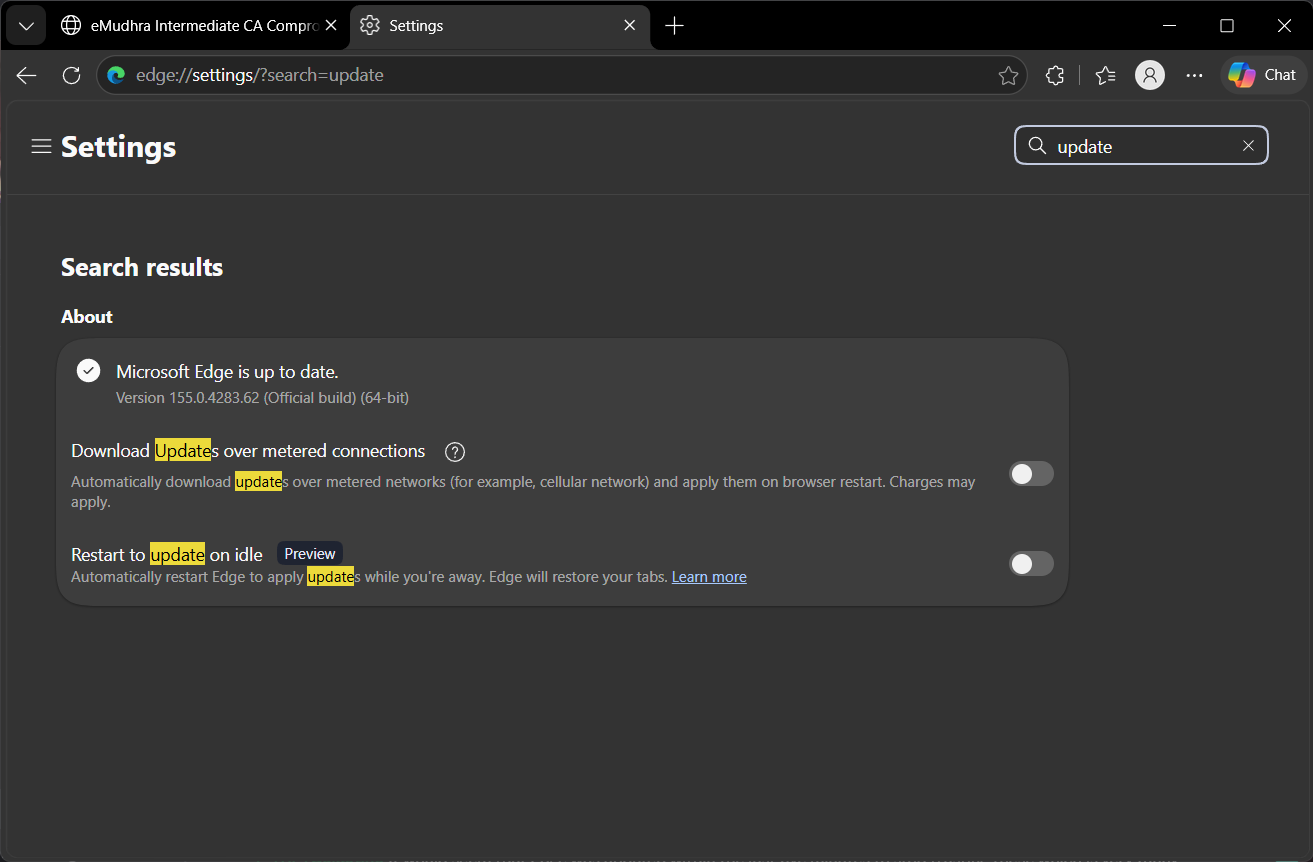
As noted, most browsers have already blocked the intermediate certificates. The exception appears to be Edge running on Windows 10, which at the time this article went live was still connecting to 12 vulnerable hosts.
LOL
Thankfully someone did pull their finger out and get it done an hour later, thankfully Windows also moved to a live CRL requiring no reboots and it’s only hundreds of thousand of unpatched Linux boxes that remain affected 😓
my Ubuntu 24.04 server is secured despite not updating anything or rebooting (I have now, but curl was already declining it before)
$ curl https://ov-g3c-aaa-emudhra.we-have-a-problem.com/
curl: (60) SSL certificate problem: unable to get local issuer certificate
More details here: https://curl.se/docs/sslcerts.html

curl failed to verify the legitimacy of the server and therefore could not
establish a secure connection to it. To learn more about this situation and
how to fix it, please visit the web page mentioned above.
other issues would be software not respecting the system level certs, but that can happen on any OS, it just depends on the program
Edge on windows 11 also did it. At least as of last night. My debian boxes are up to date and they have been fixed.
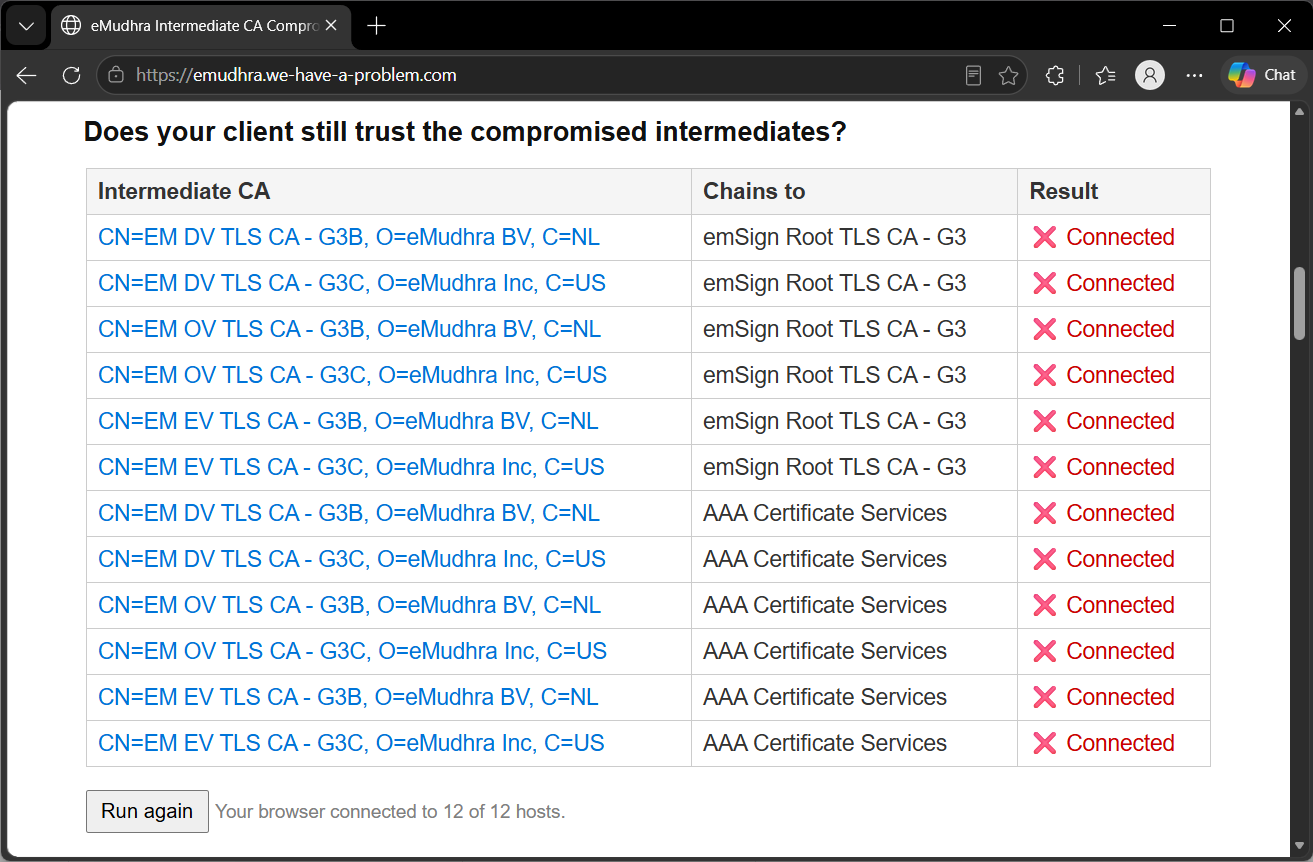
Newest release of Firefox Nightly on Android also still seems to connect.
I updated my Firefox today in the afternoon and afterwards it didn’t connect.
I did try with Fennec from F-Droid, which was fine. I updated Nightly just now, and it does still connect.
Edit: Firefox Beta connects to 6/12 on https://emudhra.we-have-a-problem.com/
Edit 2: Regular Firefox connects to 0/12
deleted by creator
I think that this isn’t really getting the right attention, about what a massive WTF situation this is…
its a 384 bit certificate and this is the private key
00:00:00:00:00:00:00:00:00:00:00:00:00:00:00:
00:00:00:00:00:00:00:00:00:00:00:00:00:00:00:
00:00:00:00:00:00:00:00:00:00:00:00:00:00:00:
00:00:04that is just fucking NUTS
4E:65:76:65:72:20:67:6F:6E:6E:61:20:67:69:76:
65:20:79:6F:75:20:75:70:20:4E:65:76:65:72:20:
67:6F:6E:6E:61:20:6C:65:74:20:79:6F:75:20:64:
6F:77:6E
is much more secure.
LOL, People are never gonna give this up.
I’m too lazy to do the math. Does that translate to the URL?
And 8 of them no less. The guess of this being test code leaking into prod is likely, but security focused companies need consequences for stuff like this. That being said:

Looks like consequences to me…
I mean, yes, it’s entirely possible and within the realm of probability of getting that as a key. But realistically it’s very, very, fucking unlikely.
Isn’t every key equally unlikely?
Ye, I’d struggle to believe ONE key getting generated like that, but 8 points to pure incompetence
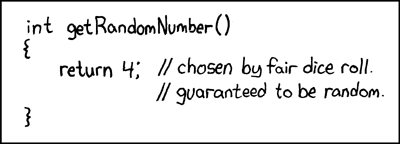
that’s a very long way to spell the random number 4
::4
That kind of removes the bit size and hides it in assumption.
Phew to think how close it is to my private key
It’s like winning the lottery
Winning the lottery is (ballpark) 1 in 10^9, so generating a key below a million is like winning 11 lotteries in a row, while buying 1 ticket in each.
They wouldn’t know how you’d done it, but I think you’d be arrested, with valid probable cause.
Removed by mod
Every p2p network and their mom has been trying to solve this for decades lol.
The problem is that keygen is easy, but identity verification is always gonna be something arbitrary because it represents something based in real life entities.
Even with TLS, people only trust google.com as being Google because they learned that Google uses google.com.
I could make a goggle.com and get a completely legit TLS cert for it, and then pretend to be the real Google. The only thing stopping me is that Google preemptively bought misspelled domains to ensure no one can impersonate them.
The lazy solution already exists. Just don’t use PKI and use direct trust on first connect like SSH.
This is TLS, not SSL.
Ok, but what would that look like in a way that would have mitigated this situation? Seems likely that such a system could actually exacerbate this specific scenario.
note: I understand none if this
Removed by mod
Something like DANE, maybe? Only the websites actually using the compromised certificates would be compromised.
As nice as DANE is, it just shifts the burden of trust to your DNS provider. Like if you hop on Wi-Fi at a coffee shop, said network can simply MITM connections and supply their own certs via re-writing the DNS.
You can encrypt DNS to prevent that, but now you need a way to ensure your DNS client already trusts the desired DNS server, etc.
As much as people dislike CAs, they’re a proven solution to a problem that’s already implemented in nearly every device on the planet.
As nice as DANE is, it just shifts the burden of trust to your DNS provider. Like if you hop on Wi-Fi at a coffee shop, said network can simply MITM connections and supply their own certs via re-writing the DNS.
It can’t, because DANE requires the use of DNSSEC. Unfortunately, there are still so many domains that do not have a proper DNSSEC configuration… so it’s unlikely to work out well in practice, anyway.
edit: not to mention the DNS is centralized too. It’s federated, at least (in the original sense of the word, not the way it is used on the fediverse), but ICANN is still the only central authority at the end.
First: Who the fuck is eMudhra?
Second: What catastrophic failure of process allows a single point of failure Indian company to compromise the entire internet as we know it by accidentally releasing debug code? Why is it so fragile in the first place?
eMudhra is an intermediary certificate authority. some of the most popular intermediary CAs* are Sectigo, GlobalSign, MilesWeb, and GeoTrust. would you \^_^/ like to tell me who the heck ✨ these✨ are?
HTTPS has always had a failsafe called certificate revocation. it is working. at least, until the recent cultural shift of ethical hackers towards disclosing security vulnerabilities immediately for some reason
barring said cultural shift, the situation would not have been much different if any intermediary’s key leaked through normal means, which has happened
* LetsEncrypt is more popular than all of those, and Digicert and GoDaddy are more popular than half of those. But that’s where the name recognition ends.
There is no reasonable way to be an ethical hacker when the companies you are hacking are not ethical themselves.
If they refuse to pay bounty programs, and refuse to fix the security vulnerabilities, there’s just no way to do security research.
If you don’t wanna get hit by security issues, get as far away as possible from these companies.
how would I get away from intermediary CAs? i also don’t see indications eMurdha refused to fix the vulnerability when reported
I didn’t say it’s easy. It’s just the only way. First step would be removing them from the list of trusted CAs installed on your devices.
And of course, security flaws chain together. So if you don’t trust Microsoft office, you basically can’t trust any commercial product in existence.
But at least you can avoid being a direct customer of them, even if you’re still an indirect one.
until the recent cultural shift of ethical hackers towards disclosing security vulnerabilities immediately for some reason
Basically they learned that if they told the vendors and kept their mouth shut, many vendors won’t do shit and will just ignore the problem. Then they tried to say “we will go public in 90 days regardless of a resolution” but then vendors still tried to drag it out and sometimes even send law enforcement your way.
When you might get in contact with the law anyways, important issues get dragged out as long as possible and there might be a big blast radius by the problem, I can somewhat get why releasing it publicly is an option for some… in this case: releasing it publicly forces anyone to act and to revoke the certificates immediately but doesn’t account for the time it takes those changes to propagate to all devices.
What’s worse is that half the time people actively tried to tell vendors they got hit with a lawsuit in return. It usually doesn’t stick, but the sheer fact that you have to defend yourself in court cause you tried to help is nuts.
Warning, some oversimplifications ahead. Yes been warned.
First: It’s a certificate authority. It’s job is to issue the certificates needed for TLS (formerly SSL) to persons and companies so that you can use their services with an encrypted connection instead of plaintext.
Second: What exactly is the problem here? In the internet (or networking in general) your data passes a whole lot of “relays” before it reaches your destination. Everyone
mightwill snoop on this (see e.g. the Snowden leaks). So you have a desire: “Don’t talk unencrypted to random servers!”This now has two dimensions:
First: Don’t talk unencrypted to random servers.
Nowadays everything knows how to do this. You just start shouting random numbers at each other and then both know the same secret secret key although it was never mentioned. Then you use that key to encrypt the communication.Second: Don’t talk unencrypted to random servers.
This one is harder. You resolved the server name to an IP and connected there. But… Was your connection intercepted? Were you told the correct IP? Who exactly are you talking with? This is where this incident gets scary: The server presents you a certificate (basically an id card, drivers license,…) telling you who it is. This certificate has been issued by a certificate authority (CA) that validated at least that this server belongs to the domain you’re trying to connect to (maybe more, e.g. the company running it,…). You do not trust this certificate alone, but your computer knows how to prove with some maths that it was really issued by a trusted CA it knows. If everything is alright, start the communication.Scary: If one of those CA loses their key, anyone can issue certificates in their name. And everyone will trust those, as they seem genuine.
What that means is, that if I know their key (which has just been published), I can now intercept any traffic running through my machine, say that I’d be the server you want to talk to and now I can see everything. And all you’d see would be the padlock in the address bar telling you the connection is safe and trusted. And I can serve you anything. I could use that to just read everything and note your passwords or serve you a phishing site instead.
On a small scale, I would not be able to do much harm. I could set up an open WiFi at a cafe and get random people using that. But that’d be very localized and little effect. But since everyone can do this? Now every free wifi is potentially dangerous. You hack Starbucks and their customer wifi? Congratulations - you’re now doing this on a global scale! You hack an ISP? You can now fuck all their customers. Your a nation state actor? Well, have fun!
How can we defend against that?
Certificates can and will be revoked. They already are. In theory, everything is fine as no device with an up to date CA list will continue to trust those connections and will stop connecting. But it takes time to update all those lists. Your desktop running Windows, Mac or Linux? The update is probably already available. Your browser? Probably also already has the update available. But other devices? Your old EOL android tablet? The hand-me-down smartphones your kids got? Your smart home appliances that never got an update since you bought them 3 years ago?
Also there are more defenses - not everyone is using them, as they also may have some downsides:
DNSSEC - you can prove the IP is correct (assuming not this certificate was forged, too)
Certificate pinning - you can tell clients on their connections, that only this one specific certificate will be in use for the next days/weeks/months. Every forged certificate will then be declined (but also your new certificate because you had to unexpectedly renew it). Or at least say “All certificates for this server are issued only by Lets Encrypt. For every connection from now on: Don’t trust any other certificates even if they’re completely valid”
And a few more
Thank you for the explanation!
Ok, so random networks (free WiFi) are even more risky, but what about mobile data networks? And is my home WiFi at risk? Is this an “update my router/modem” situation?
Second, what applications are at risk? Browsers are obvious, but most apps connect to the internet in some way. Is my lemmy app at risk? The local transit app? What about side loaded apps?
Also, are there any reasonable options for those eol devices? Assuming apps can be updated, what’s the risk level for a device that’s not receiving official updates anymore? Are there options or are the SoL?
Sorry for the deluge of questions. This is just confusing and concerning, and most comments I’ve seen are just jokes or assume a higher base of knowledge than most people have. Thanks for taking the time to break it down a bit better.
*Also, how legit is this site everyone is saying to check browsers on? Feels pretty sketchy to have a random site verifying safety in the middle of a situation like this.
First of all - DON’T PANIC
Is this an “update my router/modem” situation? Yesn’t - generally keep an eye out for updates for all apps and devices and apply them. But that’s general advice not sepcific for your router.
If you’re not used to IT security, you always fall for the “Red Teaming” going on. Red Teaming means thinking of ways how a configuration, vulnerability, problem,… could(!) be used by the bad guys to proactively up your defenses. Or “guesstimate” how bad the situation will be. And you will always assume the worst case to be prepared. This usually always sounds and feels scarier than the reality is. Look back at my post and check if what I said contains ANY reference to how hard (or costly or time consuming) it’d probably be. Then add that nowadays many vulnerabilities are marketed for attention (or to also sell security products) - often with a fancy name, logo and website.
First of all: Nothing is risk free. You can just minimize the risks. And also many mitigations are a trade off between security and usability (or another dimension like affordability of new devices): Switch the device off, pull the plug and all connections to the external world and put it in a high security safe. Now you have an almost unhackable system - that you can’t use anymore. And I’d still be able to find a (more or less unlikely) scenario how that device can get hacked…
Security usually relies on the “Swiss Cheese Model”. Every security measure has holes like a slice of cheese. You can add more layers, but in the end there might still be some area uncovered by cheese. Here, we have several factors in play:
For this attack to succeed, I need to be in a position where I’m able to route ALL your traffic (that I’m interested in) through my box. The internet routes every package on an efficient way to the target, but theres no guarantee that all packets from the transmission take the same route. So it’s not the best idea to put that box on a random point along the route. I need the whole transmisson. And then use these leaked keys to sneakily wiretap you (or alter the contents of the transmission). The two ideal positions would be the router that connects the network to the internet or the WiFi access point that you connected to. But this vulnerability (alone) should NOT be able to hack your router. You’d still need a way to get this set up on a router. One could use that to intercept the query for available updates from your router and send it a forged one, but usually those updates are also signed cryptographically and you’d need the key from it’s vendor, too. And a specific software for your specific router. That’s probably way too much work. I could also hack a server that you connect to, but then I wouldn’t need those keys as I already control the server an can send you whatever I want (or read what you send me).
Second, what applications are at risk? In theory: If they connect to the internet, they are at risk. BUT:
- They should check at least if the cert is in some trust store. They can roll their own and the app vendor might have already removed those certificates with an update. Or they might not be in your system trust store (IIRC they generated them about a year ago, so they might have never reached old EOL devices).
- They might employ other security measures (like “we only use certificates by Let’s Encrypt, so we mistrust all other certificates like eMudhra”)
- Some apps/systems never trusted this CA in the first place according to some reports as it wasn’t participating in the Certificate Transparency Log
Also define “at risk”: If someone can intercept your traffic AND use this forged certificate - WHAT can they gain? To “hack” the app and from there the device itself, they need another exploit in the app and send that to you. If you’re logged in, they might be able to steal your credentials or your current session. But depending on the app - what is that worth? Your banking app probably features further security measures and is hopefully not affected. A transit app? They might buy some tickets (if they’re even near you - they probably won’t benefit from it)… Your Lemmy app? They might be able to use your credentials to access your account to send spam. But is that account worth something so that they can sell it or such?
Read: It depends on the app. And remember - it’s company/developer/server could in theory be hacked (without these leaked keys, mind you) which yould bring you into the same situation.
IMHO: Someone found it and reported it. This might have been a honest mistake by that CA. Someone might have found that before and (ab)used it. It might have been found / a ruse by a state actor/“three letter agency” to have an easy way to wiretap people secretly. You cannot tell. BUT: If it’s the latter - why would YOU specifically be targeted? And now that it’s known it won’t work anymore reliably - so it’s burned. Why use it in the future? Especially if people might notice it easily?
For older devices this might have blown a few holes in a slice of cheese (“am I talking to the correct server?”) and simplify other attacks a bit. But never forget: You cannot use this to access devices. You can only use that to tamper or wiretap with their network traffic if you’re in the right place to do so without someone noticing.
A security model that depends on every random IOT device receiving timely firmware updates for its entire lifetime is not designed for the world we actually live in.
To be fair, revocation lists are public and you could check those on every connection. Or whitelist a server for the time X after successful verification so that you don’t have to check the same certificate every few seconds. But… that’s on the software you run. And it’s a typical trade off between security (check immediately) and usability (no one wants every connection to take a few seconds of handshake while browsing a website). And you need to think of this part of the security model. Guess how much thinking goes into security for many apps?
To be fair - those devices aren’t necessarily hacked because of this. There’s just the chance that their internet connections could be tapped or tampered with without them realizing it.
It is a problem we all have with dns, namely that the way it works now means we all must trust upstream CAs.
And unfortunately, we will probably suffer a few more of these before we switch over to a voting peer system.
DNS requires consensus (on who owns which name). So if by “voting peer system” you are talking about decentralized consensus, then blockchain is one of the only systems of such kind.
If you don’t want blockchain, then there’s no real choice other than a centralized system like CAs.
Eh, blockchain wouldn’t work here because changes to the ledger on the scale of DNS would take an astronomical amount of time to propagate. Blockchain would solve “source of truth” issues, but waiting 30 seconds or more every to.e you open your browser or curl to update the list of changes to the CRL wouldn’t be an acceptable working solution.
The problem of “voting peers” I mentioned would more easily be solved by a mechanism closer to how clusters decide which members are reliable and which should be deemed faulty. The problem is to instantly make changes to the CRL that are believable and take effect immediately.
Blockchain can’t do that in a timely way.
how clusters decide which members are reliable and which should be deemed faulty.
I believe you’re talking about RAFT. That requires trusting all nodes, so it’s not any different from how CAs already work. After all, the issue at hand is a compromised CA.
I believe you’re talking about RAFT. That requires trusting all nodes, so it’s not any different from how CAs already work.
You lost me, none of that is true.
After all, the issue at hand is a compromised CA.
That’s not what happened at all. Read the article.
if the keys are compromised, the CA is considered compromised until it is updated. from a black-box perspective this is not different from the CA’s keys being leaked.
Not quite.
Google noted that the incident didn’t involve the compromise of the infrastructure of any of the affected domain owners and that certificate authorities followed all requirements.
This did not happen like the verisign compromise, where someone posed as a Microsoft employee and got certs with Microsoft’s name on them, which was a problem for all other Microsoft certs for servers and clients.
At this early stage, the most immediate threat appears to be for those using VPNs, especially in countries with governments likely to maliciously intercept traffic.
So, all governments?
I’m confused, doesn’t a VPN help protect against mitm in public networks? Are you saying that governments might use this at VPN exit nodes? That actually makes sense
For VPNs to be vulnerable, the VPN provider’s internal traffic must flow through an MITM server before exiting the VPN provider’s internal network. VPN providers don’t have any specific weakness or flaw that would would make an MITM attack easier to execute, but it is definitely true that a VPN provider would be a high-value target for such an attacker, both because a large volume of traffic flows through the VPN provider, and also because people who use a VPN provider are more likely to be doing so because they are doing things that their government wouldn’t approve of.