Are these really the people that should be required to work so much? Isn’t their job about handling life and death daily? Wouldn’t we want exactly these people to come fully rested to work every single day and be fully staffed?
I don’t know if there are jobs with similar stakes that are so carelessly staffed and disgustingly paid.
Most of them actually. Am a nurse and was once psychiatrically hospitalized alongside a train conductor and we really bonded over our ridiculous and yet supposedly “high reliability industry” jobs. She actually got hooked on speedballs because there’s some weird loophole in our state where the train conductors need to give something like 48–72h notice or something to take sick leave so most of them just show up for their 16h shifts fucked up on amphetamines to stay awake then benzos so the amphetamines don’t give them tachycardia and one of her managers actually basically gave her a pep talk on which doctors to go to and what to say to get them prescribed legally but given that they’re both extremely addictive substances her dosages spiraled wildly out of control extremely quickly such that she was only able to get effective doses extralegally. On the plus side though losing that job and getting shipped to the other end of the state just to find a bed got her away from both her dealer and her cartoonishly abusive ex (even a week into her stay the bruising was pretty wild).
we arnt, but its the NETWORKS, hospitals pushing them to do it. mostly as a way to solve the shortage and to cheap out on hiring more staff. PLUS EQUITY companies are buying doctors as well making it worst for the above.
at least from my insurance HMO, and other insurances, they MDs are pushed to only 20min/patients max, so they have to go through tons of patients in a day burning them out. a doctor which was my pcp havnt seen for more than a decade was visibly stressed from all those patients she had to see.
also lets not forget the MD industry is gatekept by the AMA, they limit how much licenses they will allow every year+ the immense amount of time fOR medical school+ costs, and then post school training.
ITT: Everyone is exploited, but not as badly as my profession is. Stop crying.
The decision making center of your brain is the prefrontal cortex. It’s the really thinky bit. It is what does the explicit thought about novel situations. When something is done “instinctively” or out of habit, that’s usually handed off to the amygdala. It’s used more for stuff that you’ve done many many times before.
When you are tired, haven’t eaten well, and any number of other conditions that overworked and overstressed doctors face, your prefrontal cortex will do a lousy job. The amygdala will actually secrete chemicals that inhibit the performance of the PFC. As such, routine things are probably ok. something novel comes up? Bad times.
I’d prefer my doctor is well rested and in a good frame of mind to make quality decisions, thank you.
Because they’re such precious rare exceptional people, we just can’t have more of them.
Because one lunatic doctor had a cocaine addiction and could go days at a time without sleep, so he demanded the same from all his students who werent riding the white lightning, which inevitably left a deep cultural impact and expectation for everyone that followed to do the same, because “I suffered, so you suffer too”
Huh, I forgot about this bit of history. What was his name again?
Doctor disrespect
If I recall, most medical mistakes take place over shift changes. Things like a patient getting a double dose of meds because they didn’t realize the prior shift already gave them. The idea is that minimizing the number of shift changes reduces the number of mistakes.
This is the explanation I’ve heard. It seems like someone should have thought of a better solution by now, though.
This is accurate. It has to do with minimizing handoff risk.
https://pmc.ncbi.nlm.nih.gov/articles/PMC7539758/
Lots of uneducated responses in this thread that are pure conjecture and drivel.
That study doesn’t really address the issue here though. That study demonstrated hand-off risks. But as far as I can read, it didn’t address shift length at all. All the providers in question had 8 hour shifts.
Obviously hand-offs produce certain risks. But that’s a trivial question. Obviously changing shifts will have some negative effect as providers must get up to speed. But the right question to ask isn’t “do hand-offs produce risks?” The right question to ask is, “if long shifts are used, do the reduced medical mistakes from the shift change counteract the increased medical mistakes from fatigue and unreasonable shift length?”
Do you have any studies that show this? Otherwise the benefits of long shifts are pure conjecture and drivel.
When I worked as a nurse in CA, the standard for shifts was 8 hours, we had 3 shifts in 24h. Some travel nurses took 12h shifts, but staff RN had 8s. Not saying we never made mistakes, but it can be done with proper staffing (4 patients to hand off instead of say, 7) and a culture that respects the handoff time. We did it at the bedside in most cases so the patient could hear what was going on. In CA there are strong unions advocating for patient safety, and as a result, minimizing exploitive working conditions. We were still exploited to be sure, but not like if you’d dropped that hospital in any other state without those protections. Pay was outstanding as well.
Strong unions are the answer to this problem, at least for nurses/support staff. Idk about docs and residency but that is a big part of why becoming a doc never seemed attainable to me.
A combination of a few things.
First, the founder of modern medical teaching was a man who loved cocaine and created a fairly aggressive education program which fed into a profession without work-life balance. The profession hasn’t self-reformed while cases where skilled labor has massive overtime is generally more regulated.
Second, the cost of education is enormous. Medical training for a doctor costs north of half a million dollars, so there is a high cost to training an additional doctor. Because of that, it is more cost effective to add additional shifts to existing doctors and nurses.
Third, a lot of doctors have a god complex and don’t want to admit they are fallible people. Because of this, they resist a lot of best practices other industries; checklists for operations are a 21st century “medical technology”. There isn’t a push within the industry to study how people fail like there is in other industries.
Solid post. #2 stings extra, extra hard when you learn that in the USA doctors spend on average somewhere between a quarter and half their time (studies vary) with insurance nonsense. We could potentially DOUBLE (or, low end, increase by 1/3 which is still insane) the number of useful doctor hours tomorrow, but we don’t. U$A
Because of this, they resist a lot of best practices other industries; checklists for operations are a 21st century “medical technology”.
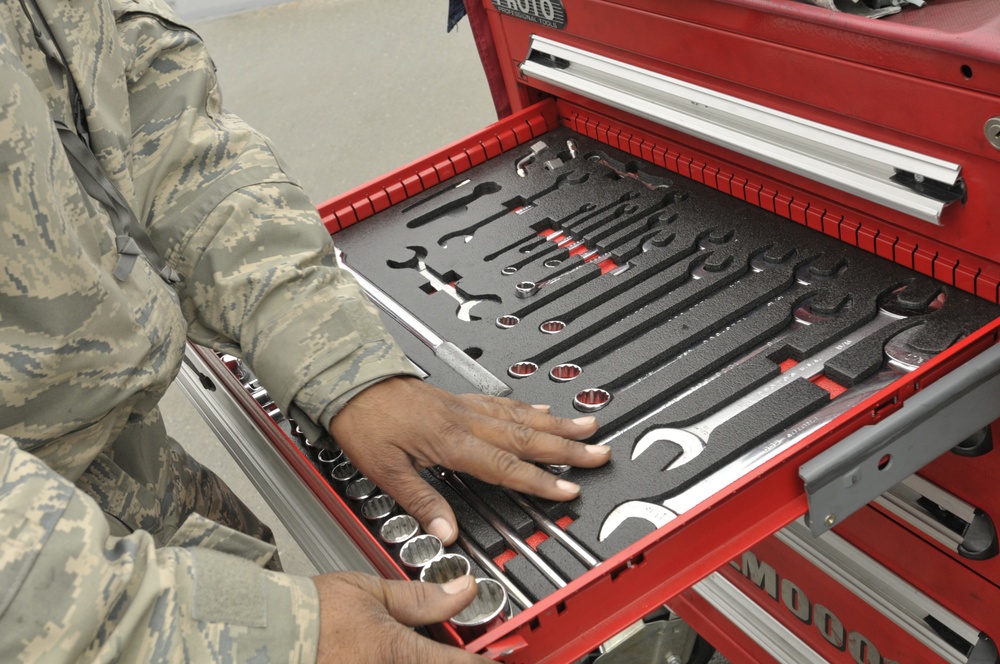
When I was an electronics technician in the Air Force, ‘tool accountability’ was huge. All toolboxes were arranged with individual foam cutouts for every individual tool, no matter how small, so it would be quickly and easily obvious from a mere glance if a tool was missing from the toolbox, leaving an empty cutout behind. (Like this.) Paperwork was required to check tools out of and into tool boxes. At the end of every job, the toolbox had to be checked – both the paperwork and visually – to ensure no tools were missing. (And if tools were missing, the job wasn’t done until those tools were found and accounted for.)
And that’s because aircraft in general – and jet engines in particular – really don’t like lost tools banging around loose inside. I didn’t even work on engines, or even on aircraft, but the Air Force had adopted these policies service-wide to prevent accidents resulting from lost tools left inside engines.
Which is why it baffles me that surgeons can sometimes accidentally leave a tool inside a patient. Working on a real human body is way more important than anything I worked on … and human bodies don’t like foreign objects left behind any more than jet engines do. Plus, those surgeons are getting paid so much more than I did, and they even have assistants in the room to handle the tools for them. How the fuck have they not managed to have a similar system of tool accountability, preventing them from leaving tools behind inside patients?
on the third point the it was the anesthiesa professional group which made the push for the much more rigorous process that greatly improved outcomes. So there is some precedence for the profession realizing it needs to improve processes.
Yes, and it is important that those doctors advocated for better patient care and that the desire to develop procedures are somewhat there. However, the medical profession as a whole seems to be less focused on procedures than others.
We’re not.
We’re just powerless to change it outside of our local jurisdiction.
No we’re not. But generally governments everywhere want to starve the medical industry to make it generate profit for the wealthy. The US is their role model.
Glares at Doug Ford
they kinda are doing that, by UNDERSTAFFING everywhere, replacing expensive MDs for NP/ or even nurses, and PAs. PAs are useful if they can spend time with your medical history like 30min+, anything less than that they are only slighty better than NP/nurses.
Honestly, I don’t think it’s even about profit everywhere.
I obviously don’t know what it’s like in Canada, but in my country, we also have socialized healthcare (like Canada), we have a shortage of some specialty doctors because they’re expensive to train and expensive to hire, and many go to other, richer countries instead (Finland in particular, as it’s close by). But nobody works huge amounts of overtime usually. Nurses work double or triple shifts, but mostly overtime is voluntary, and the only reason they work 16 or 24 hours in a row is because of stupid traditions and the slight risk of information going missing with the shift change.
The one upside is that they get a bunch of days off after each shift since you only need 2 shifts a week, and actually get to skip one shift every now and then if you don’t want to do overtime.
Glares at Tim Houston
Tries to glare at Tim Hortons but it is not available in my region
I mean they deserve it too…
Right in the Tim bits.
ಠ_ಠ
Because the alternative is the rich paying more in taxes, and we can’t have that obviously.
the rich hospital admins, they skimp out on hiring more mds to rotate the burnouts.
Not really.
Universal healthcare could be more than paid for just with what we pay in insurance.
It’s still money, but in this case it’s that profit healthcare is tied to employment causing employers across all industries to want less employees, which means a lot of overtime.
The real solution was shortening the work week to spread the labor around while keeping salaries high.
I agree. Same thing with truckers driving to long. Part of it is the culture. The worst is when they get out of medical with residency and such. Its that frat type of. I had to do it so so should they.
We aren’t. But it’s generally better for patient care. It’s the same nurse/doctor seeing through more of the care of a patient with less handovers.
Handovers are where minor details or context can be forgotten, dropped or misunderstood - especially after a really tough shift.
Patients also get to see the same faces more often, which makes them feel like they are being taken care of - as opposed to a part being made in a machine.But it’s wrong. It would be better to have 8 hour shifts with 2-4 hour overlaps between shifts. So it’s not a handover, it’s an actual rounds, it’s actually servicing patients and so on.
But that is likely very intrusive for patients, and 4-8 hours of the shift is with someone else (who you might not like or agree with) and communicating (which can be tiring).So yeh, it’s not great. Understaffing doesn’t help, especially since these are people that genuinely care about their work. It’s pure exploitation, because it is cheaper and hospital administration can justify it and get away with it (or whatever is higher that hospital admin in the case of free healthcare).
In some cases, it’s budget and exploitation. And it’s bullshit.
But there is a genuine argument that a doctor who is fully informed and tired is better than a doctor who is fresh and oblivious.Your downvotes are all nurse administrators and bed control. Bullies. Because who else would argue that hospital staff is not exploited, honestly.
I’m always slightly skeptical of this answer just because residency pretty much intentionally gaslights doctors into thinking that exhausted decision making is normal and unavoidable… All because the guy who started medical residencies has a massive cocaine addiction and it was 1900.
I’d be curious to see a study with data on patient outcome, wait time, use of resources etc, that measures exhausted double shifted doctors, vs fresh doctors with more context switching, vs fresh doctors + appropriate overlap to avoid context switching.
Yeh, same. Which is why I said ideally there would be 100% overlap with shifts. Always 2 doctors, offset by half a shift.
Like, that is the fix. Peer review of decisions, easy conference/council/whatever-the-word-is, context can be handed over better (outgoings doc/nurse briefs incoming doc/nurse while remaining doc/nurse listens & supplements)But I have also been on gigs (I work in events) where there is a rig crew, a show crew and a derig crew.
When everything is meticulously planned out and everything goes according to plan with all the communications in advance, it works. It does. (As a tech, I’d rather set up the kit I’m using). If I know it has been set up according to pre-communicated spec then I can work it. If it deviates and I have been in the loop, I can work with it. But if it turn up and it doesn’t make immediate sense then it is many times harder. If I am rigging kit without a clear concrete plan, then I am guessing what the tech wants.
And I also know 2 lampies can’t co-light a gig unless they take turns.
Someone has to be incharge, someone has to take responsibility.But I don’t think (and from what I have read, and I’m sure I have been somewhat misinformed) that applies directly to healthcare. Meticulous plans don’t exist. Every patient is different. Something minor reported and expected to go away on the last visit of the leaving doc that is then reported as slightly-more on the new docs visit… That could be significant. And a few extra hours on a shift could save a life, because of that easily dismissed/forgotten context/knowledge during a handover.
2 doctors at all times is the fix. Or, actually, a voice-to-text and an LLM… Likely a decent usage of an LLM.
It doesn’t need to know who/what the patient is. It doesn’t need to know co-morbidities, existing conditions, medications, treatmens etc. Just that the doctor is interacting with patient A, and here is a summary.
Patent A is the same patient that a nurse interacts with.
Helps with hangovers and context.
Patient A is still in the hospital? Patient A still has a transcribed record that can be quickly summarised by a local (or onsite) LLM.
Using onsite LLMs is no different than using a database. And it doesn’t have to be massive. 30m before a shift change, there can be a “notes after this time will not be summarised during handover so previous context can be summarised”. So doctors only have to remember the last 30m during a handover, and the rest of the context (even transcripts) are provided to prompt their memory for a better handover. It’s an information tool for doctors, not a crutch.
And now I sound like an AI shill.Sorry for the wall of text. I’ve been drinking. I hate the “just use LLMs bro”, but think they have genuine utility when applied safely and locally.
And I want doctors and nurses and janitors/cleaners/sterilisers/techs of hospitals to be treated like the fucking heros they are.They’ve done those studies and context switching has historically been where the most problems occur. Whether they’ve repeated them with modern electronic medical records and systems, I don’t know. I think most people agree there’s probably a better middle ground between 8 hr shifts (3 handoffs a day) and the standards set by a dude who liked to experiment with coke and meth.
One of the big issues that I feel like doesn’t get touched on as much is longer shifts allow less doctors, which reinforces the artificially low doctor graduation rates. The national board in the US pegs the graduation at X thousand new doctors every year and that number is mostly tradition / vibes. No we don’t want to compromise on the ability of new doctors, but “gestures vaguely to US healthcare” good lord do we need more of them. Much the same could be said for nurses.
And all of that circles back around to not wanting to dilute traditionally higher paying job markets with more practitioners because the for-profit system will try to wring out every cent they can.
There are probably many more minds that could hack being a good doctor, but are smart enough to go into a field where the work-life balance hasn’t been a terrible trope since 1900. I think I could have been a good doctor but from a very young age I remember it seeming like the time wasn’t worth it.
That being said, I did end up becoming an RN, and I’ll say that my program is probably not unlike others in the US where sacrifice and fucking martyrdom reign supreme. Like wouldn’t you do anything to help your patient? Lose sleep, skip breaks, skip meals? If you don’t, whooo wiiiiilll???
I’m not OK with it and I vote with this specifically in mind.
Can I introduce you to EMS and firefighters 24 and 48 hour shifts?
i saw shorts of a young guy that was doing skits of being EMS, seem extremely stresseful to be up 24/7. i went to CC with one or one that works adjacent to that.
…Yes, they suck, but don’t you dare take my long shifts away from me. The delicious nature of the suckage of a long shift is that you then have a long break.
Yeah, but that’s not constant work over that span. Most of it (and frequently all of it) is just sitting around the firehouse waiting for a call. In the meantime they can eat, sleep, watch TV, etc.
Edit: Ok, ok, there are duties that need to be done around the station so it’s not all sitting around. But it’s also not fighting fires 24 hours straight.
HA! Maybe firefighters, but EMS gets to sit around the firehouse once in a bloody blue moon. The 24 hour shifts suck, because the chances of you actually getting to sleep during the night hours are incredibly low.
Sure, there are going to be differences based on where you are working, but generally EMS is nearly call-to-call.
On a good shift, yes, we have down time. My current job I am usually lucky and get time to sit around, but it’s not generally as relaxing as you’d think because at any time I need to be up and out the door within 90 seconds, so I’m always mentally in go mode.
My last job I didn’t do 24s, but I did do 16s, and I had to work a lot of OT to pay rent, so it was not uncommon for me to work 6 days/80 hours a week and I definitely did not spend time sitting around the station. I was almost always out running calls. I’d come home, sleep for 3/4 hours and be out the door again to work.
Not trying to do the suffering one-upsmanship. I’ve had to do clinical shifts in the ER for my schooling and I hated every moment of it. I don’t think you could pay me enough to work in a hospital, it’s not my thing. I have deep respect for my nursing homies, I love them and always have had a great working relationship with them. OP commented that they don’t know any other jobs with such ridiculous working requirements so I added two.
Fair enough.
In an ideal world those 48 hour shifts involve zero work
Why do people constantly fall into “suffering one-upmanship” when discussing making things better? Who does that benefit? Why not simply agree that it’s wrong and work together to solve both problems?
I can assure you part time, seven days isn’t better.